Last post, I talked about some of the math behind the large-scale problems in sports; the use of statistics and finance, how probability appears in tournament designing, where linear algebra determines rankings, and how several branches of math you may never have heard of before converge in scheduling. And for the most part, I didn't actually present any math at all - I just sort of described the general gist of the way math is used and left it there. This post will be different, hopefully, by actually showing you some of the math involved.

First off, I'll ask a well-known Microsoft interview question:
why are manhole covers round?
If you haven't heard it before, take some time to think of some possible answers. There are a lot of very practical answers, and most come down to some
geometric fact about the circle. Something provable about circles before even considering how they work in the physical world. And this idea is one that will come up later in this post - I won't directly refer to this example, but the idea of
geometric facts having practical implications is pretty important. BUT for now, back to sports. What math goes into deciding how the game works?
 SPECIFICATIONS
. Length and width of the playing area; number of players per team; time limits; points awarded per action; equipment size; there are a lot of very specific rules in every sport determining how the game is to be played. And many of them involve a measurable quantity - length, number, mass, area, time - which can be mathed upon. But chances are that most of these rules developed through trial and error, not through mathematical reasoning - people would try it one way, find it doesn't work so well, and so adjust things to make it work better. So there really isn't a strong connection to mathematics here (at least not one I can easily find). I wouldn't be surprised if some math was used in making the official decisions though - examining the statistics of various athletes playing under various rules, and predicting a set-up that would make the game-play go as well as possible.
Although I definitely could say something about the geometry of a sports court. Lots of rectangles, often circles too. But again, nothing too mathematical behind the sizes of these - can't find any sports court with dimensions following the
golden ratio, for example, which seems to pop up in so many other places. Again, sizes seem to be more dependent on what people have found to work.
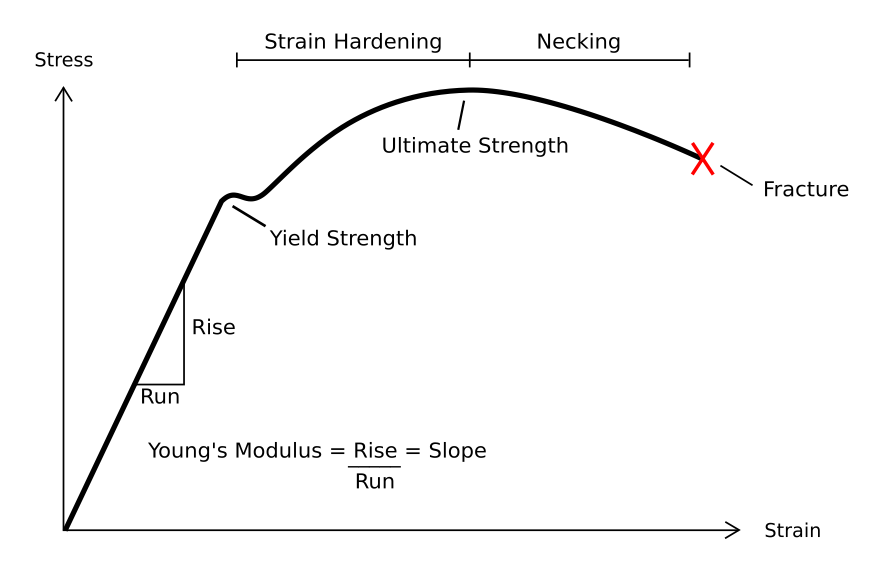 |
sports equipment has a lot to do with resilience - if you
stretch or squeeze something a certain distance (strain),
how much force will it push back with (stress) |
EQUIPMENT PHYSICS. So sports have all sorts of different equipment. There are balls, shuttles, rackets, sticks, goals, nets, masks, padding, shoes, and more. One basic consideration that has to go into all of these is the material to make the equipment from. To make sure nothing will fall apart in the middle of a game, for one thing. Any protective wear - padding, masks, shoes - should be made of a material that is slightly resilient - able to cushion a blow, but not let it get all the way through, and to distribute the force over a wide area. The goals, nets, etc. have to be able to take a beating without being to dangerous to play around (imagine a volleyball net made of barbed wire... *shudders*). Sticks and rackets should be rigid enough to transfer a powerful blow, but also slightly bouncy so that when the ball/puck/human head hits it, it will reflect most of the kinetic energy back into the ball/puck/human head. Determining the optimal bounciness/hardness of the ball is also important for many of the same reasons. These concerns all fall under materials science, which math is definitely applied in (to calculate resilience, for example - see the graph), but these aren't exactly direct applications of math, so I won't go too much into these (though they still are pretty interesting).
Another consideration is how big or heavy the various equipment should be - most of these (goal size, net height, etc) fall under specifications (above) and were probably developed mostly by trial and error; a few have more physical answers, such as the best length of a hockey stick or tennis racket to apply the most force to whatever you're hitting. Again, math is applied here, but it's more of a physics question (levers, angular momentum, torque) so I'll leave it be for now.
EQUIPMENT SHAPE. Ohhhhh man. Here's where it gets gooood. This particular section, it turns out, was my entire motivation for writing this series on math and sports because it's just so cool.
 |
for the purposes of this blog post: top = football,
bottom = soccer ball. |
Many sports use a spherical ball of some sort. And the reason for that should be pretty straightforward, if you've ever tried to played soccer with a football (We'll use the North American definitions of soccer and football here - see the diagram to the left - purely for convenience's sake, to avoid the verbiose and potentially-offensive-to-Canadians "American football"). You know how annoying the behavior of the football is whenever it bounces. The shape of the football is not designed for hitting the ground, it's designed for aerodynamics; any sport which involves a ball that frequently touches the ground - basketball, soccer, tennis, field hockey, and countless others - must have a spherical ball.
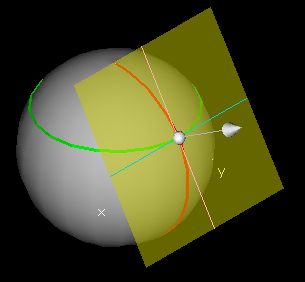 |
this arrow comes straight from the
center of the sphere; so if the yellow
plane were the ground, then the
center of the sphere would be directly
above the point of contact. |
Why? Because (using slightly technical jargon - see the figure to the left) a sphere is the only 3d shape such that the tangent plane at any point is perpendicular to the line between the center of the shape and that point. In other words, whenever a sphere hits the ground (or a foot, or a wall), no matter how it lands, its center is directly above the point of contact. And so when a sphere hits the ground and bounces, the normal force from the ground, acting upwards, will just turn the downward motion of the ball into upward (ignoring any effects of friction and spin for now). In other words, it will bounce according to the well-known law of reflection - the angle at which it lands will equal the angle at which it bounces back. And so you can predict its motion. Despite the physical interpretation, this is a purely mathematical fact of spheres - lines from the center to any point are perpendicular to the tangent plane at that point.
 |
I know this doesn't look like a football.
Just use your imagination. |
This doesn't happen with a football, for example (or a cube, or any non-spherical object), because when a football lands, its center isn't necessarily directly above the point where it hit the ground. Part of the normal force gets put into making the football go back up, but another part goes into spinning the ball (something known as torque). So it won't bounce as high as you'd expect, and it will spin strangely in some unexpected direction. This is the same thing you see happening with dice rolling (which is what makes them so hard to predict), or when you drop your pencil and instead of bouncing back up to you, it ends up in another dimension, never to be seen again. This is why spherical pencils would be awesome.
Similar ideas go into rolling - the sphere is the only shape which doesn't "prefer" any orientation, because it's symmetrical in all directions. Symmetry is the idea that a shape looks the same even when you look at it from a different direction; for example, rotate a square 90 degrees, and it looks exactly like it did before. But no matter how you rotate a sphere, it'll always act the same. Every other shape will have some points where it will rest nicely, but some where it will tip over. And this makes a sphere much nicer to play with (Hockey is a notable exception to the rule that "things which touch the ground must be spherical," because it doesn't go in the air as much, and so bouncing isn't as big of a concern, and because it has no need to roll since it's on ice. But its round shape comes from the same reasoning - it should act the same way no matter which side you hit it from).
 |
| Football aerodynamics |
So other than sports which employ some strange shape for some strange reason (footballs and badminton shuttles are designed for their aerodynamics, which is itself a fascinating topic but again, more physics, less direct math), the balls used in sports are spheres for a good reason.
But how do you make a sphere? Unfortunately, though spheres are a very natural shape, they're very hard to produce - especially out of materials that are good for sports. Some balls (such as volleyballs) have an inflatable rubber part inside, known as the bladder, which can be pumped up to form a sphere, and some (like baseballs) have a center made of rubber or cork, wrapped up in yarn to form a ball. But a lot of sports want some sort of leather covering for the ball. So when leather comes just in flat strips, how on earth do you make it into a sphere shape to cover the ball? Speaking of earth, this, in fact, is extremely closely related to the problem of drawing maps. The earth is a sphere, so how do you draw flat maps of it?
 |
| Constructing a circle out of flat parts |
Both of these questions can be connected with a branch of mathematics known as
topology - the study of the basic structure and properties of shapes, not necessarily length or size or angles (which sets it apart from geometry). There's a well-known joke (well, well-known among mathematicians at least) that a topologist can't tell the difference between a donut and a coffee cup, because they both have the distinguishing property that there's a single hole that goes right through them, and that's all topologists notice. One of the central concepts of topology is that of a manifold: any shape that can be made by sewing together pieces that are basically "flat." And by proving things about the little flat pieces, you can then prove things about the entire manifold. So a sphere is a manifold, for example, because you can sew together a bunch of flat things to make something that's essentially spherical. A torus (donut) is also a manifold - as are many other incredibly weird shapes that topologists spend their time studying.
 |
Not all manifolds are as nice as a sphere.
(the Calabi Yau manifold) |
So the fact that the sphere is a manifold is what makes map-making make any sense. You can't really make a sphere flat without destroying it - but you can make flat pieces and describe how they fit together. Which is what maps are - little flat pieces of the sphere. And though they don't actually study topology to do so, this fact, that the sphere is a manifold, is what allows sports equipment manufacturers to make balls. They make flat pieces and stick them together.

So the question is... what kind of flat pieces do you make, and how do you stick them together to end up with a basically spherical shape? One solution is the tennis ball / baseball method - two strange round pieces that fold over towards each other. Basketballs use eight strips of different types, four of which line up with each other to make a hemisphere. A standard volleyball is made up of eighteen thin strips; three strips are pieced together to make a slightly curved panel, and the six panels are pieced together in the same arrangement as the faces of a cube - so you can identify a top, bottom, front, back, left, and right.
 |
| the regular polyhedra (also known as Platonic solids) |
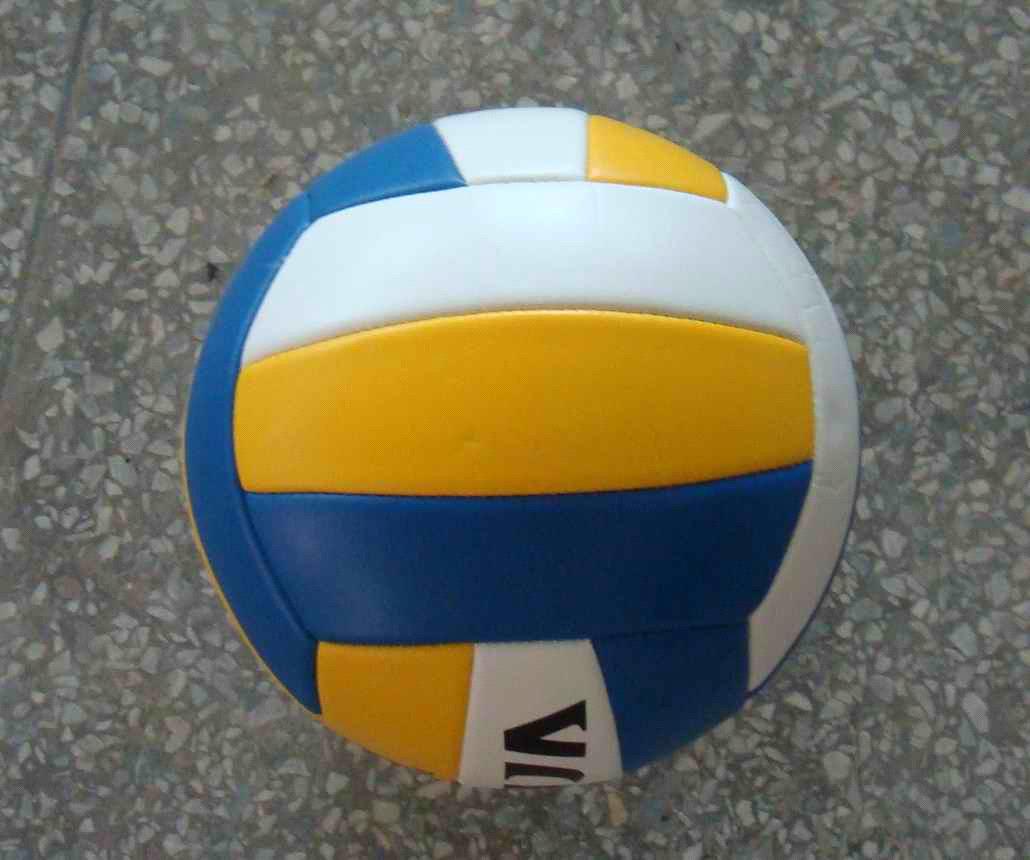 |
the volleyball: a cube
that looks like a sphere. |
Now the volleyball in particular, of the last couple balls described, is pretty interesting - because it's essentially a cube. Which is strange - cubes have sharp corners, completely unlike spheres. But the idea is that you take a nice shape - like a cube - and just add a few extra curves to it and you get a sphere (to the topologist, who sees a coffee cup and thinks it's a donut, spheres and cubes are identical). In fact, you could do the same thing with all regular polyhedra (listed above; a regular polyhedron is a 3d shape where every edge is the same length, and every face is the same shape). But practically speaking, this wouldn't work too well with, say, a tetrahedron - the corners are a little too sharp, the faces a little too flat. But as you add more faces, you should get closer and closer to a sphere. And presumably, with enough faces, you almost wouldn't even have to worry about making the faces themselves curved (like you do for the volleyball); the sphere shape will just come automatically. Unfortunately, no regular polyhedron has enough faces for that.
The idea behind choosing a regular polyhedron was that every face is the same - which, if you remember, is pretty important to the way a ball works. The more every side looks like every other side, the better. But what if we take one step back from regular polyhedra, and instead look at the shapes you can get if you allow a couple different types of faces? These are known as the Archimedean solids. While the sphere looks the same from any direction whatsoever, and the regular polyhedra look the same no matter what face you look at, Archimedean solids look the same from any vertex (any point where different edges meet) - every vertex is bordered by the same regular shapes. So they're still pretty symmetric. The diagram below shows all Archimedean solids. Look at the picture for a while; can you find one that looks familiar?

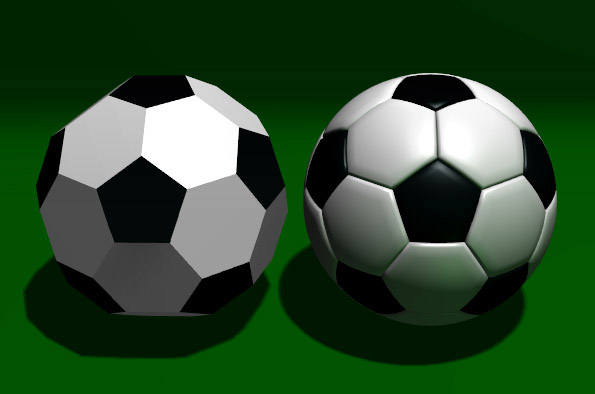 |
a soccer ball is just an arrogant (i.e.
"puffed up") truncated icosahedron. |
Did the truncated icosahedron stand out at all? If so, then that's because that's the shape of the soccer ball! You can make this shape by taking an icosahedron, and chopping a chunk off every vertex (the pentagons are where the vertices of the icosahedron used to be; the hexagons come from the triangle faces that got their corners clipped). So you get a shape with 32 faces, 60 vertices, and all the faces are pretty close to being the same (hexagons and pentagons aren't all that different). This looks like a pretty ideal shape for a ball - just puff it up with a bit of air and it should fill out into a sphere shape rather nicely.
Well aren't we humans so smart for coming up with this shape.
That's right, when you kick around a soccer ball, you're really kicking around a molecular model. Now you'll never be able to play the sport without feeling like a nerd ever again.
Ok, not really, the soccer ball wasn't made in order to model a molecule. But what this DOES show is how interconnected math is. The same mathematical structure - the truncated icosahedron - appears both in molecular physics and in sports. Pretty powerful subject now, isn't it?
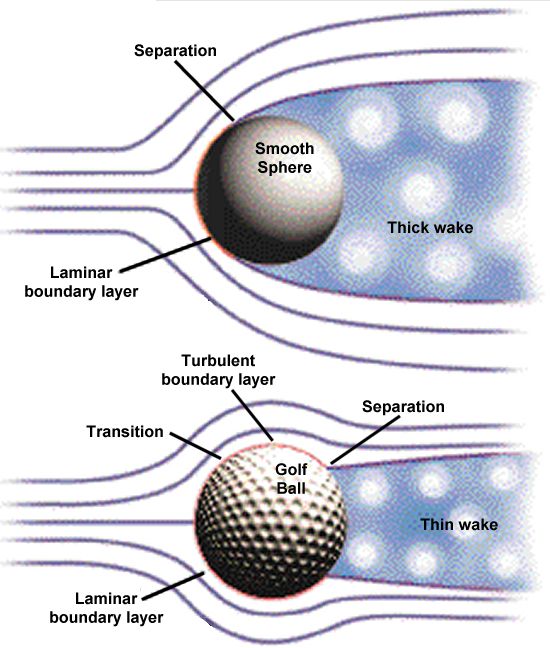 |
| dimples diminish air resistance. |
There's one other type of ball that has some pretty interesting math behind it - the golf ball. It doesn't face the same "how do you make a sphere out of flat stuff" problem because it's a solid ball of synthetic material. But it does bear one property that makes it stand out - dimples. Amazingly, adding little holes to a golf ball actually makes it fly farther - but again, this is a physical phenomenon which I won't get into here. What I will get into is the geometry of these holes - how do you spread them out? Again, symmetry is of utmost importance - the ball has to look basically the same from any viewing angle, otherwise it will act differently depending on its orientation. The Polora, a golf ball manufactured in the late 1970s, wasn't like this - it had deeper holes along the equator, and shallower holes everywhere else, which caused it to spin differently once in flight - it was banned soon after it was released, and official balls were forced to satisfy certain symmetry requirements.
Oddly enough, however, there is no "standard golf ball;" most golf balls have 250 to 450 holes, with some having over 1000. And yet, manufacturers are forced to obey the symmetry laws if they want their golf balls to be officially allowed. So how do you spread out the holes evenly on the sphere?
It turns out that quite often,
you can't spread out the holes evenly. For example, if you try to spread out 5 holes on a sphere, you can never get them truly "evenly" spread out. The best you can do is put two at opposite ends, say the North and South poles, and three along the equator. But then the ones at the poles will be more isolated than the ones on the equator are.
But at least, for five holes, we know the best you can do, even if it's not perfect. It turns out that in general,
even the best possible you can do isn't known. Now we haven't described what we mean by "evenly distributed" - and different definitions will actually give different answers. But practically every good definition faces the same problem - we simply don't know the best possible arrangement of holes. We've been able to compute very good arrangements, but have no way of knowing if a better one might exist.
 |
cube and icosahedron made into spheres. The cube kinda
looks like a volleyball. |
There are a few cases, however, that we understand quite well - and yes, the regular polyhedra are back! If you take a sphere, and imagine drawing a regular polyhedron inside the sphere, so that the vertices all touch the sphere, then these corners would give you points that are perfectly evenly spread out. So that means we can spread out 4 points (using the vertices of a tetrahedron), 6 points (octahedron), 8 points (cube), 12 points (icosahedron), and 20 points (dodecahedron), and under any good definition of "perfectly spread out," these will be so.
 |
no chance of fitting another
pentagon in there. |
So what's to stop us from starting with one of these configurations, and just adding on extra holes inside? I mean, maybe it won't be "the perfect configuration," but it'll still be pretty darn good. And so that's what ends up happening most often - golf ball manufacturers split up their ball into faces based on a regular polyhedron, and just tile the inside of each face with holes. This works for any regular polyhedron except the dodecahedron, because the cube is made of squares and the rest are made of triangles, and squares and triangles
tesselate (a bunch of them can be fit together without leaving any gaps). The dodecahedron is made of pentagons, on the other hand, and these don't tesselate, so you can't really divide them up as nicely into similar shapes.

So here's an example of that getting put into practice. In the diagram to the left, the orange triangle comes from the face of an icosahedron - note how in both cases, they tiled that face with four smaller triangles, and filled in with holes. The left picture shows holes right on the vertices (as I described), while the one on the right doesn't, instead putting three circles in each little triangle. The left pattern requires holes of different sizes; the right pattern leaves some big gaps around some of the vertices; so neither are perfect, but both are acceptable golf ball designs. These designs come from
U.S. Patent 4,560,168, which includes several other tiling patterns as well, all based on the faces of the icosahedron.
Phew, I think that's enough geometry for now. Let's not get into the shapes of hockey sticks and of the faces of tennis rackets and the shapes of all those other things out there. (I don't even particularly like geometry as much as some other branches of mathematics). I still have one more subject to discuss: what kinds of mathematics can actually be used by the athletes themselves - how people can use math
when they're actually playing.

I really thoroughly enjoyed your post!
ReplyDeleteVery nicely explained and helped me a lot!
Workouts discovered that the quantity of weight raised is lesser compared to just how difficult the customer presses and also the number of times they are required to relax as a result of muscular tissue exhaustion. The only means he might evoke that sort of strength from customers was to reduce their exercises from an hr to 45 mins or much less. “I saw that a lot of my customers invested the 60 min plus exercises pacing themselves, seldom attaining, their optimal capacity.” “The objective is to promptly obtain the body to wear out to ensure that the customer experiences exhaustion and also requires remainder.”
ReplyDeleteBruce Drago MMA
Bruce Drago MMA Workouts
Bruce Drago MMA Workout Routines
Bruce Drago MMA Workout Routines
Bruce Lee Drago Workout
Bruce Lee Drago Workout Routines
Bruce Lee Workout Routines