We use examples from the natural world - the sizes and angles of plant leaves which grow at certain ratios; the extremely geometrical structure of molecules (and hence crystals, snowflakes, etc.); the cicadas which come out once every 13 or 17 years, because those are prime numbers; I could go on for a looong time.
 |
| A Julia Set. If this isn't art, then what is? |
We use examples from visual art and architecture - the golden ratio which appears everywhere in the Parthenon, the aesthetic attraction of fractals such as the Mandelbrot set, the method for scaling down things which are farther away to give pictures their realism - again, the examples are endless.
We use examples from music - intervals as ratios of frequencies, and "nice" intervals being ratios of small whole numbers; rhythmic subdivision based on powers of 2 and 3 (and very rarely higher numbers); the mind-boggling connections between the 24 common key signatures (12 semitones, major and minor) and the 24 symmetries of a dodecagon (12 rotations, unflipped and flipped) - if you get me started on any of these topics, you better have an escape route planned, because I could literally keep you for hours discussing these.
Lesson learned - nature, art, music, and math are all pretty connected.
 |
| This is NOT what goes on in the mind of your average football player. |
But what about sports? From experience, when most people try to put math and sports together, they come up with something like "oh when you shoot the basketball you calculate the path of the trajectory and the force and angles needed to make it go in lolololol" and... no. Just no. While the physics is accurate, no one actually uses that math during a sports game (I'll address this more in a later post). But there definitely are some strong connections between math and sports, which I hope to illuminate in the next couple posts. I'll be missing a lot, of course - these are just a few connections that came to mind. As the title says, I'm starting with "big picture" stuff - as in, the math that comes before you even look at the sports games themselves. Honestly, these topics are fairly boring compared to what I'm going to write about in later updates, so if you find this hard to read, fear not! My next post has (☞゚ヮ゚)☞ MORE PICTURES ☜(゚ヮ゚☜)
STATISTICS. I'm convinced that any extremely devoted fan of a sports team actually has a stronger understanding of statistics than the average person with no interest or a mild interest in sports. The reason? Statistics are EVERYWHERE in sports. Every player has their points/blocks/interceptions per game, their height and weight, their cumulative results over the past however many seasons, their age, their vertical jump, and many more; and teams, likewise, have their wins-losses-ties per season, the last year they made the playoffs, their advantages and disadvantages over other teams in the league... truly mind-blowing amounts of information.
 And yet somehow, devoted fans manage to hear all that information, and not just know it, but interpret it. They can hear a player's batting average and immediately rank them as spectacular, good, average, meh, or awful. They can look at a player's information and deduce how well they would work with the players from this or that team. They can see a team's current standings and predict both an expected outcome, as well as the specific games that would need to be won in order for them to get that goal. Prediction - that's the power of statistics. There would be no point in statistics if it doesn't help you make guesses. A good statistician isn't one who knows a bunch of formulas (though these often do help), but one who can make accurate guesses based on the data given. And so in that sense - many sports fans are statisticians.
And of course, there are the people who make a living calculating and compiling sports statistics, and people who's job it is to analyze the data - and they put far more work into the mathematics than fans do. Statistics is all about collecting information and predicting future information - without it, sports tournaments would be pointless, there would be no craze about wins/losses or team standings, and watching sports games would just be about having a good time. So you have statistics to thank for sports culture as we know it.
RANKING ALGORITHMS. Very connected to the above, but much more awesome. Given a bunch of statistics, how do you actually use the information? How do you choose which players to draft for a team? Which athletes to represent a country in the Olympics? Which horse to bet on? As mentioned above, just knowing a lot of data isn't enough to do statistics - the power of statistics is in its predictions. If a team had to choose between two players to select, and one was better than the other in every way, the choice is obvious - but how do you rank players that have different abilities in different areas? It would be foolish to randomly choose one statistic (say height) and just choose a player based on that. Partly you might have to use intuition - but there are mathematical tools out there that make the decision a whole lot clearer.
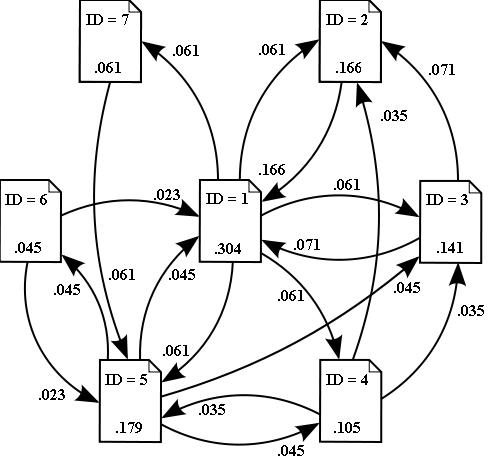 |
| An Internet with seven sites is complicated enough... |
I'm not a statistics person - in general, data is kind of annoying. The real world is so much uglier than the beautiful patterns you can find in math. But possibly the most beautiful use of data I've ever seen came in an intro to linear algebra class, when we were introduced to the basic algorithm Google uses to rank its pages - they take tons and tons of data, and manage to get an incredibly useful fact (the ranking of pages) out of it. The diagram to the right is pretty complicated already - the fact that Google can get meaningful information out of billions of web pages is astonishing, and shows the power of linear algebra. Pleeeease ask if you're curious, it's actually a mind-boggling idea and I'd love to share it, but I won't here right now.
So it turns out that major sports organizations use a similar idea when they rank athletes. They take all the statistics of that player, do some linear algebra to it, and get out a ranking of players. Fascinating.
TOURNAMENT. Which team should play which? How will you determine the winner? Will there be runner-ups? A consolation bracket? Is there enough time for round-robin play? These aren't just arbitrary decisions - a lot of planning has to go into each one. I was on my high school student council for three years... and every single time we hosted a gym night, I would be the one in charge of creating the tournament brackets. It's not as easy as drawing a bracket and randomly picking teams to go in each slot. Granted, I had a few things to worry about that professional leagues didn't - for example, I had a time constraint of a couple hours as opposed to a couple months, so every five minutes counted, and I did my best to make sure that every team would have at least one good game (i.e. don't put a team of freshman girls against a team of senior guys).
 |
| In case you didn't know what a tournament bracket looks like. |
But every tournament has its own host of problems to solve to make sure the tournament works well. Most major league sports have a certain tournament style that they feel solves these problems most effectively. But I can guarantee you that a significant amount of mathematical thinking went into setting that as a standard. Probability is one of the biggest factors here - what are the chances of a team that deserves to win getting eliminated early, or the chances of a comparatively weak team making it really far?
For example, in single-elimination, if the two top teams get put together, then the second-place team might get eliminated at the beginning, which means the resulting rankings don't reflect actual ability. A good tournament is one in which it is very likely that each team will end up about where it's supposed to be. In this sense, the "best" tournament is one where every team plays every other team five or six times (again, probability comes in here - the more games you play against a single team, the more likely the results will average out to reveal the actual comparative ability of the two teams), but this is incredibly inefficient. So you have to find a tournament structure that will be likely to rank teams where they deserve to be ranked, but doing so in as few games as necessary. And being totally fair about it. That's a tough math problem.
SCHEDULING. Related to the above, but even harder. Have you ever thought how difficult it is to take 20 teams, living completely separate from each other, and come up with a schedule that lets every team have the right number of games with every other team, with a good balance of home and away games, all while avoiding conflicts where a team should be in two places at the same time?
 |
| taken from this presentation by Richard Hoshino on travel schedules for Nippon Professional Baseball |
It turns out that this is an INCREDIBLY difficult problem, and many professional mathematicians are working on ways to find efficient solutions. That's right - WE DON'T KNOW how to find the best solution yet. And the study of this problem connects many different branches of mathematics together - graph theory (the study of networks and connections - which team should play which?), dynamical systems (how a certain set-up develops over time), computer science (what should we ask the computer to do if we want it to find a good solution as quickly as possible?), and more. I had the opportunity to talk with a mathematician who was working in this field last year - and he had just made a proposal to Japan's Nippon Professional Baseball League for a way to schedule games that would minimize flight time (meaning less wasted travel time for the players, and less environmental impact). Deep, deep math goes into this.
And this isn't just a problem for national sports leagues - train or airplane schedules, TV programming, business meetings, schools trying to set up a class schedule, or even you trying to find a good day to meet up with a bunch of friends who are busy most of the time - these are very hard problems.
FINANCES. um... duh. Any sports organization has to know how to deal with money, and dealing with money requires math. Amateur sports leagues care about money because they don't have enough to squander it; professional sports leagues care because they want to make as much money as possible. The thing that might not be quite so "duh" about it is how finances interplay with the other math problems a team faces. Because in the end, one of the main things that stops a league from making a "perfectly fair" tournament, and the thing which makes pursuit of an ideal schedule as important as it is, is finances.
These are some of the big factors that come into play on the large scale of sports - tournaments, schedules, rankings, finances, statistics. If you managed to read through all that, good - because it gets more fun from here on. Up next I'll be talking about the rules and equipment of sports games, which, believe it or not, is a lot more fascinating (in my opinion at least. See for yourself).

No comments:
Post a Comment