So just today, I watched a talk on TED (one of my favourite websites - hundreds of amazing and inspiring new ideas) that confirmed my idea that there was some form of mathematical reasoning other than counting going on. The talk, "What do Babies Think" by Alison Gopnik, basically talked about what goes on in the minds of very young children, and showed that the infant mind is actually much more powerful than you might expect.
There's a lot of great info in that talk, but the part that grabbed my attention was when Bayes' Theorem was brought up. I don't want to get too much into Bayes' Theorem right now - I might write a blog post about it some time. It looks kinda complicated, but it's actually a fairly simple idea, and it's really really important - in my opinion, it's the hardest math everyone needs to know (even if you don't ever get what all the symbols mean, understanding the idea is important)
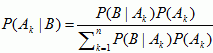 |
| Bayes' Theorem - don't get scared by the symbols |
Gopnik raises a very interesting point in her talk - perhaps young children have a conceptual understanding of Bayes' Law even before they learn how to count! As they learn how the world works, they actually use the evidence they get to decide what explanation is most likely, and what kind of experiments they need to run to get the evidence they need (8:45~14:35 in the video - the ADORABLE experiment starts from 12:20).
So back to my original blog posts - I proposed that counting actually arises out of a sense of ratio, that ratio is more fundamental than counting in some ways - counting is just a tool that allows you to do more complex things (like arithmetic). But one thing I didn't think of then, that makes a lot of sense now, is that in addition to a sense of ratio, young children likely also have a sense of probability. A very strong one, too - you have to be able to make educated guesses (guesses that have a good chance of being right) in order to learn anything. I think even really young babies understand chance - "if I cry, it's more likely that I'll get food." "When I think the right thing, that weird thing at my side moves. It's probably under my control!" "I hear the sound 'mama' whenever this person is around, so chances are, I should make that sound too."
It's interesting, isn't it, how so many people struggle with division when ratios seem to be a natural part of the way humans think, and how probability just confuses most people when it's supposedly such a natural thought process... maybe this comes from lack of integration of different parts of the mind. Maybe people struggle with division because their natural intuition about ratio is never correlated with the computations they're taught (built up from counting). Maybe probability makes no sense because it's always taught, again, from the foundation of counting, and we don't develop the connection to our natural sense of what should be more probable.
This is still all just speculation. I have no idea if this "multi-foundational approach" to teaching math will work at all. But it seems to me that if we really want students to understand what's going on, rather than just know how to move symbols around, we'll have to connect each topic in math class with a part of their mind that's already used to thinking in that way. That's my hypothesis, at least. We'll have to find some more evidence to get a better idea of how likely the hypothesis actually is.

No comments:
Post a Comment