It's interesting how many people introduce themselves saying something like
"I can be kind of random sometimes."
"just as a warning, don't get weirded out by the stuff I do."
"The more you get to know me, you'll see how strange I can be."
ok, that's great. Just about everyone can say that, so you're really not saying anything unusual.
If you really want someone to know that you're random, here's a tip I learned from my 2nd grade English teacher: why not show them instead of tell them?
e.g.
you: "Hey, have you been to Nicaragua?"
other: "No, why? Have you?"
you: "No, I haven't either, but I think it would be really cool to go there someday."
other: "Cool! Why Nicaragua?"
you: "oh, I just think it would be really cool to learn enough of the language to run into as many barbershops in Managua (that's the capital!) as I can, yelling "Don't panic! The aardvarks haven't escaped yet!"
other: ... "uh, why Nicaragua in particular?"
you: *stare at them incredulously, as if they just asked a really stupid question, and then move on to the rest of your introduction as if you couldn't be bothered to answer that question*
Wouldn't that make things so much more exciting? And actually prove that you're random without having to tell them?
Wednesday, October 19, 2011

Monday, October 10, 2011
1, 2, 3... not the best place to start? (Part P(A) - further evidence, revised hypothesis)
So about a month ago, I released a series of posts talking about how we start to learn mathematics, and argued that we might want to stop assuming that all math can be learned starting the foundation of counting - that there are other natural starting points, such as an intuitive understanding of ratios, that should be tapped in order to help children understand what they learn. if you haven't read the original posts, you can start here.
So just today, I watched a talk on TED (one of my favourite websites - hundreds of amazing and inspiring new ideas) that confirmed my idea that there was some form of mathematical reasoning other than counting going on. The talk, "What do Babies Think" by Alison Gopnik, basically talked about what goes on in the minds of very young children, and showed that the infant mind is actually much more powerful than you might expect.
There's a lot of great info in that talk, but the part that grabbed my attention was when Bayes' Theorem was brought up. I don't want to get too much into Bayes' Theorem right now - I might write a blog post about it some time. It looks kinda complicated, but it's actually a fairly simple idea, and it's really really important - in my opinion, it's the hardest math everyone needs to know (even if you don't ever get what all the symbols mean, understanding the idea is important)
Simply put, this is the math behind learning. It talks about how, as you collect information (by observing things, collecting data, reading, listening, etc), you can figure out what the best explanation behind that information is.
Gopnik raises a very interesting point in her talk - perhaps young children have a conceptual understanding of Bayes' Law even before they learn how to count! As they learn how the world works, they actually use the evidence they get to decide what explanation is most likely, and what kind of experiments they need to run to get the evidence they need (8:45~14:35 in the video - the ADORABLE experiment starts from 12:20).
So back to my original blog posts - I proposed that counting actually arises out of a sense of ratio, that ratio is more fundamental than counting in some ways - counting is just a tool that allows you to do more complex things (like arithmetic). But one thing I didn't think of then, that makes a lot of sense now, is that in addition to a sense of ratio, young children likely also have a sense of probability. A very strong one, too - you have to be able to make educated guesses (guesses that have a good chance of being right) in order to learn anything. I think even really young babies understand chance - "if I cry, it's more likely that I'll get food." "When I think the right thing, that weird thing at my side moves. It's probably under my control!" "I hear the sound 'mama' whenever this person is around, so chances are, I should make that sound too."
It's interesting, isn't it, how so many people struggle with division when ratios seem to be a natural part of the way humans think, and how probability just confuses most people when it's supposedly such a natural thought process... maybe this comes from lack of integration of different parts of the mind. Maybe people struggle with division because their natural intuition about ratio is never correlated with the computations they're taught (built up from counting). Maybe probability makes no sense because it's always taught, again, from the foundation of counting, and we don't develop the connection to our natural sense of what should be more probable.
This is still all just speculation. I have no idea if this "multi-foundational approach" to teaching math will work at all. But it seems to me that if we really want students to understand what's going on, rather than just know how to move symbols around, we'll have to connect each topic in math class with a part of their mind that's already used to thinking in that way. That's my hypothesis, at least. We'll have to find some more evidence to get a better idea of how likely the hypothesis actually is.
So just today, I watched a talk on TED (one of my favourite websites - hundreds of amazing and inspiring new ideas) that confirmed my idea that there was some form of mathematical reasoning other than counting going on. The talk, "What do Babies Think" by Alison Gopnik, basically talked about what goes on in the minds of very young children, and showed that the infant mind is actually much more powerful than you might expect.
There's a lot of great info in that talk, but the part that grabbed my attention was when Bayes' Theorem was brought up. I don't want to get too much into Bayes' Theorem right now - I might write a blog post about it some time. It looks kinda complicated, but it's actually a fairly simple idea, and it's really really important - in my opinion, it's the hardest math everyone needs to know (even if you don't ever get what all the symbols mean, understanding the idea is important)
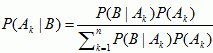 |
| Bayes' Theorem - don't get scared by the symbols |
Gopnik raises a very interesting point in her talk - perhaps young children have a conceptual understanding of Bayes' Law even before they learn how to count! As they learn how the world works, they actually use the evidence they get to decide what explanation is most likely, and what kind of experiments they need to run to get the evidence they need (8:45~14:35 in the video - the ADORABLE experiment starts from 12:20).
So back to my original blog posts - I proposed that counting actually arises out of a sense of ratio, that ratio is more fundamental than counting in some ways - counting is just a tool that allows you to do more complex things (like arithmetic). But one thing I didn't think of then, that makes a lot of sense now, is that in addition to a sense of ratio, young children likely also have a sense of probability. A very strong one, too - you have to be able to make educated guesses (guesses that have a good chance of being right) in order to learn anything. I think even really young babies understand chance - "if I cry, it's more likely that I'll get food." "When I think the right thing, that weird thing at my side moves. It's probably under my control!" "I hear the sound 'mama' whenever this person is around, so chances are, I should make that sound too."
It's interesting, isn't it, how so many people struggle with division when ratios seem to be a natural part of the way humans think, and how probability just confuses most people when it's supposedly such a natural thought process... maybe this comes from lack of integration of different parts of the mind. Maybe people struggle with division because their natural intuition about ratio is never correlated with the computations they're taught (built up from counting). Maybe probability makes no sense because it's always taught, again, from the foundation of counting, and we don't develop the connection to our natural sense of what should be more probable.
This is still all just speculation. I have no idea if this "multi-foundational approach" to teaching math will work at all. But it seems to me that if we really want students to understand what's going on, rather than just know how to move symbols around, we'll have to connect each topic in math class with a part of their mind that's already used to thinking in that way. That's my hypothesis, at least. We'll have to find some more evidence to get a better idea of how likely the hypothesis actually is.
Sunday, October 9, 2011
The second-most stressful 24 hours of Jesus' life (Part 4)
(continued from Part 3)
Are we still within 24 hours? Well, assuming Jesus heard of John's death in the early afternoon the day before (kind of an arbitrary guess, but reasonable when you consider that the disciples' concern about food would probably have come up around lunchtime, not dinner, if they had crossed the lake in the morning), then yes, this would still be within 24 hours - in fact, it’s just after dawn of the following day.
At this point, it would probably be more effective just to read John 6:25-70, because though Matthew and Mark generically talk about how the crowds gathered, John is the only book which talks about what the discussion at the time was actually about. Plus, I myself don't understand the significance of everything he says in this passage, so it would be better to see it all for yourself. But basically, Jesus is doing his best to convince people that yes, he does want the people to come to him and be fulfilled, but no, his main purpose is not to provide the people with material things. He provides them with a much different picture of what his purpose is - telling them straight up "I'm not going to let you make me king. In fact, I'm giving myself to you to eat - only then will you never go hungry."
Strange? Definitely. And many people turn away at this point. They were looking for a Messiah that did what they wanted - when this Jesus turned out to be radically different, and even weird, when they realized that they had been let down, they instantly dropped their enthusiasm and deserted ship.
Imagine the stress of this moment. All Jesus was trying to do was to tell people the truth, to tell people what was really good for them, what would save them... but rather than finding hopeless people and giving them hope, all he seemed to do was take mobs of extremely hopeful people and make them turn away in hopelessness. Some success THAT was. After the months, the years perhaps, of gathering followers, of speaking to crowds, of being loved by the people, he decides that instead of doing the temptingly glamorous thing (becoming political ruler), he would stick to his main purpose - and he lost many of his devoted followers. His very purpose was to bring people to God - but by living out that purpose, he turned people away. Maybe he knew that would happen. Maybe he came to terms with the fact that this would have to play out that way. But he loved these people, and to see them turn away from such a direct offer of life and relationship would have deeply saddened him. You can feel the hurt in Jesus' voice as he turns to his twelve "most loyal" ones and asks "You do not want to leave too, do you?"
"Most loyal" ones, eh?
The ones who cared more about their own time alone than about the masses of people looking for hope?
The ones who screamed in terror when Jesus approached them?
The ones who let the fear of waves overcome the trust in their Lord?
The one who, Jesus knew, would turn Jesus over to those who wanted to kill him, in the most stressful 24 hours of his life?
Jesus must have felt so incredibly lonely at that point. Before, when he wanted to be alone, he was faced with multitudes of people who needed him. Now, when he desperately wanted to see people come to him, he saw them all turn away - the only ones left were cowardly and untrustworthy. As he asked, "You do not want to leave too, do you?" it's almost like he expected them to walk away as well.
But I'm sure Jesus found solace in this:
"Simon Peter answered him, 'Lord, to whom shall we go? You have the words of eternal life. We have come to believe and to know that you are the Holy One of God'" (John 6:68-69)
Are we still within 24 hours? Well, assuming Jesus heard of John's death in the early afternoon the day before (kind of an arbitrary guess, but reasonable when you consider that the disciples' concern about food would probably have come up around lunchtime, not dinner, if they had crossed the lake in the morning), then yes, this would still be within 24 hours - in fact, it’s just after dawn of the following day.
At this point, it would probably be more effective just to read John 6:25-70, because though Matthew and Mark generically talk about how the crowds gathered, John is the only book which talks about what the discussion at the time was actually about. Plus, I myself don't understand the significance of everything he says in this passage, so it would be better to see it all for yourself. But basically, Jesus is doing his best to convince people that yes, he does want the people to come to him and be fulfilled, but no, his main purpose is not to provide the people with material things. He provides them with a much different picture of what his purpose is - telling them straight up "I'm not going to let you make me king. In fact, I'm giving myself to you to eat - only then will you never go hungry."
Strange? Definitely. And many people turn away at this point. They were looking for a Messiah that did what they wanted - when this Jesus turned out to be radically different, and even weird, when they realized that they had been let down, they instantly dropped their enthusiasm and deserted ship.
Imagine the stress of this moment. All Jesus was trying to do was to tell people the truth, to tell people what was really good for them, what would save them... but rather than finding hopeless people and giving them hope, all he seemed to do was take mobs of extremely hopeful people and make them turn away in hopelessness. Some success THAT was. After the months, the years perhaps, of gathering followers, of speaking to crowds, of being loved by the people, he decides that instead of doing the temptingly glamorous thing (becoming political ruler), he would stick to his main purpose - and he lost many of his devoted followers. His very purpose was to bring people to God - but by living out that purpose, he turned people away. Maybe he knew that would happen. Maybe he came to terms with the fact that this would have to play out that way. But he loved these people, and to see them turn away from such a direct offer of life and relationship would have deeply saddened him. You can feel the hurt in Jesus' voice as he turns to his twelve "most loyal" ones and asks "You do not want to leave too, do you?"
"Most loyal" ones, eh?
The ones who cared more about their own time alone than about the masses of people looking for hope?
The ones who screamed in terror when Jesus approached them?
The ones who let the fear of waves overcome the trust in their Lord?
The one who, Jesus knew, would turn Jesus over to those who wanted to kill him, in the most stressful 24 hours of his life?
Jesus must have felt so incredibly lonely at that point. Before, when he wanted to be alone, he was faced with multitudes of people who needed him. Now, when he desperately wanted to see people come to him, he saw them all turn away - the only ones left were cowardly and untrustworthy. As he asked, "You do not want to leave too, do you?" it's almost like he expected them to walk away as well.
But I'm sure Jesus found solace in this:
"Simon Peter answered him, 'Lord, to whom shall we go? You have the words of eternal life. We have come to believe and to know that you are the Holy One of God'" (John 6:68-69)
To this, Jesus responds "Have I not chosen you, the Twelve?" In other words, "I knew what I was doing." Sure, these are plain, unrefined, cowardly, untrustworthy people - but that's all Jesus needed. Just as he only needed a small packed lunch to feed thousands of hungry followers. When God is involved, your perspective totally changes.
And you know, I think that's how Jesus was able to make it through this stressful 24-hour period. After hearing about his friend and supporter's death; empathizing with his tired disciples and with crowds searching for hope; resisting the temptation to take the time alone to grieve right away; organizing thousands of people into small groups; somehow distributing thousands of meals from a single serving; learning that people were about to force him into the role of king; pulling an all-nighter; seeing his most trusted followers cower in fear; trying to explain his purpose to people who wanted to fit him in their own little box; watching people turn away from the truth; and knowing that one of his disciples would eventually betray him - through all that, he had his perspective right. He knew what was important in the end - that not much was needed to get him through incredibly heavy stress. The "small" things - his night of prayer (although that was, admittedly, not exactly "small"), Peter's confession of faith, the opportunity to teach - these made it all worth it. These gave him the strength to endure. Because with God in the picture, even the small things can make all the difference. The single serving of bread and fish made up for the masses of hungry people - because they were dedicated to God, and God knows how to multiply. A few uncultured and weak disciples made up for the masses that turned away - because they were dedicated to God, and would later be used to change the world.
Does believing that Jesus faced stress like this make him somehow less dependable? By no means. If anything, it makes him more dependable - if he remained true to his mission in the face of this unbelievable stress, it means that he understands what we go through. It means he knows our stress, and also knows how to handle it; and as we get to know him more, we'll learn from him how to handle it better too. God wants us to be more like himself, more reflective of who he is in every way - including dealing with stress.
Again, this is largely my own interpretation. I don't know if these all happened in a 24-hour period, and I definitely don't know if Jesus reacted the way I said he did most of the time. And it's also possible that you don't believe any of this happened at all, or at least, that the stories were tampered with and exaggerated. But at the very least, I hope this made you view stress, and Jesus, in a new way.
The second-most stressful 24 hours of Jesus' life (Part 3)
(continued from Part 2)
Just before dawn, Jesus has been so spiritually refreshed and regenerated that he goes out to meet his disciples by walking across the stormy lake. They scream in fear of him, and he has to reassure them that he's not a ghost. One of his disciples climbs out of the boat to walk towards him, but almost drowns because he let fear of the waves take over him. Essentially, these events confirm the fact that Jesus' disciples are cowards. Even if he knew that already, that must have been slightly frustrating ("You of little faith," Jesus asks in Matthew 14:31, "why did you doubt?"). It seems like the stressors just keep on coming.
So they get to the other side of the lake, and as soon as they arrive, everyone hears about it, and soon enough, the crowds have arrived again. But this time, they're more crazy than ever. They've just seen something that could solve the problem of world hunger once and for all... or at least, solve their own hunger. Just about everything the people say in John 6 has something to do with food. But there's another point that I hadn't realized at first, until reading Philip Yancey's The Jesus I Never Knew.
The fact is, the Jews in that time were eagerly awaiting a Messiah - the "anointed one" - someone who would be fully endowed with God's power in order to re-establish God's kingdom on earth. More precisely, the people were looking for someone who would restore Israel to, and beyond, its former glory. Someone who would throw off the hold of the Roman dictators who currently ruled the land, and be king of the Jews. They wanted a military leader.
Jesus claimed to be the messiah. He performed miracles. He healed the sick. He fed his people. And... he had the people sit down in organized groups of fifty to a hundred people before he fed them.
It seems a small point - I missed it the first time through. First of all, this would be another stressful thing - if you haven't tried it before, you have no idea how hard it is to divide people into groups. I was in student council, and sometimes the events we led required dividing the people into groups - SO much stress in that simple activity. I can't imagine how tough it would have been to get over five thousand people into smaller groups.
But another, more significant point: no matter how you look at it, organizing people into groups is not something a generic wise sage would do. This is the action of someone who wants efficiency - who else but a military commander? Imagine the excitement the people must have had as they sat in groups, like an army - only to have that excitement doubled by all getting free food from their general. This Jesus, who had just gone around teaching people at first, was finally getting his people organized into centuria (divisions of 60, 80, or 100 soldiers in the Roman army - the analogy is obvious) - clearly he was about to declare war on the Romans any moment now!
In fact, John (the book, written by the disciple, not the baptist) gives another reason Jesus dismissed the crowds so quickly - according to John 6:15, Jesus knew that the people were about to force him to become king, which was totally against his goal in coming to earth.
Jesus almost couldn't care less about politics. Whenever someone said something to get him riled up about the Romans, he never said anything remotely rebellious. When someone asked him if taxes should be paid to Caesar, he said yes, since the coins had Caesar's picture on them. "Give to Caesar what is Caesar's and give to God what is God's" (Matt. 22:21). Nothing about economics, nothing about the rights of the people - he didn't care about "Caesar's things." Jesus was concerned about what belonged to God - which is why he got mad at the Pharisees, not the Roman centurions. Why he overturned tables in the temple, not in the Roman puppet-king's palace. I don't think we should take from this that we should ignore politics or economics - these are important parts of the world we live in, and to properly glorify God, we ought to manage these systems well. But that clearly wasn't Jesus' goal. He came to spread God's kingdom, not as a nation conquering territory, but as a gift of supreme grace conquering the hearts of any who chose to accept it. Becoming a political ruler would be totally against that purpose.
So I'm assuming that in his intense prayer night, he not only was trying to recover from the shock of John's death, he was also desperately asking for the strength to stand up against efforts to make him political king. I'm sure he felt the temptation to give in - he felt it before (Luke 4:6-7), and even though he knew his purpose and he wouldn't give in, dealing with temptation is stressful.
Now back to the mob of fanatical people, looking for a political leader who would keep his people fed and lead them to military victory.
(continued in Part 4)
So they get to the other side of the lake, and as soon as they arrive, everyone hears about it, and soon enough, the crowds have arrived again. But this time, they're more crazy than ever. They've just seen something that could solve the problem of world hunger once and for all... or at least, solve their own hunger. Just about everything the people say in John 6 has something to do with food. But there's another point that I hadn't realized at first, until reading Philip Yancey's The Jesus I Never Knew.
The fact is, the Jews in that time were eagerly awaiting a Messiah - the "anointed one" - someone who would be fully endowed with God's power in order to re-establish God's kingdom on earth. More precisely, the people were looking for someone who would restore Israel to, and beyond, its former glory. Someone who would throw off the hold of the Roman dictators who currently ruled the land, and be king of the Jews. They wanted a military leader.
Jesus claimed to be the messiah. He performed miracles. He healed the sick. He fed his people. And... he had the people sit down in organized groups of fifty to a hundred people before he fed them.
It seems a small point - I missed it the first time through. First of all, this would be another stressful thing - if you haven't tried it before, you have no idea how hard it is to divide people into groups. I was in student council, and sometimes the events we led required dividing the people into groups - SO much stress in that simple activity. I can't imagine how tough it would have been to get over five thousand people into smaller groups.
But another, more significant point: no matter how you look at it, organizing people into groups is not something a generic wise sage would do. This is the action of someone who wants efficiency - who else but a military commander? Imagine the excitement the people must have had as they sat in groups, like an army - only to have that excitement doubled by all getting free food from their general. This Jesus, who had just gone around teaching people at first, was finally getting his people organized into centuria (divisions of 60, 80, or 100 soldiers in the Roman army - the analogy is obvious) - clearly he was about to declare war on the Romans any moment now!
In fact, John (the book, written by the disciple, not the baptist) gives another reason Jesus dismissed the crowds so quickly - according to John 6:15, Jesus knew that the people were about to force him to become king, which was totally against his goal in coming to earth.
Jesus almost couldn't care less about politics. Whenever someone said something to get him riled up about the Romans, he never said anything remotely rebellious. When someone asked him if taxes should be paid to Caesar, he said yes, since the coins had Caesar's picture on them. "Give to Caesar what is Caesar's and give to God what is God's" (Matt. 22:21). Nothing about economics, nothing about the rights of the people - he didn't care about "Caesar's things." Jesus was concerned about what belonged to God - which is why he got mad at the Pharisees, not the Roman centurions. Why he overturned tables in the temple, not in the Roman puppet-king's palace. I don't think we should take from this that we should ignore politics or economics - these are important parts of the world we live in, and to properly glorify God, we ought to manage these systems well. But that clearly wasn't Jesus' goal. He came to spread God's kingdom, not as a nation conquering territory, but as a gift of supreme grace conquering the hearts of any who chose to accept it. Becoming a political ruler would be totally against that purpose.
So I'm assuming that in his intense prayer night, he not only was trying to recover from the shock of John's death, he was also desperately asking for the strength to stand up against efforts to make him political king. I'm sure he felt the temptation to give in - he felt it before (Luke 4:6-7), and even though he knew his purpose and he wouldn't give in, dealing with temptation is stressful.
Now back to the mob of fanatical people, looking for a political leader who would keep his people fed and lead them to military victory.
(continued in Part 4)
The second-most stressful 24 hours of Jesus' life (Part 2)
(continued from Part 1)
So why would Jesus decide to spend an entire night in prayer?
Let's backtrack a bit. One of the reasons Jesus was trying to get away from the crowds originally was for the disciple's sake, to let them rest. But there was actually another reason behind the decision to cross the lake - one that affected Jesus himself. Matthew and Mark (and Luke, in passing) describe what happened just before Jesus crosses the lake - John the Baptist was beheaded.
You have to understand the relationship Jesus and John had with each other to fully grasp the significance of this. Jesus' mother, Mary, and John's mother, Elizabeth, were cousins, who knew each other very well. It's recorded that Mary spent three months of her pregnancy with Elizabeth (likely because she thought Elizabeth was the only one she could trust in her situation), and they were both pregnant at the same time - as such, it's very likely that Jesus and John knew each other from as early as they could remember. They probably played together and learned together. John was son of a priest and Jesus the son of a carpenter, so there was a difference in class, but it's clear that that didn't concern either of them. John ended up abandoning his priestly life to live in the desert, preparing the way for Jesus to start his work; and when Jesus was ready to begin, John was the one to baptize him. John had the utmost respect for Jesus ("the straps of [his] sandals I am not worthy to stoop down and untie" - Mark 1:7), and Jesus always spoke very well about John ("I tell you, among those born of women there is no one greater than John" - Luke 7:28). John was perhaps the only person alive at the time who truly understood who Jesus was.
John was put in prison for standing up for what was right - in amazing courage, he told off the regional king for having an affair. But John died for no good reason - he died because a drunk king made a silly promise that a moody woman could take advantage of. And soon after, Jesus heard about it. He got the news that his strongest supporter and (most likely) best friend had been killed.
What would you do if your best friend just died - not out of bravery, not from an accident or sickness, but because a drunk guy wanted to keep up his reputation? Think about it for a second.
Now imagine that, in addition to that, crowds of people, totally oblivious to the news, are coming up to you, asking for something... help with homework, your autograph, the latest gossip, whatever.
Wouldn't you want to get away from it all? Spend some time alone? So you can scream and cry about the injustice of the world in solitude?
I figure that's exactly what Jesus wanted to do. In fact, most likely, he intended to cross the lake, get off at the other side, leave his disciples, and go straight to spending hours in prayer. Not the "Dear God, thank you for your blessings... please help me to... Amen." kind of prayer, but a complete release of emotion; a laying out of his soul before his Father. He probably wanted to scream "WHY?!", to sit there weeping, and to find peace in his heart again before he returned to his ministry. To refresh his emotional strength, which had been drained by the news, but also his spiritual strength, which had been drained by the sheer force it took to forgive the people responsible for John's death. This, readers, is stress.
Some people might feel uncomfortable while reading this - I'm almost making Jesus look weak, like it's hard for him to forgive, like things can scare him or even make him question God's plan. Maybe I'm wrong; maybe Jesus was able to stay totally cool the whole time. But though I believe Jesus was God, I also believe he was human - and part of being human is being outraged. Being scared. Crying. Struggling. And other places in the bible record him doing these exact same things - being filled with anger, pleading with God to change his mind, weeping. So why not here too, after his best friend's death?
Now, the fact that he took his disciples with him in the boat is pretty extraordinary - it shows that even in the midst of this incredible pain and suffering, he saw the stress of the people around him, and realized that they too, needed some time away from the crowds, even though their stress was just from being too busy, not from an emotional loss. And when he arrives at the other shore and - surprise surprise - sees the crowds waiting, keeping him from his time alone in prayer, he doesn't try to run away - he has compassion on them. Nowhere is the "you don't understand what I'm going through;" he doesn't even say "I'll be able to help you better once I've calmed down a bit," he just sits down with them and starts teaching them.
Imagine the temptation Jesus must have had to send the crowds away as soon as his disciples asked him to do so. Imagine how alluring the silence would have been, the chance to spend time crying in his dad's arms. But no; he forces the disciples to get involved, to think beyond themselves, and in doing so, has to get more involved himself.
Was that healthy? Many psychologists today would say it wasn't - that you shouldn't overwork yourself, that when you're stressed, you have to stop and rest, to avoid burnout. Even if you're doing very good things, you have to stop if it risks your own health.
I don't know how to reconcile that with what Jesus did. Should I follow his example? Or should I be concerned enough with my own well-being to stop doing something good once it starts to pressure me? Maybe Jesus just knew that both he and his disciples could handle the extra push... I don't know.
But at any rate, the miracle goes over well, the crowds are well-fed and excited (as we'll soon see, perhaps too excited), and as quickly as he can, Jesus sends everyone away. He knows he's near his human limits. He has to get away and pray. And pray he does. For nearly eight hours, until he is fully refreshed, emotionally and spiritually. But even now, I suppose that he still would have been feeling the physical effects of sleep deprivation, and the sort of empty exhaustion you feel after completely releasing all your emotions - a very satisfying feeling, but tiring nonetheless.
So yeah, that's pretty intense. But guess what, the 24 hours aren't over yet, and neither is the stress!
(continued in Part 3)
So why would Jesus decide to spend an entire night in prayer?
Let's backtrack a bit. One of the reasons Jesus was trying to get away from the crowds originally was for the disciple's sake, to let them rest. But there was actually another reason behind the decision to cross the lake - one that affected Jesus himself. Matthew and Mark (and Luke, in passing) describe what happened just before Jesus crosses the lake - John the Baptist was beheaded.
You have to understand the relationship Jesus and John had with each other to fully grasp the significance of this. Jesus' mother, Mary, and John's mother, Elizabeth, were cousins, who knew each other very well. It's recorded that Mary spent three months of her pregnancy with Elizabeth (likely because she thought Elizabeth was the only one she could trust in her situation), and they were both pregnant at the same time - as such, it's very likely that Jesus and John knew each other from as early as they could remember. They probably played together and learned together. John was son of a priest and Jesus the son of a carpenter, so there was a difference in class, but it's clear that that didn't concern either of them. John ended up abandoning his priestly life to live in the desert, preparing the way for Jesus to start his work; and when Jesus was ready to begin, John was the one to baptize him. John had the utmost respect for Jesus ("the straps of [his] sandals I am not worthy to stoop down and untie" - Mark 1:7), and Jesus always spoke very well about John ("I tell you, among those born of women there is no one greater than John" - Luke 7:28). John was perhaps the only person alive at the time who truly understood who Jesus was.
John was put in prison for standing up for what was right - in amazing courage, he told off the regional king for having an affair. But John died for no good reason - he died because a drunk king made a silly promise that a moody woman could take advantage of. And soon after, Jesus heard about it. He got the news that his strongest supporter and (most likely) best friend had been killed.
What would you do if your best friend just died - not out of bravery, not from an accident or sickness, but because a drunk guy wanted to keep up his reputation? Think about it for a second.
Now imagine that, in addition to that, crowds of people, totally oblivious to the news, are coming up to you, asking for something... help with homework, your autograph, the latest gossip, whatever.
Wouldn't you want to get away from it all? Spend some time alone? So you can scream and cry about the injustice of the world in solitude?
I figure that's exactly what Jesus wanted to do. In fact, most likely, he intended to cross the lake, get off at the other side, leave his disciples, and go straight to spending hours in prayer. Not the "Dear God, thank you for your blessings... please help me to... Amen." kind of prayer, but a complete release of emotion; a laying out of his soul before his Father. He probably wanted to scream "WHY?!", to sit there weeping, and to find peace in his heart again before he returned to his ministry. To refresh his emotional strength, which had been drained by the news, but also his spiritual strength, which had been drained by the sheer force it took to forgive the people responsible for John's death. This, readers, is stress.
Some people might feel uncomfortable while reading this - I'm almost making Jesus look weak, like it's hard for him to forgive, like things can scare him or even make him question God's plan. Maybe I'm wrong; maybe Jesus was able to stay totally cool the whole time. But though I believe Jesus was God, I also believe he was human - and part of being human is being outraged. Being scared. Crying. Struggling. And other places in the bible record him doing these exact same things - being filled with anger, pleading with God to change his mind, weeping. So why not here too, after his best friend's death?
Now, the fact that he took his disciples with him in the boat is pretty extraordinary - it shows that even in the midst of this incredible pain and suffering, he saw the stress of the people around him, and realized that they too, needed some time away from the crowds, even though their stress was just from being too busy, not from an emotional loss. And when he arrives at the other shore and - surprise surprise - sees the crowds waiting, keeping him from his time alone in prayer, he doesn't try to run away - he has compassion on them. Nowhere is the "you don't understand what I'm going through;" he doesn't even say "I'll be able to help you better once I've calmed down a bit," he just sits down with them and starts teaching them.
Imagine the temptation Jesus must have had to send the crowds away as soon as his disciples asked him to do so. Imagine how alluring the silence would have been, the chance to spend time crying in his dad's arms. But no; he forces the disciples to get involved, to think beyond themselves, and in doing so, has to get more involved himself.
Was that healthy? Many psychologists today would say it wasn't - that you shouldn't overwork yourself, that when you're stressed, you have to stop and rest, to avoid burnout. Even if you're doing very good things, you have to stop if it risks your own health.
I don't know how to reconcile that with what Jesus did. Should I follow his example? Or should I be concerned enough with my own well-being to stop doing something good once it starts to pressure me? Maybe Jesus just knew that both he and his disciples could handle the extra push... I don't know.
But at any rate, the miracle goes over well, the crowds are well-fed and excited (as we'll soon see, perhaps too excited), and as quickly as he can, Jesus sends everyone away. He knows he's near his human limits. He has to get away and pray. And pray he does. For nearly eight hours, until he is fully refreshed, emotionally and spiritually. But even now, I suppose that he still would have been feeling the physical effects of sleep deprivation, and the sort of empty exhaustion you feel after completely releasing all your emotions - a very satisfying feeling, but tiring nonetheless.
So yeah, that's pretty intense. But guess what, the 24 hours aren't over yet, and neither is the stress!
(continued in Part 3)
The second-most stressful 24 hours of Jesus' life (Part 1)
I think we can all agree that Jesus' life was by no means easy. When you look at all he did, and all he had to go through, whether you're a Christian or not, whether you believe all the accounts of his life or not, there's no way you could say he didn't struggle. And to anyone who knows anything about Jesus' life, it's almost a given that the 24 hours before his death would almost certainly have been the most difficult 24 hours in his life. The agony he felt before anything even happened to him was enough to make him sweat blood, and yet his three closest followers fell asleep when he most needed their support; one of his twelve followers betrayed him into the hands of enemies using a symbol of friendship; none of his disciples stood by him when he was taken; he was sentenced to murder for extremely sketchy and unjustifiable reasons; he endured humiliation and torture beyond the legal limit at the time; he hung in one of the most excruciating positions ever devised for hours until his death; and perhaps most painful of all, he felt guilt for the first time ever as all the sins in the history of the world were laid on him. To say his last day was stressful would be the ultimate understatement.
But as I was reading some of the gospels, another day really stood out to me as a point which, the more you look into it, also looks unbearably stressful. I'm referring to the 24-hour period in which Jesus fed 5000 men from five loaves of bread and two fish - recorded in Matthew 14, Mark 6, Luke 9, and John 6.
So what exactly happened in this 24-hour period that made it so stressful? At this point, I'm actually going to take a bit of liberty in my interpretation of the bible (better to tell you that straight out), because I actually don't know if everything I'm going to talk about occurred in the same day. If there's one thing you learn from reading the gospels, it's that chronology wasn't the main thing on the writers' minds - to them, what happened and who did it was much more important than when it happened. Except perhaps for Luke, the doctor who "carefully investigated everything from the beginning" in order to "write an orderly account" (Luke 1:3) - but even he was just collecting memories from eyewitnesses, not recording the events as they happened. So it's impossible to know what order all the events actually happened in - but the more you find similarities between the different accounts, the more you can assume that they happened in that order. If the 24-hour period really did progress in the way I propose it did, then it would have had more stressors than almost any other similar day you could find recorded in Jesus' life, other than that of his death. But even if it didn't, you can still probably learn something about Jesus and how he handled difficult situations.
All right, enough with the technicalities. Let's see what went down in Galilee that day.
Jesus leaves in a boat across the Sea of Galilee in order to be alone; to take a break from noisy crowds and spend some time with just him and his disciples. Mark and Luke both say that this was just after Jesus' disciples came back from some amazing (yet certainly tiring) experiences, going around proclaiming who Jesus was and performing acts of power in his name, but that the crowds were too excited to give them even a chance to eat, let alone rest. And in fact, though they sail all the way across to the other side of the lake in order to have some peace and quiet, the crowds travel around the lake just to catch up with them.
So here Jesus is, facing this crowd of crazed people, disillusioned by life, desperately longing for someone to lead them - and Jesus, though he wanted to be alone, has compassion on them. He stays with them and teaches them for hours on end, and they eagerly swallow up his words.
His disciples come up to him, asking him to send the crowds away so they can go into the nearby villages and buy supper because it was getting late. Which sounds nice on the surface. But you learn something as you read through the gospels - with a few exceptions, people who interact with Jesus are always wearing some kind of mask. What they say is hardly ever what they mean - they claim to have good motives to hide selfish intentions; they ask tricky questions that they don't really want answers to; they talk about the abstract in order to direct attention away from their personal life - but Jesus always slices right down to the heart of the issue. Even the people who have been with Jesus for years don't seem to understand that he can see right through them.
So here are the disciples, asking Jesus to send the crowds away (so they can buy supper). They probably did care about the people somewhat, but it's not too hard to think up another possible motive - they wanted to be left alone. These ordinary people Jesus calls his disciples - fishermen, tax collectors, etc. - have just spent weeks doing intense travelling, speaking, and healing, way beyond anything they ever expected they would do, and were looking forward to some time to rest - and these crowds are keeping them from relaxation. They've had enough of masses of people. So they tell Jesus to send them away.
They don't want to be involved with the crowds. So how does Jesus respond? I mean, he did take them away in the boat to be alone before, so wouldn't he support their wish to be alone now? But for whatever reason - maybe to reveal their mask, maybe to teach them something about compassion - He makes them get as involved as they could possibly get... "you feed them."
Typical. Jesus always does that - tells people the exact opposite of what they want to hear.
Now, there's a lot of insight to be gained from this short, simple event, about trust, about power, about compassion, about prayer, about submisssion, but I'm sidetracking from my original point - to talk about why this 24-hour period was so stressful. So here's a quick rundown of the rest of the story: the disciples freak out at Jesus' request. So Jesus just asks them for what they've got - turns out one boy (out of thousands of people) was smart enough to pack some food. Jesus is satisfied; he divides the people into organized groups, gives thanks for the food, starts distributing this boy's meal... and everyone somehow has enough to eat. The disciples then went around picking up basketfuls of leftovers.
Immediately after this happens, Jesus sends his disciples away on the boat and dismisses the crowd. Which is kind of odd if you think about it - Jesus did everything - traveling, sleeping, talking, eating - with his twelve disciples. But now he sends them away, and goes off on a mountainside to pray. Now, this isn't odd in itself - there are other instances of Jesus spending time alone in prayer. It seems likely to me that he would have spent hours every day in time alone with the Father - and every waking second in communication with him.
But what is odd is the amount of time he spends in prayer this night. He starts in the evening, just after everyone's eaten the miracle meal and gone home. And he stays there until just before dawn. 4 in the morning. That's like 8 hours in prayer. Now, Jesus was fully human. Meaning he needed sleep in order to keep his biological processes going. Meaning spending the entire night in prayer is not something he'd do all the time, especially considering how busy his days were. So this is something special. He must have a good reason to want to spend this night in particular in such deep connection with his Father...
(continued in Part 2)
But as I was reading some of the gospels, another day really stood out to me as a point which, the more you look into it, also looks unbearably stressful. I'm referring to the 24-hour period in which Jesus fed 5000 men from five loaves of bread and two fish - recorded in Matthew 14, Mark 6, Luke 9, and John 6.
So what exactly happened in this 24-hour period that made it so stressful? At this point, I'm actually going to take a bit of liberty in my interpretation of the bible (better to tell you that straight out), because I actually don't know if everything I'm going to talk about occurred in the same day. If there's one thing you learn from reading the gospels, it's that chronology wasn't the main thing on the writers' minds - to them, what happened and who did it was much more important than when it happened. Except perhaps for Luke, the doctor who "carefully investigated everything from the beginning" in order to "write an orderly account" (Luke 1:3) - but even he was just collecting memories from eyewitnesses, not recording the events as they happened. So it's impossible to know what order all the events actually happened in - but the more you find similarities between the different accounts, the more you can assume that they happened in that order. If the 24-hour period really did progress in the way I propose it did, then it would have had more stressors than almost any other similar day you could find recorded in Jesus' life, other than that of his death. But even if it didn't, you can still probably learn something about Jesus and how he handled difficult situations.
All right, enough with the technicalities. Let's see what went down in Galilee that day.
Jesus leaves in a boat across the Sea of Galilee in order to be alone; to take a break from noisy crowds and spend some time with just him and his disciples. Mark and Luke both say that this was just after Jesus' disciples came back from some amazing (yet certainly tiring) experiences, going around proclaiming who Jesus was and performing acts of power in his name, but that the crowds were too excited to give them even a chance to eat, let alone rest. And in fact, though they sail all the way across to the other side of the lake in order to have some peace and quiet, the crowds travel around the lake just to catch up with them.
So here Jesus is, facing this crowd of crazed people, disillusioned by life, desperately longing for someone to lead them - and Jesus, though he wanted to be alone, has compassion on them. He stays with them and teaches them for hours on end, and they eagerly swallow up his words.
His disciples come up to him, asking him to send the crowds away so they can go into the nearby villages and buy supper because it was getting late. Which sounds nice on the surface. But you learn something as you read through the gospels - with a few exceptions, people who interact with Jesus are always wearing some kind of mask. What they say is hardly ever what they mean - they claim to have good motives to hide selfish intentions; they ask tricky questions that they don't really want answers to; they talk about the abstract in order to direct attention away from their personal life - but Jesus always slices right down to the heart of the issue. Even the people who have been with Jesus for years don't seem to understand that he can see right through them.
So here are the disciples, asking Jesus to send the crowds away (so they can buy supper). They probably did care about the people somewhat, but it's not too hard to think up another possible motive - they wanted to be left alone. These ordinary people Jesus calls his disciples - fishermen, tax collectors, etc. - have just spent weeks doing intense travelling, speaking, and healing, way beyond anything they ever expected they would do, and were looking forward to some time to rest - and these crowds are keeping them from relaxation. They've had enough of masses of people. So they tell Jesus to send them away.
They don't want to be involved with the crowds. So how does Jesus respond? I mean, he did take them away in the boat to be alone before, so wouldn't he support their wish to be alone now? But for whatever reason - maybe to reveal their mask, maybe to teach them something about compassion - He makes them get as involved as they could possibly get... "you feed them."
Typical. Jesus always does that - tells people the exact opposite of what they want to hear.
Now, there's a lot of insight to be gained from this short, simple event, about trust, about power, about compassion, about prayer, about submisssion, but I'm sidetracking from my original point - to talk about why this 24-hour period was so stressful. So here's a quick rundown of the rest of the story: the disciples freak out at Jesus' request. So Jesus just asks them for what they've got - turns out one boy (out of thousands of people) was smart enough to pack some food. Jesus is satisfied; he divides the people into organized groups, gives thanks for the food, starts distributing this boy's meal... and everyone somehow has enough to eat. The disciples then went around picking up basketfuls of leftovers.
Immediately after this happens, Jesus sends his disciples away on the boat and dismisses the crowd. Which is kind of odd if you think about it - Jesus did everything - traveling, sleeping, talking, eating - with his twelve disciples. But now he sends them away, and goes off on a mountainside to pray. Now, this isn't odd in itself - there are other instances of Jesus spending time alone in prayer. It seems likely to me that he would have spent hours every day in time alone with the Father - and every waking second in communication with him.
But what is odd is the amount of time he spends in prayer this night. He starts in the evening, just after everyone's eaten the miracle meal and gone home. And he stays there until just before dawn. 4 in the morning. That's like 8 hours in prayer. Now, Jesus was fully human. Meaning he needed sleep in order to keep his biological processes going. Meaning spending the entire night in prayer is not something he'd do all the time, especially considering how busy his days were. So this is something special. He must have a good reason to want to spend this night in particular in such deep connection with his Father...
(continued in Part 2)
Subscribe to:
Comments (Atom)