Tuesday, December 27, 2011

A Note from the Past: "June 2, 2010"

So my blog has been kind of inactive lately, and since it's Christmas break, a lot of people will probably be bored and have little better to do. So I decided to take a few of my old Facebook notes and repost them here over the course of a week or two in case anyone feels like reading them. This one is titled "June 2, 2010." Enjoy.

Woke up at 5:00 to work on my double-entry journal entries for Celebration of Discipline. Had three chapters left to do, and decided to type them up. Decided to just type in quotes, and put in commentary later. Breakfast at around 6:30. Cornflakes and toast.

Left for school at 7:00, having just finished inputting all the quotes from the book. Continuing to work on the journal entries on the train, adding commentary to each of the quotes. Arrive at school at 7:30, with two quotes left uncommented.

Needed to be at school early to make up PE credits; having been absent for 8 class periods over the past semester, I had to work for 25 minutes each period missed to make up the work. I hoped to get 4 credits done with today (1 hour 40 minutes).

7:30-8:00; mini gym locked, so did exercises on the stairs. Pushups, step-ups, etc. Successfully accomplished my first two sit-ups since last Tuesday, when an intense core workout (also for making up PE credits) killed my abdominal muscles.

A coach with a key appeared at 8:00 to open the mini-gym. Worked on the exercise bike. Time went by really slowly. Was watching some alumni set up for graduation in the gym below. Then began to realize that I could match the speed of my pedaling with the pitch the bike makes. 60 rpm is between an Eb and an E and is apparently my most natural biking speed. Decided to try some simple tunes; successfully played Mary had a Little Lamb, Twinkle Twinkle Little Star, and Amazing Grace on the exercise bike. Of course, there were glissandos between every note as the wheels accelerated to the next pitch, but hey, it was still music. Before I knew it a half hour had passed. Took a break.

Did a few exercises with weights. Took the lightest metal weights and tossed one into the air to catch. Noticed that it rung with a specific pitch when tossed. Began testing out the other weights. The 2nd, 3rd, and 4th lightest pairs of weights make a minor chord in first inversion, and the heaviest ones approximate a major scale.

Went back to the exercise bikes. Stayed until 9:10. Went to Coach Long's office to fill in my PE makeup form.

Went to Mr. C (health teacher)'s room to ask about my abs. I felt it was weird that I used to be able to do so many fairly well, but for some reason I could barely do any even a full week after I stressed them so much. Wanted to make sure nothing was wrong. Mr. C wows me with his knowledge of various abdominal problems and tells some disgusting but really cool stories. Tells me that he was concerned it was something serious, but since I'm not showing the symptoms for whatever it was called, there's no need to worry.

9:20; had to rush off for choir practice. Singing in chapel, so had to run through in the auditorium.

To class, starting school at 9:30. Bible class, for working on posters and journal entries. Handed in my poster (completed last night), and went to the computer lab to work on the journal entries. Finished one of my last two commentaries, but then got distracted by playing Gmail Snakey. Still can't beat Andrew's high score of 330. Meanwhile, various people come up to me asking for quotes from the book, questions about scheduling, or how to pronounce "capacitative." Five minutes before class ends, I quickly finish the other commentary, and try to print. Printing fails. Go to the library, print there (as the bell is ringing), give Mr. Gibson (bible teacher) my completed journal entries.

Go to chapel. Seniors leading worship. Beautiful Things - great song. Good job, seniors. Dave McDaniel speaks! good to see him back at CAJ. Gives a message about trusting God for the future and what that looks like. Both from personal example of times he got mad at God, and from the story of the twelve spies entering Canaan, and the story of Joshua. Joshua enjoyed spending time with the Lord and chose to follow his battle plan; and we can learn from that. Then choir sang "I will keep my eyes on you." Last chapel of the year came to an end.

Physics presentations in the computer lab. Electric Guitars, Noise-cancelling headphones, segways, and singing. Good job Andrew, Koji, Jacob, and Jared. Gave my matsu (yearbook) to Mr. Mhlanga (Science and math teacher) to sign.

Jacob tells me of the idea that we should take Sakamoto-sensei (Japanese teacher) out to the new Tully's Coffee shop to thank her for all she's done this year (and to have an excuse to get out of class). She agrees. Justin has an awesome picture of a sloth and a very funny caption which can only be understood given the right cultural context. But Sakamoto-sensei asked what it was and Justin had a fun (read: awkward) time trying to explain it to her. We decide to go to Baskin Robbins instead of Tullys. Monty discovers that Christina has small feet. I bought ice cream for Sensei, and so far, Jacob, Justin and Nidhi have paid me back 30-50 yen.

Get back for 4th period. Vishnu asks me to edit his presentation. I start, but don't really have time since I have to meet with Mr. Seely (business manager) and Tsuby to pass on the role of StuCo Treasurer. Good discussion ensues, going over the basic roles and responsibilities Tsuby will have to remember. He seems reassured by the meeting. I'm probably still going to have to help him a lot next year, but I'm excited to see how much he's already understanding and have confidence that he'll do a good job. He's dedicated, and that's what's important.

My lunch box is dripping wet. Apparently peach juice spilled. Oh well. Eat my rice and yakiniku outside, get approached by Vishnu to ask how his presentation was; Ria and Grace come up to me because Ria said she wanted help with math homework (Did I ever find her after that? I forget); Miye asking for help for a debate on abortion, where she is arguing in support of abortion. But eventually I have to leave to go to my violin lesson.

On arrival, Mrs. Sasaki (violin teacher) tells me (change of plans) that instead of practice from 4-6, graduation practice will begin right after school. So I won't have time for the things I planned to do after school! She told me to do them now. Went to Mrs. Foxwell (principal) to pick up my EARCOS global citizenship award certificate and travel wallet, Ms. Schellenberg (registrar) to get a piece of music from my Student-Led-Conference portfolio, to Mr. Mhlanga's room to pick up my matsu, and back. Rehearsed Bach's Concerto in E major.

Back in computer lab for U.S. History. Louisa presents on the Indian Removal Act. Sung Ji can't find her script. I try to help her find it on the computer; it's not there. She starts to panic a little. Mr. D (history teacher) reassures her she can go tomorrow. Then we research for possible comps topics next year. I decided to research problems with overcrowding in cities in Third World countries (parasite cities?). Found a few good articles and a hilarious poem called "Ideal Cities."

Went to English class to listen to and watch presentations. Good job, Daniel, Zach, Mariko, Jacob. Interesting poems, and deep analyses of the literary style and merit of each. Jacob's went through the bell... I hate it when I'm presenting and that happens to me. Donmai.

Go to orchestra. Accidentally go up to the mini-gym thinking it's there; no, it's actually in the gym. Go to the gym, get tuned, set up, etc. Graduation is in two days; need to practice. Run-through a lot of the pieces. get a break from 3:40 to 3:50. Me, Grace, Haruka, and Mami make Timothy Ho mad because we couldn't recognize a flag as South African. At 4, start practicing with seniors; lots of repetitive music. Over by 4:25.

Building closes at 4:30; before then, run Celebration of Discipline into the book drop, and empty out locker. Backpack becomes very heavy. 4:30 to 6:15 spent outside signing matsus, acting weird, singing in rounds songs not meant to be sung in rounds, stealing cell phones and tricking the owner, making up new acrostics (Keita is a genius for what he wrote in my matsu), tickling ticklish people, mechakucha/heyheyhey, and so on. A lot of different people involved so I won't name all. 6:15, me, Lana, Keita go to Lawson 100 to get food. I forgot my money at school, so he'll pay me back. Roshia pan is SO good. And ice cream.

To GT prayer/prep meeting. Give registration items in. Keita needed to make a photocopy of his insurance card, so went back to the machi, to Lawson's, while he mad the photocopy. Met Marie and Aiyanna on the way. Hung out with a group of mostly senior guys just outside Lawson's until Keita was done, then went back to the meeting. Mereta tells me that a lot of people can't go to the band concert Thursday evening.

Introductions; say name (Jonathan), song stuck in your head (Amazing Grace played on exercise bike), and thing you're excited for this summer (MATHCAMP!). Good worship, talks, prayer, discussions. 6:30 to 8:40. Afterwards, played guitar. Dave McDaniel's "Great is the Lord" is such a cool song. Jacob comes up to me with the idea of going to a Japanese hi-ba club Thursday evening. Schedule conflicts scented. Also, talk with various other people about various other schedulings needed to be done in the next couple days.

Didn't get a cookie. Left at 9:00 (building closing down), sat down on the sidewalk across from the crosswalk. Only for a short time; eventually went off to the station. Largest group I've ever gone to the station with after hi-ba, I think.

Arrived home just before 10:00. Mentally and physically exhausted. Two things I could do with such low brain power: sleep or facebook.

I chose facebook.

Welcome to my life.

Tuesday, November 29, 2011

An Actor's Best Moment

When I was in a play in 9th grade (The Diary of Anne Frank), one of the seniors in the production, who was in many ways a role model for me in all things drama, told me about the time he saved a show. A necessary prop (incriminating evidence for a murder) wasn't where it was supposed to be; in the instant he realized that it was gone, he was forced to make up lines to work around it, while still sounding completely confident that he had solved the case.

A staff member, who has been involved in musical theater productions for decades, frequently would talk of one memorable incident in which a glass bottle broke on stage in the middle of a musical number. Rather than freaking out, everyone just kept singing and dancing, while one cast member danced off the stage, danced back on with a broom, swept it all off the stage, and the show continued.

Some actors may say their best moment was when they got a certain role in a play, or earned a certain award, or pulled off a flawless performance, or got a standing ovation, or something of the like. But quite often, an actor's "best moment" comes when something goes wrong. The whole point of a play is to keep the audience inside a fantasy world; as soon as the audience realizes something is wrong, the illusion is broken. So the toughest part about dealing with big problems that pop up unexpectedly is not just being able to work around them, but staying in character the whole time, and directing as little attention as possible to the mistake; or somehow working the mistake into the plot of the story so the audience thinks it was supposed to be that way. Problem-solving is hard enough - problem-solving in such a way that no one notices that you're problem-solving is quite the achievement. And when an actor faces a problem that they can solve without anyone noticing, that very often becomes their best moment. It becomes their story.

This is my story. A story which really shows how practice, practice, practice pays off - once you get used to your character, make your character truly a part of you, you can just be your character without even thinking about it. So even as you focus on dealing with a problem, you never sacrifice being in character.


Thursday, February 17, 2011. Opening night for Christian Academy in Japan's production of Annie. Act 1 Scene 5. Annie has just arrived at billionaire Oliver Warbucks' mansion, and is being greeted by all the staff with a delightful little tune assuring her that she's gonna like it here. I, Oliver Warbucks, have been away from New York, on a tour to inspect my factories, and I am currently waiting outside the door of my house, waiting for my staff to stop singing and for the audience's applause to die down in order to make my grand entrance.

The song reaches a climax. "we know you're go~~~~nna~~~~ like~~~~ it~~~" and I go over a quick list to see if I have everything ready. Coat buttoned up, check. Hat on, check. Deep breaths. Somewhere in my mind there is a voice called "Jonathan" who is both nervous and excited because it's opening night for his last high school production, but I try to push that strange thought back. And what? Did I say it's 2011? What am I talking about, I don't live in the future. The year is 1933, there is no audience but my staff, I am upset about the state of my factories, but glad to be home in a city I love. And I feel a strange twitch in my nose.

What? I gently raise my finger to just under my nose...

and took it away to see a small red droplet.

panic

"here!!!~~~~~~~~~~~~~" the song reaches its last, sustained note, and the voice in my mind called Jonathan is beginning to get very upset. "WHAT no I can't have a nosebleed now please stop please stop what am I going to do..."

I gently try to coax Jonathan into being a bit more calm, but I must say, I'm a good deal nervous myself. I can't appear before my staff with a bloody nose, not on my first day back when I need to get all my affairs in order! I check my pockets and find that I didn't bring a handkerchief. Jonathan informs me that there is a washroom nearby - down a flight of stairs and along a corridor - but that being even five seconds late would throw off the show, and ten seconds would ruin it. In other words, I don't have time to do anything - I'll have to deal with the problem in front of everyone. I can't walk in pinching my nose... I'd prefer not to sniffle, sniffling is a sign of weakness and I am not weak. In addition, Jonathan tells me that I'm going to be on stage for a long time - through two scenes straight, including a substantive solo in which I sing about why I love NYC. How on earth am I expected to sing when I have a nosebleed to worry about?!

So Jonathan and I make a deal. He will take care of the nosebleed, he says; timing the sniffs so that they're neither too strong nor too often, just enough to keep the blood in. Making sure they don't interfere with my speaking or singing, and hopefully ensuring that few people notice. To do this, he will have to concentrate entirely on that task, and for the most part ignore what I'm doing; what I say, the people I'm with, my actions, interactions, singing, dancing, and the like. Fine by me, I never appreciated the way Jonathan always controlled me like that. But I understand that it's a big risk for him - he's so used to telling me what to say, what to do, and now he's giving me free reign. I suppose he trusts me enough now that I know what I'm doing. About time, if I do say so myself.

And with that, the four last measures of the song are over, applause swells, begins to die down. "Been away six weeks," I shout; and never before has it been so truly I, Warbucks, doing the shouting. Small sniffle, "Where the dickens is everybody?", and I swing open the doors.

Thursday, November 10, 2011

Secret Revealed

So it's about time I told y'all about where the title of this blog comes from.

March 10, 2011 - the second-last day of a unit on "Cosmos and Chaos." Chaos: disorder, destruction. Something broken. Cosmos: Order, restoration, beauty. The way things should be. How can we find cosmos in the midst of chaos? Can we turn chaos into cosmos, bring cosmos out of chaos, find the cosmos in the chaos, or create cosmos to replace chaos? Can one intend to bring cosmos but instead just increase chaos? Questions such as these were the focus of our readings, writings, and discussions for several months.

On this day, I was to give a presentation relating to this overall theme of cosmos and chaos. And what struck me at some point was that though most of us could identify cosmos or chaos when we saw it, it was extremely difficult to actually define what either of the two were. Well, chaos is perhaps fairly straightforward. But is it enough to say cosmos is a "lack of chaos?" I didn't think so.

So I began my presentation with a picture of a smiling group of friends, and asked the class "do you see cosmos or chaos?" It was fairly obvious - cosmos. I showed a picture of a war zone - definitely chaos. I went on like that, showing flowers, abandoned and run-down buildings, sunsets, and so on... but at one point I showed a mathematical pattern (a Julia Set, for those who are interested) - and some people (like me) thought it was a great example of cosmos, others thought for sure it was chaos. Then I showed a checkerboard pattern, and finally, a blank gray screen. Cosmos or chaos?

We had often compared cosmos to a completed jigsaw puzzle (every piece where it's supposed to be), and chaos being the unsolved puzzle (pieces everywhere, no order). But if order is cosmos... then is a totalitarian military regime, where everything goes according to the dictator's wishes, an example of cosmos? If chaos is when the pieces don't fit together... what if there are no pieces? Or if the pieces are all identical squares?

Through the rest of my presentation I developed the idea of cosmos being "purposeful randomness." There must be purpose (and it goes almost without saying that the purpose must also be good), or else it is just chaos; but there must also be randomness, or else it's just empty. It's boring, mundane, apathetic... unless you have purposeful randomness. It's the unexpected little things that brighten your day; the random conversations, the unforeseen opportunities. That's what makes life interesting; if your whole life strictly follows a pattern, nothing unexpected, you can hardly say that's cosmos. In fact, I argued, it's worse than chaos, because chaos, first, can help you grow or make you stronger, and second, gives you a strong desire to bring change, to strive for cosmos. But when you have just emptiness, you get neither.

There was a lot more detail, drawing out conclusions, providing examples, and so on, but I ended with a good example of purposeful randomness (the purpose being mainly to entertain, which, I would argue, brings cosmos): "So in conclusion, here’s a picture of Bruce Lee and a blue chicken, and do you have any questions?"

So yeah, that's where it came from. I guess in some ways my hope for this blog is that it yields this purposeful randomness. So far I don't think it's doing it too well, because recently most of the blog posts have just been long rants. But that's fine, as I mentioned in my introductions to the blog I don't really have a specific direction or goal in mind.

As an interesting footnote, the last day of the unit was March 11, 2011; little did we know at the time that within ten minutes of our English class ending, we would undergo the most chaos any of us had probably ever experienced.

Wednesday, November 2, 2011

Voluntary Viruses

Whoops, haven't posted in a while. All right, here's something I've been thinking about recently... chain letters. statuses that say "repost this to your status too!" Pictures that ask for as many shares as possible. Anything on the internet that has a "you have to spread this to as many people as possible" message. I'm sure there's an official term for this, but I'm calling it a voluntary virus. First of all, they are viruses; they reproduce constantly and spread through large portions of the internet. Secondly, they're the only type of virus that is spread through people deciding to pass it on. Most viruses take over software and force the computer to pass them on... but this virus is spread through human will. Pretty fascinating if you think about it.

A lot of people don't really care about voluntary viruses - if they get one, they just pass it on, no big deal. Some people take them very seriously. Some people really hate them, or at least find them frustrating to always have to deal with them. My personal reaction is one of curiosity - as I mentioned, I find the idea fascinating. Every time, I ask myself why someone would choose to pass it on... and sometimes, I do it myself, if I feel the reasons are good enough - if it's a funny joke or interesting idea, for example.

There's one type of voluntary virus that I truly despise, however.

Is it the "the more people you share this with, the more lucky you will be" kind, or the related "share this or something terrible will happen to you (you will break your leg tomorrow, or you will not be able to use Facebook for free any more)" kind? No, I find those really funny actually. Is it the "take a stand - prove who you are; only 1% will pass this on, be that 1%" kind? Not really - those do annoy me, especially when I realize how many people they're fooling (this kind of virus preys on people with low self-esteem, which I really don't like), and especially when they take the "stand up for your faith" approach, but I can't take them too seriously. That's another rant for another time if anyone is wondering about my thoughts on those, and on what I feel the proper response to these viruses are.

No, the type of voluntary virus that I just can't stand is the kind that says "if this gets 100 shares, or if you pass this on to at least ten friends, or whatever, then some person or organization will donate money so we can save this person's life."

Let's analyze this message for a bit. There are only two options (assuming we're sticking with the law of excluded middle, for anyone who cares) - it's TRUE, or it's FALSE.

Personally, I think the FALSE option is most likely most of the time. In this case, there really isn't an organization that will donate x amount of money for every person it's passed on to, and there isn't a beneficiary. If a message is in all caps or uses bad grammar, it's almost certainly in this category - someone donating money would definitely want to make a much more official-looking message. But anyways, the problem in this case is that the message is a flat-out lie. Now, most voluntary viruses have lies in them; but in this case, the people who pass it on believe that they are doing some good for someone else. So whoever concocted this virus is essentially taking advantage of people's desire to do good, and making them feel guilty if they don't pass on the message. At least most other voluntary viruses appeal to people's selfishness - "what will happen to you or your reputation if you don't send this on?" But this one strikes at a more vulnerable spot than most, and that's a pretty cheap trick.

But let's think about the more sinister option: what if it is TRUE? In this case, there is someone in need, and there is someone who has money and is willing to help whoever's in need... as long as enough people on Facebook get the message.

[pause for dramatic emphasis]

Did you catch that? Someone is out there, with the ability to help, with the desire to help... but only if enough people hear about it.

The very idea of something like this is truly horrific. Because if not enough people share, then the person in need won't get what he needs. Why on earth would someone do something like that? Can you imagine some rich guy, setting aside a couple thousand dollars to help out a dying child, and then saying "I'll save this child's life... but only if enough people on Facebook say I should." You might ask him...Why would you trust Facebook with that immense responsibility? Do you really care for this child at all? Are you just playing a game, when someone's life is at stake?

Note that this is very different from things like freerice.com, which actually do collect more money for each person that gets involved. Advertising companies, knowing that a lot of people will go to freerice.com, pay freerice money to put their advertisements up on the site, hoping that people will see them and buy the products. So every page view of freerice.com makes the site "more valuable" to the advertisers, so they pay more money to put up their ads, giving freerice.com more money to buy rice for people in need. It's a really clever setup; an example, I might say, of restoration in the mostly corrupt world of advertising. 

But none of these voluntary viruses carry any advertisements (as far as I know), so there's no way any money could be made off of the sharing itself. The only way any money could be made off the virus is by someone watching the virus and choosing to donate money as people see it. So again, we're left with the guy who could donate money, but chooses to make a game out of it instead.

This does raise a host of ethical questions... is this hypothetical rich guy doing more good than the people who don't donate any money at all, because there's at least the possibility of the person in need getting help?  Somehow I'm more comfortable with the idea of people who just don't help at all, than people who are willing to help but only if enough people know about it, and I'm not sure why... from a utilitarian perspective, the guy willing to donate is doing more to promote general happiness than the people who don't do anything. Maybe it's because he knows he has a duty to fulfill, and we know he knows it, but he's not willing to carry out the duty without some other form of compensation (a more deontological perspective)? Or maybe it's the lightness of their value of human life - the other guys, those who don't do anything, may have other concerns that get in the way - perhaps not completely justifiable, but understandable all the same. Of course, the right thing to do would be to help. But of these two alternatives (not helping, and helping if you get enough attention), why does the second option seem less justifiable than the first? Or is it just me?

Honestly, if I knew, for sure, in every single case, that the viruses were FALSE, I wouldn't mind so much - it would just be like any other voluntary virus that preys on the weaknesses of human psychology. Stupid, yes, annoying, yes, frustrating, yes - but I could live with it. There are many other stupid, annoying, frustrating things on the internet that you just have to get used to and learn to laugh at. But as long as there's even the possibility that these viruses are TRUE... it's enough to make me upset. Enough to make me write a decently long blog post about it.

I implore you: Share this blog post with everyone you know! Save the internet from the evils of voluntary viruses! Oh and also, if you send this to at least ten people in the next three minutes, you will find an envelope with $32,000 in your mailbox in the next three days.

Wednesday, October 19, 2011

Hi, I'm Random

It's interesting how many people introduce themselves saying something like
"I can be kind of random sometimes."
"just as a warning, don't get weirded out by the stuff I do."
"The more you get to know me, you'll see how strange I can be."

ok, that's great. Just about everyone can say that, so you're really not saying anything unusual.

If you really want someone to know that you're random, here's a tip I learned from my 2nd grade English teacher: why not show them instead of tell them?

e.g.
you: "Hey, have you been to Nicaragua?"
other: "No, why? Have you?"
you: "No, I haven't either, but I think it would be really cool to go there someday."
other: "Cool! Why Nicaragua?"
you: "oh, I just think it would be really cool to learn enough of the language to run into as many barbershops in Managua (that's the capital!) as I can, yelling "Don't panic! The aardvarks haven't escaped yet!"
other: ... "uh, why Nicaragua in particular?"
you: *stare at them incredulously, as if they just asked a really stupid question, and then move on to the rest of your introduction as if you couldn't be bothered to answer that question*

Wouldn't that make things so much more exciting? And actually prove that you're random without having to tell them?

Monday, October 10, 2011

1, 2, 3... not the best place to start? (Part P(A) - further evidence, revised hypothesis)

So about a month ago, I released a series of posts talking about how we start to learn mathematics, and argued that we might want to stop assuming that all math can be learned starting the foundation of counting - that there are other natural starting points, such as an intuitive understanding of ratios, that should be tapped in order to help children understand what they learn. if you haven't read the original posts, you can start here.

So just today, I watched a talk on TED (one of my favourite websites - hundreds of amazing and inspiring new ideas) that confirmed my idea that there was some form of mathematical reasoning other than counting going on. The talk, "What do Babies Think" by Alison Gopnik, basically talked about what goes on in the minds of very young children, and showed that the infant mind is actually much more powerful than you might expect.

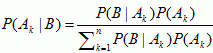
There's a lot of great info in that talk, but the part that grabbed my attention was when Bayes' Theorem was brought up. I don't want to get too much into Bayes' Theorem right now - I might write a blog post about it some time. It looks kinda complicated, but it's actually a fairly simple idea, and it's really really important - in my opinion, it's the hardest math everyone needs to know (even if you don't ever get what all the symbols mean, understanding the idea is important)
Bayes' Theorem - don't get scared by the symbols
Simply put, this is the math behind learning. It talks about how, as you collect information (by observing things, collecting data, reading, listening, etc), you can figure out what the best explanation behind that information is.

Gopnik raises a very interesting point in her talk - perhaps young children have a conceptual understanding of Bayes' Law even before they learn how to count! As they learn how the world works, they actually use the evidence they get to decide what explanation is most likely, and what kind of experiments they need to run to get the evidence they need (8:45~14:35 in the video - the ADORABLE experiment starts from 12:20).

So back to my original blog posts - I proposed that counting actually arises out of a sense of ratio, that ratio is more fundamental than counting in some ways - counting is just a tool that allows you to do more complex things (like arithmetic). But one thing I didn't think of then, that makes a lot of sense now, is that in addition to a sense of ratio, young children likely also have a sense of probability. A very strong one, too - you have to be able to make educated guesses (guesses that have a good chance of being right) in order to learn anything. I think even really young babies understand chance - "if I cry, it's more likely that I'll get food." "When I think the right thing, that weird thing at my side moves. It's probably under my control!" "I hear the sound 'mama' whenever this person is around, so chances are, I should make that sound too."

It's interesting, isn't it, how so many people struggle with division when ratios seem to be a natural part of the way humans think, and how probability just confuses most people when it's supposedly such a natural thought process... maybe this comes from lack of integration of different parts of the mind. Maybe people struggle with division because their natural intuition about ratio is never correlated with the computations they're taught (built up from counting). Maybe probability makes no sense because it's always taught, again, from the foundation of counting, and we don't develop the connection to our natural sense of what should be more probable.

This is still all just speculation. I have no idea if this "multi-foundational approach" to teaching math will work at all. But it seems to me that if we really want students to understand what's going on, rather than just know how to move symbols around, we'll have to connect each topic in math class with a part of their mind that's already used to thinking in that way. That's my hypothesis, at least. We'll have to find some more evidence to get a better idea of how likely the hypothesis actually is.

Sunday, October 9, 2011

The second-most stressful 24 hours of Jesus' life (Part 4)


(continued from Part 3)

Are we still within 24 hours? Well, assuming Jesus heard of John's death in the early afternoon the day before (kind of an arbitrary guess, but reasonable when you consider that the disciples' concern about food would probably have come up around lunchtime, not dinner, if they had crossed the lake in the morning), then yes, this would still be within 24 hours - in fact, it’s just after dawn of the following day.

At this point, it would probably be more effective just to read John 6:25-70, because though Matthew and Mark generically talk about how the crowds gathered, John is the only book which talks about what the discussion at the time was actually about. Plus, I myself don't understand the significance of everything he says in this passage, so it would be better to see it all for yourself. But basically, Jesus is doing his best to convince people that yes, he does want the people to come to him and be fulfilled, but no, his main purpose is not to provide the people with material things. He provides them with a much different picture of what his purpose is - telling them straight up "I'm not going to let you make me king. In fact, I'm giving myself to you to eat - only then will you never go hungry."

Strange? Definitely. And many people turn away at this point. They were looking for a Messiah that did what they wanted - when this Jesus turned out to be radically different, and even weird, when they realized that they had been let down, they instantly dropped their enthusiasm and deserted ship.

Imagine the stress of this moment. All Jesus was trying to do was to tell people the truth, to tell people what was really good for them, what would save them... but rather than finding hopeless people and giving them hope, all he seemed to do was take mobs of extremely hopeful people and make them turn away in hopelessness. Some success THAT was. After the months, the years perhaps, of gathering followers, of speaking to crowds, of being loved by the people, he decides that instead of doing the temptingly glamorous thing (becoming political ruler), he would stick to his main purpose - and he lost many of his devoted followers. His very purpose was to bring people to God - but by living out that purpose, he turned people away. Maybe he knew that would happen. Maybe he came to terms with the fact that this would have to play out that way. But he loved these people, and to see them turn away from such a direct offer of life and relationship would have deeply saddened him. You can feel the hurt in Jesus' voice as he turns to his twelve "most loyal" ones and asks "You do not want to leave too, do you?"

"Most loyal" ones, eh?

The ones who cared more about their own time alone than about the masses of people looking for hope?

The ones who screamed in terror when Jesus approached them?

The ones who let the fear of waves overcome the trust in their Lord?

The one who, Jesus knew, would turn Jesus over to those who wanted to kill him, in the most stressful 24 hours of his life?

Jesus must have felt so incredibly lonely at that point. Before, when he wanted to be alone, he was faced with multitudes of people who needed him. Now, when he desperately wanted to see people come to him, he saw them all turn away - the only ones left were cowardly and untrustworthy. As he asked, "You do not want to leave too, do you?" it's almost like he expected them to walk away as well.

But I'm sure Jesus found solace in this:

"Simon Peter answered him, 'Lord, to whom shall we go? You have the words of eternal life. We have come to believe and to know that you are the Holy One of God'" (John 6:68-69)

To this, Jesus responds "Have I not chosen you, the Twelve?" In other words, "I knew what I was doing." Sure, these are plain, unrefined, cowardly, untrustworthy people - but that's all Jesus needed. Just as he only needed a small packed lunch to feed thousands of hungry followers. When God is involved, your perspective totally changes.

And you know, I think that's how Jesus was able to make it through this stressful 24-hour period. After hearing about his friend and supporter's death; empathizing with his tired disciples and with crowds searching for hope; resisting the temptation to take the time alone to grieve right away; organizing thousands of people into small groups; somehow distributing thousands of meals from a single serving; learning that people were about to force him into the role of king; pulling an all-nighter; seeing his most trusted followers cower in fear; trying to explain his purpose to people who wanted to fit him in their own little box; watching people turn away from the truth; and knowing that one of his disciples would eventually betray him - through all that, he had his perspective right. He knew what was important in the end - that not much was needed to get him through incredibly heavy stress. The "small" things - his night of prayer (although that was, admittedly, not exactly "small"), Peter's confession of faith, the opportunity to teach - these made it all worth it. These gave him the strength to endure. Because with God in the picture, even the small things can make all the difference. The single serving of bread and fish made up for the masses of hungry people - because they were dedicated to God, and God knows how to multiply. A few uncultured and weak disciples made up for the masses that turned away - because they were dedicated to God, and would later be used to change the world.

Does believing that Jesus faced stress like this make him somehow less dependable? By no means. If anything, it makes him more dependable - if he remained true to his mission in the face of this unbelievable stress, it means that he understands what we go through. It means he knows our stress, and also knows how to handle it; and as we get to know him more, we'll learn from him how to handle it better too. God wants us to be more like himself, more reflective of who he is in every way - including dealing with stress.

Again, this is largely my own interpretation. I don't know if these all happened in a 24-hour period, and I definitely don't know if Jesus reacted the way I said he did most of the time. And it's also possible that you don't believe any of this happened at all, or at least, that the stories were tampered with and exaggerated. But at the very least, I hope this made you view stress, and Jesus, in a new way.

The second-most stressful 24 hours of Jesus' life (Part 3)

(continued from Part 2)

Just before dawn, Jesus has been so spiritually refreshed and regenerated that he goes out to meet his disciples by walking across the stormy lake. They scream in fear of him, and he has to reassure them that he's not a ghost. One of his disciples climbs out of the boat to walk towards him, but almost drowns because he let fear of the waves take over him. Essentially, these events confirm the fact that Jesus' disciples are cowards. Even if he knew that already, that must have been slightly frustrating ("You of little faith," Jesus asks in Matthew 14:31, "why did you doubt?"). It seems like the stressors just keep on coming.

So they get to the other side of the lake, and as soon as they arrive, everyone hears about it, and soon enough, the crowds have arrived again. But this time, they're more crazy than ever. They've just seen something that could solve the problem of world hunger once and for all... or at least, solve their own hunger. Just about everything the people say in John 6 has something to do with food. But there's another point that I hadn't realized at first, until reading Philip Yancey's The Jesus I Never Knew.

The fact is, the Jews in that time were eagerly awaiting a Messiah - the "anointed one" - someone who would be fully endowed with God's power in order to re-establish God's kingdom on earth. More precisely, the people were looking for someone who would restore Israel to, and beyond, its former glory. Someone who would throw off the hold of the Roman dictators who currently ruled the land, and be king of the Jews. They wanted a military leader.

Jesus claimed to be the messiah. He performed miracles. He healed the sick. He fed his people. And... he had the people sit down in organized groups of fifty to a hundred people before he fed them.

It seems a small point - I missed it the first time through. First of all, this would be another stressful thing - if you haven't tried it before, you have no idea how hard it is to divide people into groups. I was in student council, and sometimes the events we led required dividing the people into groups - SO much stress in that simple activity. I can't imagine how tough it would have been to get over five thousand people into smaller groups.

But another, more significant point: no matter how you look at it, organizing people into groups is not something a generic wise sage would do. This is the action of someone who wants efficiency - who else but a military commander? Imagine the excitement the people must have had as they sat in groups, like an army - only to have that excitement doubled by all getting free food from their general. This Jesus, who had just gone around teaching people at first, was finally getting his people organized into centuria (divisions of 60, 80, or 100 soldiers in the Roman army - the analogy is obvious) - clearly he was about to declare war on the Romans any moment now!

In fact, John (the book, written by the disciple, not the baptist) gives another reason Jesus dismissed the crowds so quickly - according to John 6:15, Jesus knew that the people were about to force him to become king, which was totally against his goal in coming to earth.

Jesus almost couldn't care less about politics. Whenever someone said something to get him riled up about the Romans, he never said anything remotely rebellious. When someone asked him if taxes should be paid to Caesar, he said yes, since the coins had Caesar's picture on them. "Give to Caesar what is Caesar's and give to God what is God's" (Matt. 22:21). Nothing about economics, nothing about the rights of the people - he didn't care about "Caesar's things." Jesus was concerned about what belonged to God - which is why he got mad at the Pharisees, not the Roman centurions. Why he overturned tables in the temple, not in the Roman puppet-king's palace. I don't think we should take from this that we should ignore politics or economics - these are important parts of the world we live in, and to properly glorify God, we ought to manage these systems well. But that clearly wasn't Jesus' goal. He came to spread God's kingdom, not as a nation conquering territory, but as a gift of supreme grace conquering the hearts of any who chose to accept it. Becoming a political ruler would be totally against that purpose.

So I'm assuming that in his intense prayer night, he not only was trying to recover from the shock of John's death, he was also desperately asking for the strength to stand up against efforts to make him political king. I'm sure he felt the temptation to give in - he felt it before (Luke 4:6-7), and even though he knew his purpose and he wouldn't give in, dealing with temptation is stressful.

Now back to the mob of fanatical people, looking for a political leader who would keep his people fed and lead them to military victory.

(continued in Part 4)

The second-most stressful 24 hours of Jesus' life (Part 2)

(continued from Part 1)

So why would Jesus decide to spend an entire night in prayer?

Let's backtrack a bit. One of the reasons Jesus was trying to get away from the crowds originally was for the disciple's sake, to let them rest. But there was actually another reason behind the decision to cross the lake - one that affected Jesus himself. Matthew and Mark (and Luke, in passing) describe what happened just before Jesus crosses the lake - John the Baptist was beheaded.


You have to understand the relationship Jesus and John had with each other to fully grasp the significance of this. Jesus' mother, Mary, and John's mother, Elizabeth, were cousins, who knew each other very well. It's recorded that Mary spent three months of her pregnancy with Elizabeth (likely because she thought Elizabeth was the only one she could trust in her situation), and they were both pregnant at the same time - as such, it's very likely that Jesus and John knew each other from as early as they could remember. They probably played together and learned together. John was son of a priest and Jesus the son of a carpenter, so there was a difference in class, but it's clear that that didn't concern either of them. John ended up abandoning his priestly life to live in the desert, preparing the way for Jesus to start his work; and when Jesus was ready to begin, John was the one to baptize him. John had the utmost respect for Jesus ("the straps of [his] sandals I am not worthy to stoop down and untie" - Mark 1:7), and Jesus always spoke very well about John ("I tell you, among those born of women there is no one greater than John" - Luke 7:28). John was perhaps the only person alive at the time who truly understood who Jesus was.

John was put in prison for standing up for what was right - in amazing courage, he told off the regional king for having an affair. But John died for no good reason - he died because a drunk king made a silly promise that a moody woman could take advantage of. And soon after, Jesus heard about it. He got the news that his strongest supporter and (most likely) best friend had been killed.

What would you do if your best friend just died - not out of bravery, not from an accident or sickness, but because a drunk guy wanted to keep up his reputation? Think about it for a second.

Now imagine that, in addition to that, crowds of people, totally oblivious to the news, are coming up to you, asking for something... help with homework, your autograph, the latest gossip, whatever.

Wouldn't you want to get away from it all? Spend some time alone? So you can scream and cry about the injustice of the world in solitude?

I figure that's exactly what Jesus wanted to do. In fact, most likely, he intended to cross the lake, get off at the other side, leave his disciples, and go straight to spending hours in prayer. Not the "Dear God, thank you for your blessings... please help me to... Amen." kind of prayer, but a complete release of emotion; a laying out of his soul before his Father. He probably wanted to scream "WHY?!", to sit there weeping, and to find peace in his heart again before he returned to his ministry. To refresh his emotional strength, which had been drained by the news, but also his spiritual strength, which had been drained by the sheer force it took to forgive the people responsible for John's death. This, readers, is stress.

Some people might feel uncomfortable while reading this - I'm almost making Jesus look weak, like it's hard for him to forgive, like things can scare him or even make him question God's plan. Maybe I'm wrong; maybe Jesus was able to stay totally cool the whole time. But though I believe Jesus was God, I also believe he was human - and part of being human is being outraged. Being scared. Crying. Struggling. And other places in the bible record him doing these exact same things - being filled with anger, pleading with God to change his mind, weeping. So why not here too, after his best friend's death?

Now, the fact that he took his disciples with him in the boat is pretty extraordinary - it shows that even in the midst of this incredible pain and suffering, he saw the stress of the people around him, and realized that they too, needed some time away from the crowds, even though their stress was just from being too busy, not from an emotional loss. And when he arrives at the other shore and - surprise surprise - sees the crowds waiting, keeping him from his time alone in prayer, he doesn't try to run away - he has compassion on them. Nowhere is the "you don't understand what I'm going through;" he doesn't even say "I'll be able to help you better once I've calmed down a bit," he just sits down with them and starts teaching them.

Imagine the temptation Jesus must have had to send the crowds away as soon as his disciples asked him to do so. Imagine how alluring the silence would have been, the chance to spend time crying in his dad's arms. But no; he forces the disciples to get involved, to think beyond themselves, and in doing so, has to get more involved himself.

Was that healthy? Many psychologists today would say it wasn't - that you shouldn't overwork yourself, that when you're stressed, you have to stop and rest, to avoid burnout. Even if you're doing very good things, you have to stop if it risks your own health.

I don't know how to reconcile that with what Jesus did. Should I follow his example? Or should I be concerned enough with my own well-being to stop doing something good once it starts to pressure me? Maybe Jesus just knew that both he and his disciples could handle the extra push... I don't know.

But at any rate, the miracle goes over well, the crowds are well-fed and excited (as we'll soon see, perhaps too excited), and as quickly as he can, Jesus sends everyone away. He knows he's near his human limits. He has to get away and pray. And pray he does. For nearly eight hours, until he is fully refreshed, emotionally and spiritually. But even now, I suppose that he still would have been feeling the physical effects of sleep deprivation, and the sort of empty exhaustion you feel after completely releasing all your emotions - a very satisfying feeling, but tiring nonetheless.

So yeah, that's pretty intense. But guess what, the 24 hours aren't over yet, and neither is the stress!

(continued in Part 3)

The second-most stressful 24 hours of Jesus' life (Part 1)

I think we can all agree that Jesus' life was by no means easy. When you look at all he did, and all he had to go through, whether you're a Christian or not, whether you believe all the accounts of his life or not, there's no way you could say he didn't struggle. And to anyone who knows anything about Jesus' life, it's almost a given that the 24 hours before his death would almost certainly have been the most difficult 24 hours in his life. The agony he felt before anything even happened to him was enough to make him sweat blood, and yet his three closest followers fell asleep when he most needed their support; one of his twelve followers betrayed him into the hands of enemies using a symbol of friendship; none of his disciples stood by him when he was taken; he was sentenced to murder for extremely sketchy and unjustifiable reasons; he endured humiliation and torture beyond the legal limit at the time; he hung in one of the most excruciating positions ever devised for hours until his death; and perhaps most painful of all, he felt guilt for the first time ever as all the sins in the history of the world were laid on him. To say his last day was stressful would be the ultimate understatement.

But as I was reading some of the gospels, another day really stood out to me as a point which, the more you look into it, also looks unbearably stressful. I'm referring to the 24-hour period in which Jesus fed 5000 men from five loaves of bread and two fish - recorded in Matthew 14, Mark 6, Luke 9, and John 6.

So what exactly happened in this 24-hour period that made it so stressful? At this point, I'm actually going to take a bit of liberty in my interpretation of the bible (better to tell you that straight out), because I actually don't know if everything I'm going to talk about occurred in the same day. If there's one thing you learn from reading the gospels, it's that chronology wasn't the main thing on the writers' minds - to them, what happened and who did it was much more important than when it happened. Except perhaps for Luke, the doctor who "carefully investigated everything from the beginning" in order to "write an orderly account" (Luke 1:3) - but even he was just collecting memories from eyewitnesses, not recording the events as they happened. So it's impossible to know what order all the events actually happened in - but the more you find similarities between the different accounts, the more you can assume that they happened in that order. If the 24-hour period really did progress in the way I propose it did, then it would have had more stressors than almost any other similar day you could find recorded in Jesus' life, other than that of his death. But even if it didn't, you can still probably learn something about Jesus and how he handled difficult situations.

All right, enough with the technicalities. Let's see what went down in Galilee that day.

Jesus leaves in a boat across the Sea of Galilee in order to be alone; to take a break from noisy crowds and spend some time with just him and his disciples. Mark and Luke both say that this was just after Jesus' disciples came back from some amazing (yet certainly tiring) experiences, going around proclaiming who Jesus was and performing acts of power in his name, but that the crowds were too excited to give them even a chance to eat, let alone rest. And in fact, though they sail all the way across to the other side of the lake in order to have some peace and quiet, the crowds travel around the lake just to catch up with them.

So here Jesus is, facing this crowd of crazed people, disillusioned by life, desperately longing for someone to lead them - and Jesus, though he wanted to be alone, has compassion on them. He stays with them and teaches them for hours on end, and they eagerly swallow up his words.

His disciples come up to him, asking him to send the crowds away so they can go into the nearby villages and buy supper because it was getting late. Which sounds nice on the surface. But you learn something as you read through the gospels - with a few exceptions, people who interact with Jesus are always wearing some kind of mask. What they say is hardly ever what they mean - they claim to have good motives to hide selfish intentions; they ask tricky questions that they don't really want answers to; they talk about the abstract in order to direct attention away from their personal life - but Jesus always slices right down to the heart of the issue. Even the people who have been with Jesus for years don't seem to understand that he can see right through them.

So here are the disciples, asking Jesus to send the crowds away (so they can buy supper). They probably did care about the people somewhat, but it's not too hard to think up another possible motive - they wanted to be left alone. These ordinary people Jesus calls his disciples - fishermen, tax collectors, etc. - have just spent weeks doing intense travelling, speaking, and healing, way beyond anything they ever expected they would do, and were looking forward to some time to rest - and these crowds are keeping them from relaxation. They've had enough of masses of people. So they tell Jesus to send them away.

They don't want to be involved with the crowds. So how does Jesus respond? I mean, he did take them away in the boat to be alone before, so wouldn't he support their wish to be alone now? But for whatever reason - maybe to reveal their mask, maybe to teach them something about compassion - He makes them get as involved as they could possibly get... "you feed them."

Typical. Jesus always does that - tells people the exact opposite of what they want to hear.

Now, there's a lot of insight to be gained from this short, simple event, about trust, about power, about compassion, about prayer, about submisssion, but I'm sidetracking from my original point - to talk about why this 24-hour period was so stressful. So here's a quick rundown of the rest of the story: the disciples freak out at Jesus' request. So Jesus just asks them for what they've got - turns out one boy (out of thousands of people) was smart enough to pack some food. Jesus is satisfied; he divides the people into organized groups, gives thanks for the food, starts distributing this boy's meal... and everyone somehow has enough to eat. The disciples then went around picking up basketfuls of leftovers.

Immediately after this happens, Jesus sends his disciples away on the boat and dismisses the crowd. Which is kind of odd if you think about it - Jesus did everything - traveling, sleeping, talking, eating - with his twelve disciples. But now he sends them away, and goes off on a mountainside to pray. Now, this isn't odd in itself - there are other instances of Jesus spending time alone in prayer. It seems likely to me that he would have spent hours every day in time alone with the Father - and every waking second in communication with him.

But what is odd is the amount of time he spends in prayer this night. He starts in the evening, just after everyone's eaten the miracle meal and gone home. And he stays there until just before dawn. 4 in the morning. That's like 8 hours in prayer. Now, Jesus was fully human. Meaning he needed sleep in order to keep his biological processes going. Meaning spending the entire night in prayer is not something he'd do all the time, especially considering how busy his days were. So this is something special. He must have a good reason to want to spend this night in particular in such deep connection with his Father...

(continued in Part 2)

Friday, September 23, 2011

Pigeons and Force Fields

So there are four fundamental forces of nature, supposedly. Gravity, electromagnetism (which pretty much is responsible for every force we experience except gravity), the strong force, and the weak force. For each type of force, particles can have a field around them of that force (e.g. gravitational field, magnetic field, electric field, etc), which affect other particles in the field. But what I've recently discovered is that PEOPLE have a field of force around them that ISN'T ANY OF THE ABOVE. Yes, we have gravitational fields around us, and electric and magnetic fields (weak though they may be)... but there's another force of nature surrounding each human being. It seems to always cause a repelling force most of the time (like the electromagnetic force with like-charged particles, or like dark energy, not so much like gravity); and like gravity and electromagnetism, this force is inversely proportional to some power of distance (most likely 2, but I have yet to experimentally prove this... a possible experiment is discussed below)

Evidence? I've got plenty. Everything I'm going to say, you already know to be true - you've just never realized the implications of it.

FACT 1: People in a small enclosed space (such as an elevator) spread out so as to evenly fill the space.
EXPLANATION: This is exactly what a repelling force, inversely proportional to distance, would be expected to do. A system of electrons constrained to a given space, will naturally develop over time into a configuration of least potential energy - essentially, when the electrons are as far apart as possible. Once it reaches this position of equilibrium, any change in the system will result in two charges being brought closer together, giving a higher potential energy - which can only happen if some external force is applied. Of course, the electrons may not actually find the "best" arrangement; the most one can say is that they will achieve a local minimum of potential energy.
Likewise, in an elevator, people naturally arrange themselves to be in a position of furthest distance from their neighbors - maybe not the best possible configuration, but a configuration in which any change would only bring two people closer together. If my theory is correct, this can easily be interpreted, as above, as finding a local minimum in the potential energy of the system. And when new particles (humans) are introduced to the system, or when particles (humans) are removed, the system rearranges to find a new local minimum in potential energy.


FACT 2: Bringing people together causes complex phenomena.
EXPLANATION: Considering the above result, one may then ask "if the force field surrounding humans is a repelling force, then what brings people together?" The simple answer is that there are many other variables, many other forces at work besides just the predictable, natural "human force" I'm postulating. For example, a force of friendship may easily overcome the natural human force field; and the force of gravity will clearly overcome this force field if one human is positioned directly above another with no solid object in between. The human force is a comparatively weak force - its effects only come out in situations in which no other force can override it (such as in a closed elevator, in which the only other significant forces are vertical - gravity and the normal force - so the horizontal effects of the human force field may show).
But a more complex and enlightening answer is a direct result of the repelling nature of the force - In any system in which a repelling force is the dominant force in question, then smaller distances will result in higher energies, and thus more complex behavior. Consider, for example, how two colliding molecules don't just bounce off each other if a certain energy level (the activation energy) is reached; they may undergo a chemical reaction. And in high-energy particle collisions, higher energies will result in more complex results, which is why further research can only happen when higher-energy particle accelerators are built.
So what does this mean for humans? Well, as mentioned in the explanation of fact 1, without the application of some external force, humans will naturally stay apart from each other. But if some force is applied, two particles can actually be brought together; and if the inverse relationship between force and distance holds, this will result in a higher potential energy. Potential energy will equal the ability for a system to do work - so when people are brought together, and the energy of the system increases, more work can be done by the system.
This, essentially, is how civilization was possible. This is the physical basis of sayings such as "two heads are better than one" and "the whole is greater than the sum of its parts." Bringing people together results in, quite literally, a large potential. Potential energy can be converted into many different forms - which is why people in groups can achieve so much. Rather than seeing the natural repelling force as a reason for humans to stay apart, it should be seen as a reason to come together - because for forces inversely proportional to distance, energy is stored in the force field, and the energy is larger if the distance between particles is smaller.


FACT 3: Animals tend to "bounce away from" humans, even at a distance.
EXPLANATION: This was actually the inspiration behind the discovery of this new kind of force. Animals too, seem to be affected by this human force field (perhaps all conscious life forms actually have this field around them?). There are actually many different reactions of animals towards humans - some attack, some run up with wagging tail, some instantly dart away, etc. - as mentioned above there are countless other forces at work in determining how a given animal responds to a given human, and most will override this realtively simple human force. But we can find a "control" case in a particular species which is neither domesticated nor wild - neither friendly to nor completely fearful of humans - the pigeon. This species likely has the simplest, most repeatable (and therefore testable) reaction to human beings out of any vertebrate; barring the imposition of additional variables (such as bread crumbs), the behavior of pigeons can give us the most raw data about the way this force surrounding human beings truly works.
Imagine approaching a stationary pigeon at a relatively low velocity. There will be a certain distance, an "event horizon" if you will, at which the pigeon will begin to move away, but then return to being stationary. The "event horizon," in this case, is the distance at which the human force is equal to the other forces acting on the pigeon (such as the unwillingness-to-move force), resulting in a net force of 0 on the pigeon; once the distance of separation is smaller than this distance, the human force becomes stronger than the other forces acting on the pigeon, causing a net acceleration away from the human, until it is far enough away that the other forces once again overcome the human force.
An analogy to magnets would be helpful. Imagine slowly bringing one magnet A closer to another magnet B, with like poles facing each other. Up until a certain point, magnet B will remain stationary. Only once the distance of seperation is small enough so that the magnetic force can overcome the force of static friction acting on magnet B will magnet B move away from magnet A, just to, once again, remain stationary.
Now, if you move magnet A close to magnet B really quickly, magnet B will respond with a higher acceleration away from A, because the quicker you are, the closer A can get to B before B can accelerate away, resulting in a stronger force on B and more pent-up energy, which will give B a stronger push. This behavior can also be seen in pigeons - the faster you approach them, the faster they move away. In fact, up to a certain critical distance, the behavior of pigeons near humans is very much like the behavior of a magnet in another magnet's magnetic field. They literally "bounce away" from the human's force field, and bounce off faster if the human moves towards them faster.
At a certain critical distance, something unexpected happens - the pigeons change modes of transportation and take flight. But this is exactly what I mentioned in Fact 2: once a certain energy threshold is reached, behavior may drastically change. In fact, in a way that is very analogous to the pigeon, string theory predicts that at high enough energies, a collision between high-speed particles may actually send gravitons out of our regular three dimensions, so as to be unobservable. Analogous to the pigeon, I say, because a high-energy encounter with pigeon and human will send the pigeon out of the regular two dimensions of interaction (confined to staying on the ground) to a third dimension, resulting in completely different behavior.

The above fact leads to a possible experiment. Roughly stated (I'll have to work out the precise details on my own), we would approach a given pigeon at different constant velocities, and observe the velocity of the pigeon at various points in time throughout the interaction. By calculating the acceleration from the velocity data, we will be able to calculate the force acting on the pigeon at each point in time. Comparing this force as a function of time to the distance of separation between human and pigeon as a function of time, we may be able to determine some form of relationship between force and distance.

This would have to be tested on many different pigeons, because each pigeon will have a different reaction to the human force - likely due to an as yet unknown property, similar to mass and charge, that can be calculated into the force formula. However, when we do the above analysis on a given pigeon's motion, this property (assuming it is constant) should cancel out when various data points are compared with each other, yielding a pure ratio between forces and distances - the relationship between forces and distances can be analyzed to see what the precise relationship between force and distance is. (I hypothesize that it is, like gravity and electromagnetism, an inverse square relationship).

I still have a long way to go before this theory is completely developed - I hope to perform the experiment sometime soon (though I lack sufficient tools to perform it with much accuracy), and this will give me the mathematical foundation to this otherwise very qualitative theory. But I'm convinced that either the data will support this theory, or lay the groundwork for an even more profound, effective theory.

Call me crazy if you will. But mark my words: by the time I'm done... you'd be right.

Squirrels

I saw a squirrel army-crawling through the grass today. It found a giant dead leaf (bigger than the squirrel), and pounced on it, rolled over on its back like a cat playing with a ball of yarn and started munching on it. I almost laughed out loud.

Friday, September 16, 2011

Math homework

"ugh" is probably the most common reaction to the title of this post (including synonyms). Most people just don't like math homework. In fact, you may think "only people who love math would like math homework." Well... even some people who love math don't like math homework. Good example: me in high school (I'll get to me in college later on).

Yes, that's right, I didn't like math homework. Somehow or other, I managed to put aside my dislike of the problems and focus on the math itself, which I found much more beautiful, quirky, and open to exploration and discovery. I did far more math than math homework in my high school years (as evidenced by literally hundreds of pieces of paper covered with tiny mathematical scribbles, none of which had anything to do with what I was learning in school - the following is one from back in 8th grade):


So people may ask - how? How could I put aside my dislike of the boring set of problems that had to be solved every day? How could I look through the giant obstacle of daily assignments that blocks so many other people from ever appreciating the cool stuff behind it?

And what I've recently realized is... I kind of cheated a bit.

A bit of background first. I've always liked math. From before I was even in elementary school, math was something I found interesting. Sometimes, it was just because I felt I did it well, so it made me feel good about myself. Sometimes it was because I felt it connected things well, or had interesting results. There were various reasons for my enjoyment of it... but it wasn't until 8th grade that I REALLY started getting into math. Up until 7th grade, I was doing the stuff everyone else was doing. Perhaps I did it better than average, or got the concepts quicker, but I was learning 7th grade stuff - figuring out how to work with variables, dealing with different types of numbers (negatives, irrationals), plotting points on the coordinate plane, and so on. By the end of my 7th grade year, I was really good at 7th grade math - no more than that. But within half a year, I had taught myself calculus. That's... a big jump.

Almost all the credit for this rapid change goes to my 8th grade math teacher, Mr. Finlay. I didn't realize it at the time, but what he did for me, essentially, was pulverize any ideas I had that math was to be learned in a strongly structured way. I started the school year at a new school in Canada (I was in Japan previously) and was given a 9th grade math textbook - no testing out of 8th grade math, no asking me if I thought I was ready, nothing - I was just put into a class of 8th graders learning 9th grade math (though some were working on 10th or even 11th grade math at the time). I accepted the challenge, and started working on 9th grade math. About a month into the year, Mr. Finlay pulls me aside and says "You don't seem to be having any trouble with this stuff. Why don't you take the 9th grade test and we'll get you started on 10th grade math?" And so, a week later, I got the 10th grade textbook. I officially stayed at that level through the year - but that sudden jump, from 7th grade to 10th grade math in just a couple months, gave me a lot of momentum, and I just kept moving. Kept exploring, kept discovering - until, as I mentioned, I learned calculus over Christmas vacation. Not well enough to take the AP test, definitely - I couldn't integrate anything more complicated than a polynomial, for example. But for the first time, I was hungry for math, not just interested in it. I basically ignored the textbook that whole year - and Mr. Finlay didn't mind at all. He knew I was learning more than the textbook could teach me.

Fast forward to the beginning of 9th grade - return to Japan, to a smaller school with fewer resources, and therefore a more structured learning environment (it takes a lot of resources - time, people, books, training - to provide a program that can be personalized to fit every student's learning style). After some hard work, I managed to get into 10th grade math (again). A bit of a step back in some ways, but it was definitely a new experience to be learning with people a year older than me, and I learned a lot that I never would have otherwise. I had a math teacher named Mr. Mhlanga, and he, like Mr. Finlay, understood that I didn't need the textbook problems in order to learn, that I was getting somewhere on my own. So he let me get away with not doing much work. Same in my 10th grade year, when I took AP Calculus AB - again, Mr. Mhlanga was the teacher, and he emphasized taking charge of your own education, meaning "do what you know you need to do." He graded very little - so I did very little, and did fine. 11th grade, I took AP Calculus BC... which wasn't actually a class at my school, so it turned into a study hall in which I basically didn't do calculus. And then in 12th grade, I had no math class.

So what do I mean by "I kind of cheated a bit?" Basically... I haven't done math homework regularly since 7th grade. :p

And it was after 7th grade that I started really getting into math.

Coincidence? Maybe. But that's not my point. What I meant to talk about is where I am now...

Do I like regularly assigned math homework now that I'm out of high school? I actually don't know. After not having done it regularly for five years, maybe my thoughts on it have changed. Maybe all the time I spent away from it, getting a solid foundation in other ways of doing math, will make me appreciate the math behind the assigned problems more. Maybe the fact that college problems are more interesting than high school ones will give me more motivation. But it could be the other way too... five years without regular math homework means five years of losing my touch. I'm not used to doing regular homework problems any more. Getting back on track could be very hard, very painful, and just make me hate regularly assigned problems even more. Which will it be? So far, I've done one assignment for each of my two math classes (both a week early!), and it's actually been pretty fun so far. But the real test will come once I have to start doing them over and over and over and over again. Will the novelty wear off? Will I get bored or frustrated? Or will I continue to find the problems invigorating? We have yet to see. I'll let you know in a couple of months.

Tuesday, September 13, 2011

Obviously.

So this past week has been packed with stuff. I arrived at my dorm, had an incredibly busy six-day orientation (each day started at 9 AM and only one ended before midnight), met up with a friend from Japan for a day, and started attending courses. And now I have a bit of time to write... but, as you probably know, the more there is to write about, the harder it is to choose a topic.

So I'll just talk about an interesting thing I noticed in one of my classes - Algebra I it's called (and no, this is not the same as the Algebra I you learn in middle or high school). At one point, the professor was defining a union of sets - basically, if you have two collections of objects, then the union is what you get from putting all those objects together into one collection. More formally, "the union of X and Y contains all elements z such that z is an element of X or z is an element of Y." Now, he had a lot to cover, so he just zipped through the definition, and throughout the talk, he kept referring back to it, but I noticed something interesting - he never clarified what he meant by "or."

Now, I've seen unions defined before, but the first time I learned it, it was carefully explained that "X or Y" in math meant "at least one of them." This is very different from how or is usually used in English - when someone asks "coffee or tea," "both" is usually not considered as an answer. You may talk about "the answer is B or C" - that means one or the other, not both. If you ask "should I give money to Steven AND Stephanie," the answer is yes or no, but if you ask "should I give money to Steven OR Stephanie," it's not a yes-or-no answer - you have to choose one or the other. In regular English, OR means "pick only one," which is very different from the "or" mathematicians use.

I really wasn't sure what to do - I'm sure most people in the class knew what the professor meant. But if anyone in the class thought that the "or" meant "only one, not both," they would be stuck with that for a long time - small misconceptions such as this, I know for a fact, can cause huge frsutration and confusion about math. So I decided to bring this up - I asked the professor "Just to clarify, the 'or' you're talking about is an inclusive or, right?" hoping he would use the opportunity to explain the language more clearly.

And he did - but in an odd way. He explained to the class that yes, in fact, "or" can have two meanings - and that in logic, sometimes people use the exclusive or, "xor," which means to pick one or the other but not both. "But," he said, "for this, I'm using the usual version of 'or,' meaning in one, the other, or both."

[oomph moment here]*

The usual version? To professional mathematicians maybe... but what about to students who've never gone beyond basic high school math, and have never seen Boolean operators or logical statements? Yes, if these people are going into math, they'll have to be taught what "or" means in a math context - but that's something that needs to be taught, not assumed.

Basically, the professor forgot what it's like to be "normal" - when you spend your life around a specific group of people, and you learn to think like them, you forget about what the "normal" way to think is (and I won't go into a huge discussion here about "what is normal" - just bear with me on that)

Nothing against the professor - in many ways, he teaches really well. The main reason I bring this anecdote up is because it's a great illustration of what happens more generally - there are many people that get so involved in a specific group that they forget what it's like to be outside the group, even if they were outside it once. They assume that what's obvious for them would be obvious to anyone. I'm sure I do the same thing - the scary part is that, by definition, I wouldn't know if I'm doing it. If I think something's obvious, I wouldn't give it a second thought. So basically, this served as a reminder to question the obvious - not necessarily to question its truth, but to question its obviousness. Maybe it'll turn out not to be true - then good for me, I've learned something. But if it is true, then questioning its obviousness will make me realize that this truth is not something to take for granted - that it's much deeper, more amazing and profound than I ever would have thought.

*I'm sure there's a better term for it, but I'm going to use "oomph moment" to mean a point at which I say something that's really mind-blowing, bizarre, incredible, strange, surprising, ridiculous, or otherwise thought-provoking - it means "stop and think about what I just said - if you understand the significance, it should be a big deal, maybe even a bit of a shock. If you don't understand, don't worry, I'll explain it right away"

Sunday, September 4, 2011

Thoughts on an Airplane

First, reasons I like window seats.
- the view. I loved it as a little kid, and I still love it now. This past trip (flying from Calgary to Toronto) was probably one of the best  I've had in a long time- as we took off, there was a perfect view of almost the entire city of Calgary, with the snow-capped Rockies in the distance (truly awe-inspiring). Flying over the prairies is an interesting experience... you know when you look at satellite images on Google Maps or Google Earth and the land looks like a haphazard patchwork of rectangles? Well, the prairies actually look like that. And completely flat in all directions. Kind of dizzying. The approach to Toronto was cloudy, but very high clouds - once we got in low enough, there was a perfect view of the huge city. We actually had to fly past the airport, turn around, and come back, so from my window, I got to see the whole city, and many parts of it twice - resorts, amusement parks, vast neighborhoods of houses, complex road junctions, huge train yards, factories, etc. And off in the distance, by a body of water that stretches off to the horizon, a black silhouette shrouded in cloud, the lone spike of the CN Tower, stood proudly yet ominously in the distance. So exciting.
- you can have a larger carry-on. I always pack my backpack too full, so it doesn't fit under the seat. When I have an aisle seat, the flight attendants always get concerned that it's a hazard - but by the window, no one cares if the backpack doesn't fit.
- you never have to be bothered by people who want to get out to go to the washroom or by flight attendants reaching over you to give other passengers refreshments.
- related to the two above, but you can make your space "yours" - keep your tray down, take your shoes off, do whatever without worrying that it'll get in the way of other people.
- while there's not quite as much leg room as in an aisle seat, the wall of the airplane curves outward a bit, so there's room to nestle an extended leg between the seat in front of you and the wall.
- you can take your time getting off the plane, without worrying about whether the people further in need to get somewhere quickly.

In the end, the only main downside to having a window seat I can think of is guilt - whenever you need to go to the washroom or get something from a flight attendant, you feel bad about bothering the people beside you.

Now, my particular window seat wasn't as great this ride because it was the only seat in the plane where the in-flight entertainment system wasn't working. But every annoyance is a blessing in disguise - I used the chance to sleep. Or to try.

School buses look like yellow pastels from thousands of feet in the air. Especially when there's a bunch parked beside each other.

Lesson learned - if there's not room for your carry-on in the overhead compartments directly above you, find an empty spot closer to the front of the plane, not further in the back. I learned this the hard way, and had to wait until every other passenger was off the plane before I could go back and get my stuff. First time being the last passenger on a plane.

Sorry, I tried to think of some deep philosophical connection between an airplane and life, but nothing profound came to mind. I hope you enjoy these simple, down-to-earth (pun intended) thoughts instead.

Saturday, September 3, 2011

Number Sense Tester

As mentioned in 1, 2, 3... not the best place to start? (Part 2A), I decided to make a basic number sense tester. It's inspired by the one found here - but with a few things I thought should be changed.

So without further ado, here it is. Note that pressing Space Bar (when you're not in the middle of a test) lets you fiddle around with some options if you want to.

A few basic modifications I made...
(1) more dots. The other number sense tester could only go so far; this one can show up to 500 of each colour, allowing extremely small ratios to be tested. If you want to limit yourself to 20 anyways, press space bar and edit the "max. number of dots of each colour" field. For most purposes I've found you don't really need more than 100.
(2) different background colour. The original uses #666666, or 40% gray (from 0% black to 100% white). But with this, the yellow stands out too much - some very basic testing showed that of all my incorrect answers, about 80% would be because I saw too much yellow. Conversely, if the background were white, the blue would stand out too much - 75% of my incorrect answers were because of seeing too much blue. The colour I ended up choosing - #AAAAAA (67% gray) was the best I could find to show blue and yellow fairly equally.
(3) ratios. Simple - just divide blue dots by yellow dots (or the other way around, depending on which has more)
(4) calculating skill level. This was the hardest part - to find a way to take all the results and calculate about where your skill level is. Much thanks to the Mathcamp alumni mailing list for helping me figure out how to go about calculating that.
(5) providing tests based on skill level. Whatever your skill level is, you'll be given a couple questions just above it and a couple just below it, so you're always at a place you're comfortable with.
(6) options. Press space bar to change things... maybe you'll discover something by tweaking the options a bit. Can you get a better score if you have fewer (or more) dots? Does the relative size of the dots make a difference? Try it out for yourself.

This was mostly just for fun, so chances are I won't come out with an updated version, even if I do find ways to make it better... but if you have any comments or suggestions, I'd love to hear them!

Friday, September 2, 2011

Question Time! Tonedeaf Overtones

"just wondered do you think its mathematically/physically possible to make a single note thats in disharmony with itself? like the close overtones in it are not in harmony?" - Philip Chuah

Answer: YES.


Brief intro to overtones: Everything you hear, you hear because something is moving, causing the air around it to move, which pushes a wave of air into your ear where it is heard. Musical notes come from a specific type of movement - vibrating at a constant speed. When you pluck a string, blow into a tube, hit a metal bar, or anything like that, something vibrates at a regular speed, producing a note. The faster it vibrates, the higher the note you get.

Here's a weird thing though - Only the simplest waves - sine waves (like in http://www.youtube.com/watch?v=R7D1f6U6TpU) - come from just a smooth vibration back and forth. Every real-world instrument actually vibrates in a more complicated way. But the cool thing is that these complicated vibrations can actually be split up into a bunch of simple vibrations - called overtones - that add up to the original!

You can see overtones at work quite easily if you have a stringed instrument like a guitar, or violin, or piano. Touch a string lightly at exactly the halfway point and play that string - you will see that the string still vibrates, but at a higher pitch. This is one of the overtones of the string. The same thing happens if you hold your finger one third of the way down the string, or one fourth, or one fifth. In fact, all the overtones of all instruments that vibrate along a straight line (strings, pipes, etc) can be found by dividing up the length evenly. And whenever you play the string, all of those overtones actually are played at once. And in fact, it's precisely the relative strengths of the overtones that give each sound a different quality. Why does flute have such a "pure" sound? Because only the first one or two overtones are very strong. What gives brass instruments their piercing texture? Because of the shape of the instrument (more cone-like than tube-like), it brings out the odd harmonics, while the even harmonics are really weak. In instruments with a "rich" sound like violin or human voice, you can go up a long ways in the overtone series and they'll still be pretty strong. But while the strengths of each overtone change from instrument to instrument, the pitch of each overtone is always the same in most instruments - you can get each overtone by evenly dividing the length.

But, as briefly mentioned in the video, some instruments don't have quite as nicely placed overtones. In particular, 2 or 3-dimensional vibrators have stranger overtones. If not controlled right, usually the overtones will just be messy and result in noise - like most drums. But sometimes the overtones can be controlled to sound not so bad. This 3-d aluminum bar shows this well - the 1st overtone is an octave above the fundamental (so it sounds ok), but the 2nd overtone is just a half step above the 1st! With 1-d vibrators, the overtones almost always sound nice with the original note, because they're so nicely divided - you'd have to go past the 10th overtone before you'd get two overtones a half step away from each other. But 3-d objects aren't limited in that way.

So in conclusion - yes, a note can be out of tune with itself. Case closed.

Thursday, September 1, 2011

Left-handed Guitar

Wow, I've been getting a lot of traffic on this blog from my last four posts on learning math... hundreds of views in total (though interestingly, less and less for each part... obviously not many people feel like reading through the whole thing :p). It's tempting to devote the blog entirely to that kind of topic now, because I know I'll get a lot of interested readers...

But no, I'm still going to use this blog to do random stuff. I may do another math-or-education-related post in the future, or just a questioning-the-way-we-do-things-in-general post, but the timing for that remains on MY terms. Mwa ha ha I'm so selfish.

So anyways. This was actually from August 17, when we were staying over at someone's house in the maritimes. And they had a left-handed guitar!


(sorry the background hum is kinda loud sometimes... the humidifier was on)

A few thoughts on playing left-handed guitar. First of all, IT'S HARD. Even though I had a solid theoretical base, and I knew chords, notes, fingerings, strum patterns, etc. it still took a long time to actually get my fingers to do what I wanted them to do (I'd actually had about an hour of practice before what you see on video). So for people picking up the instrument for the first time, who don't know the notes or chords, it must be even harder. I hope I can remember this experience for the future so I can empathize better with people learning for the first time.

I think it was actually a lot harder than when I learned right-handed guitar. Which leads me to my second point - having played violin for eight years before picking up guitar made it a lot easier to learn. Not only did I understand music better, but my left hand was used to holding down strings, and my right hand was used to moving back and forth to make the notes. I actually learned bass guitar too, starting in 6th grade - that also helped my left hand hold down strings, and my right hand make the notes. So by the time I got to guitar, my hands were kind of already used to that. But switching directions was hard because neither hand was used to what it was supposed to do.

Thirdly... the next time I get a right-handed guitar, I want to try playing it upside-down. It would be so cool to get good at both ways.