Monday, April 30, 2012

Monday, April 23, 2012
The curse of virality - a KONY2012 review
So first there was the video.
Then there was the incredible popularity. The video, a plea for help in an effort to bring justice to Joseph Kony, was watched over 100 million times, produced millions - quite possibly billions - of tweets, got over 3.5 million people to pledge to write to their government about the issue, involved several celebrities and other famous figures, and generated hundreds of Facebook groups around the world devoted to "Cover the Night:" a mission to make Kony famous (or rather, infamous) by putting posters of him up everywhere on April 20th.
At around the same time was the criticism. Some fairly harsh, some merely urging caution, but all pointing out several things wrong with the mission - that the organization behind it wasn't financially trustworthy; that they were supporting a militia as corrupt as the man they were trying to catch; that the video, as well as the entire mission, seemed Eurocentric and paternalistic; that the issue was far more complex than they were making it out to be; and a host of other problems. In particular, many Ugandans responded to the video, and in fact a riot broke out at one rural showing of the video, in anger at its message.
Then there was the breakdown - the narrator of the video, co-founder of Invisible Children, apparently due to the incredible stress of trying to manage a viral sensation, temporarily lost his sanity. And this of course came with many, many reactions.
Then, on April 20th, there was a hush, as the world sat waiting to see just how big Cover the Night would be. Some cities deployed extra police officers, uncertain of what to expect. Practically every major city had a Facebook event page for the night with thousands of people listed as attending.
On Saturday morning, cities around the world woke up to a world of red. Posters lined every building on every street, large banners hung from lamppost to lamppost and off the sides of bridges; roads had been turned into giant canvasses of chalk art displaying Kony's now all-too-familiar face. It was everywhere.
...no, no it wasn't. The world woke up and for the most part didn't have much of a clue that anything was different. Take my experience for example - I was walking all over downtown Toronto over the weekend for various errands and events, a total of nearly 20 km, and in all that time I saw a total of two Stop Kony posters. Two. You'd think that with 6000+ people signed up to attend on Toronto's Cover the Night Facebook event page, the posters would be a bit more visible. Unless they all chose to cover the same secluded alleyways.
So what went wrong? Why would a mission that started off so popular so drastically fizzle out? The viral video was immensely successful, was it not? Perhaps it was the massive wave of criticism that disconcerted people? Perhaps it was seeing the leader of the movement going wild on the street? Perhaps if there had been less criticism, if Jason Russell had just managed to keep his act together, the night would have exploded in colour and posters.
No, the problem was in the presentation. The very thing that allowed the video to rack up so many hits was the same thing that caused it to die - virality.
Invisible Children decided to use a fairly new technique for their mission, one that hasn't been applied all that much in the past - a youtube video, intended to be spread via social networking. And this post, to clarify, is going to focus on this medium; the presentation, not the content. While I do have opinions on whether supporting the cause is good or not, I'm not going to discuss that in depth here - so assume, for now, whether you agree or disagree, that Invisible Children Inc. had the purest of goals and an ethically flawless plan, and that Cover the Night would have, if successful, actually been significantly beneficial to the current political and social climate in central Africa. Keeping this in mind, let's scrutinize the viral video plan.
Likely, they had looked at other viral phenomena (Trololo, Rebecca Black's Friday, and Susan Boyle come to mind as ones the general public is likely to have heard of) and figured that the same networking power that allowed those videos to hit the 8-digit mark would push theirs somewhere as well. And when the views started piling in, they got excited because their message was being spread.
One thing they may not have checked out though... (taken from Google Trends)


I suppose the spike is much sharper here than the other videos (no "plateau week"), which is definitely a little surprising, and they couldn't have expected. But the lesson from above still holds true here, and is something they should have expected - a viral video will, for the most part, leave the consciousness of the internet within a month after its spike. Again, there are exceptions (nyan cat being one), but it's never wise to depend on exceptions.
So if Invisible Children Inc. wanted Cover the Night to be a success... why didn't they set it for March 20? Or keep it set at April 20, but release the video a month later than they did? They might have chosen a date a month and a half away in order to give people time to prepare - but on the contrary, given too much time to complete a task often makes people less likely to do it (the "there's still time" attitude - the root of procrastination). And besides, people are busy and constantly bombarded with information, there's no way they're going to spend fifty days thinking about a single cause. Give them twenty, and if it's an important enough task, they might decide to keep it in mind the whole time, and carry the excitement through to the end.
Others might argue that no, this social-media-generation is just too passive, nothing would have happened no matter what the timing. That the quote from Hotel Rwanda fits all too well here: "I think if people see this footage, they'll say 'Oh, my God, that's horrible.' And then they'll go on eating their dinners." But I don't completely agree. I've seen legitimate effort go into this movement; if the people who saw the video and were touched by it were told they could do something to help right away, I think many of them would have, especially after seeing how many others were on the same boat. I don't think this would have been a good thing, because it would have been taking advantage of people's emotions to build the movement, but it would have gotten results (perhaps this is exactly the reason they gave it so much time... because they wanted everyone involved to be there because they had made a rational decision to, apart from the emotion of the video?). Yes, for a large number of people, the issue would have been passivity - many people would have gotten excited online, but fail to follow through, regardless of timing. But more generally, I would say the issue is not just plain passivity - it's a short attention span.
To us (meaning practically anyone on the internet enough to read this blog post), a viral video - or practically any shared social media - is a one-time thing. We see it once, or maybe a couple hundred times in a day if it's really funny, and we bring it up in conversations and on our online profiles while it's fresh in our mind, but soon enough there's something else exciting to look at, and we throw it in the giant toy box of all the coolfunnyrandominterestingthoughtprovokingdisgustingaweinspiring things we've ever seen, to be called upon if needed, but not kept on our mental workbench. And if you make a video and hope it goes viral, this is what you must expect.
And so here we are, on the other side of April 20, with not much different than before. Actually that's not entirely true; there was, in fact, a significant worldwide turnout (some instances are shown on the KONY2012 website). Many people did stay devoted; those who had thought the issues through and decided to stick by the cause (and perhaps those who had bought the action kit when they were still passionate about it and felt it would be a waste not to at least put those few posters up). The students at my old high school (see picture on the left) are a good example of this. Though they were concerned about the financial issues behind Invisible Children Inc., they still wanted to support the cause - so after discussion, prayer, and planning, they decided to make all their own t-shirts, posters, etc. so they didn't have to support the organization financially. And when April 20 rolled around, they were ready. Perhaps not enough students to cover Tokyo, but from a high school of just 200 students, the kind of turnout you see here is remarkable.
So you have the people who thought through the issues and decided to support the cause. And then you have the people who thought through the issues and decided that the plan would do more harm than good. And I have strong respect for both of these groups, for choosing to spend the time to think through the issues just long enough to be able to understand their own position. Unfortunately these seem to be the minority. You can tell by the thousands of "attendees" on hundreds of Facebook groups who never followed through that there are millions of people who, though they may think they care when they first watch the video because of how it tugs at their emotions, are all too ready to move on when it's no longer entertaining. And there are likely just as many people who saw a single critique of the movement and used that as a getaway; an excuse to stop thinking about the issue without a guilty conscience.
Although, who am I to judge that? I definitely put some thought into the issue, reading what I figured was a large variety of viewpoints and primary sources before deciding that supporting the Stop Kony movement wasn't part of my purpose here. But to the people whose lives revolve around issues such as these, I probably seem just as fickle and "I have an excuse to stop thinking now" as everyone else. I am very much a part of the internet generation, susceptible to many of the same failures.
But going back to the people who made the video; they tried something new and innovative, with very little previous experience to go on. They couldn't have known how it would turn out, and while it sparked attention beyond their expectations, it sparked far less action. Because in the end, a lot of people care, but they don't care for long enough. And this is especially true of anything shared worldwide by social media.
Finally, a related page that discusses a lot of the things I was talking about, and from more credible sources. Oh, and apparently there will be a new step of action on November 3; I wonder how many people will show up to that, 8 months after the release of the viral video? But by this time you're probably at the end of your attention span for this topic, so it's about time to move on to something new that the internet has to offer.
Then there was the incredible popularity. The video, a plea for help in an effort to bring justice to Joseph Kony, was watched over 100 million times, produced millions - quite possibly billions - of tweets, got over 3.5 million people to pledge to write to their government about the issue, involved several celebrities and other famous figures, and generated hundreds of Facebook groups around the world devoted to "Cover the Night:" a mission to make Kony famous (or rather, infamous) by putting posters of him up everywhere on April 20th.
At around the same time was the criticism. Some fairly harsh, some merely urging caution, but all pointing out several things wrong with the mission - that the organization behind it wasn't financially trustworthy; that they were supporting a militia as corrupt as the man they were trying to catch; that the video, as well as the entire mission, seemed Eurocentric and paternalistic; that the issue was far more complex than they were making it out to be; and a host of other problems. In particular, many Ugandans responded to the video, and in fact a riot broke out at one rural showing of the video, in anger at its message.
Then there was the breakdown - the narrator of the video, co-founder of Invisible Children, apparently due to the incredible stress of trying to manage a viral sensation, temporarily lost his sanity. And this of course came with many, many reactions.
Then, on April 20th, there was a hush, as the world sat waiting to see just how big Cover the Night would be. Some cities deployed extra police officers, uncertain of what to expect. Practically every major city had a Facebook event page for the night with thousands of people listed as attending.
On Saturday morning, cities around the world woke up to a world of red. Posters lined every building on every street, large banners hung from lamppost to lamppost and off the sides of bridges; roads had been turned into giant canvasses of chalk art displaying Kony's now all-too-familiar face. It was everywhere.
...no, no it wasn't. The world woke up and for the most part didn't have much of a clue that anything was different. Take my experience for example - I was walking all over downtown Toronto over the weekend for various errands and events, a total of nearly 20 km, and in all that time I saw a total of two Stop Kony posters. Two. You'd think that with 6000+ people signed up to attend on Toronto's Cover the Night Facebook event page, the posters would be a bit more visible. Unless they all chose to cover the same secluded alleyways.
So what went wrong? Why would a mission that started off so popular so drastically fizzle out? The viral video was immensely successful, was it not? Perhaps it was the massive wave of criticism that disconcerted people? Perhaps it was seeing the leader of the movement going wild on the street? Perhaps if there had been less criticism, if Jason Russell had just managed to keep his act together, the night would have exploded in colour and posters.
No, the problem was in the presentation. The very thing that allowed the video to rack up so many hits was the same thing that caused it to die - virality.
Invisible Children decided to use a fairly new technique for their mission, one that hasn't been applied all that much in the past - a youtube video, intended to be spread via social networking. And this post, to clarify, is going to focus on this medium; the presentation, not the content. While I do have opinions on whether supporting the cause is good or not, I'm not going to discuss that in depth here - so assume, for now, whether you agree or disagree, that Invisible Children Inc. had the purest of goals and an ethically flawless plan, and that Cover the Night would have, if successful, actually been significantly beneficial to the current political and social climate in central Africa. Keeping this in mind, let's scrutinize the viral video plan.
Likely, they had looked at other viral phenomena (Trololo, Rebecca Black's Friday, and Susan Boyle come to mind as ones the general public is likely to have heard of) and figured that the same networking power that allowed those videos to hit the 8-digit mark would push theirs somewhere as well. And when the views started piling in, they got excited because their message was being spread.
One thing they may not have checked out though... (taken from Google Trends)
Trololo
Rebecca Black
Susan Boyle
The common factor in all these three diagrams is that every viral video spikes, and then after perhaps a week of popularity, there's a sharp decline. Within a month, the popularity of a video is significantly lower than its peak. You can point out a few differences in the above graphs - for example, in the surprising resurgence of Susan Boyle one month later - but these aren't constants. The constant is the spike, short popularity, and quick downfall.
So, then, is this any surprise at all?
Kony
I suppose the spike is much sharper here than the other videos (no "plateau week"), which is definitely a little surprising, and they couldn't have expected. But the lesson from above still holds true here, and is something they should have expected - a viral video will, for the most part, leave the consciousness of the internet within a month after its spike. Again, there are exceptions (nyan cat being one), but it's never wise to depend on exceptions.
So if Invisible Children Inc. wanted Cover the Night to be a success... why didn't they set it for March 20? Or keep it set at April 20, but release the video a month later than they did? They might have chosen a date a month and a half away in order to give people time to prepare - but on the contrary, given too much time to complete a task often makes people less likely to do it (the "there's still time" attitude - the root of procrastination). And besides, people are busy and constantly bombarded with information, there's no way they're going to spend fifty days thinking about a single cause. Give them twenty, and if it's an important enough task, they might decide to keep it in mind the whole time, and carry the excitement through to the end.
Others might argue that no, this social-media-generation is just too passive, nothing would have happened no matter what the timing. That the quote from Hotel Rwanda fits all too well here: "I think if people see this footage, they'll say 'Oh, my God, that's horrible.' And then they'll go on eating their dinners." But I don't completely agree. I've seen legitimate effort go into this movement; if the people who saw the video and were touched by it were told they could do something to help right away, I think many of them would have, especially after seeing how many others were on the same boat. I don't think this would have been a good thing, because it would have been taking advantage of people's emotions to build the movement, but it would have gotten results (perhaps this is exactly the reason they gave it so much time... because they wanted everyone involved to be there because they had made a rational decision to, apart from the emotion of the video?). Yes, for a large number of people, the issue would have been passivity - many people would have gotten excited online, but fail to follow through, regardless of timing. But more generally, I would say the issue is not just plain passivity - it's a short attention span.
To us (meaning practically anyone on the internet enough to read this blog post), a viral video - or practically any shared social media - is a one-time thing. We see it once, or maybe a couple hundred times in a day if it's really funny, and we bring it up in conversations and on our online profiles while it's fresh in our mind, but soon enough there's something else exciting to look at, and we throw it in the giant toy box of all the coolfunnyrandominterestingthoughtprovokingdisgustingaweinspiring things we've ever seen, to be called upon if needed, but not kept on our mental workbench. And if you make a video and hope it goes viral, this is what you must expect.
 |
| KONY2012 in Tokyo |
So you have the people who thought through the issues and decided to support the cause. And then you have the people who thought through the issues and decided that the plan would do more harm than good. And I have strong respect for both of these groups, for choosing to spend the time to think through the issues just long enough to be able to understand their own position. Unfortunately these seem to be the minority. You can tell by the thousands of "attendees" on hundreds of Facebook groups who never followed through that there are millions of people who, though they may think they care when they first watch the video because of how it tugs at their emotions, are all too ready to move on when it's no longer entertaining. And there are likely just as many people who saw a single critique of the movement and used that as a getaway; an excuse to stop thinking about the issue without a guilty conscience.
Although, who am I to judge that? I definitely put some thought into the issue, reading what I figured was a large variety of viewpoints and primary sources before deciding that supporting the Stop Kony movement wasn't part of my purpose here. But to the people whose lives revolve around issues such as these, I probably seem just as fickle and "I have an excuse to stop thinking now" as everyone else. I am very much a part of the internet generation, susceptible to many of the same failures.
But going back to the people who made the video; they tried something new and innovative, with very little previous experience to go on. They couldn't have known how it would turn out, and while it sparked attention beyond their expectations, it sparked far less action. Because in the end, a lot of people care, but they don't care for long enough. And this is especially true of anything shared worldwide by social media.
Finally, a related page that discusses a lot of the things I was talking about, and from more credible sources. Oh, and apparently there will be a new step of action on November 3; I wonder how many people will show up to that, 8 months after the release of the viral video? But by this time you're probably at the end of your attention span for this topic, so it's about time to move on to something new that the internet has to offer.
Tuesday, April 10, 2012
Math and Sports - in the game
So in my first post in this "Math and Sports" series, we saw how math can be used around sports, but not necessarily in the sports themselves. Next we looked at how math can be used to decide how exactly the sport will work - the rules and the equipment. Finally, we'll dive in one final step - how to use math when you're in the game.
But before I get to that, I need to clarify how math is NOT used in sports.
Yeahhhhh... no. Nope. Sports don't work like that. First of all, just because you can calculate the force and angle doesn't mean you have the hand-eye coordination to produce exactly that force and that angle on demand - but more importantly, even if you could, stopping to calculate at a crucial millisecond is a formula for disaster.
In my late elementary and early middle school years, I took judo - and one of the main philosophies of judo is never think. It sounds like a very Eastern, zen-like philosophy, and it is, but it actually reflects a very important aspect of sports - skills should never be calculated. Weekly judo practices would include hours upon hours of repetitive drills - for the first month or so, the only thing I practiced was how to fall correctly. Forwards... backwards... sideways... from a standing position... from the knees... when thrown... when tripped... when shoved off balance... hour after hour, week after week. The end result? When I fall, I do it safely, keeping my neck rigid to avoid whiplash or banging it against the ground, spreading my arms out and slamming them against the ground to distribute the load, rolling just enough to avoid a too-sudden change in momentum. Not because I think "oh look I'm falling I need to protect my head, what should my ideal momentum be before coming to a stop..." no, at the speed a judo match moves, having to think that wouldn't give you enough time. It HAS to be a natural reaction, as natural as closing your eyes when a fast-moving object is coming towards your face. Once I was done with falling (which actually never happened - even the masters keep practicing their falls, so they never lose the habit), I moved on to various attacks - but here it was the same. You never have time during a match to think "the opponent is vulnerable here, I should move this way and get them off balance and..." no, you see, and move. It has to be an instinctive response. And until it is, you keep training. And once it finally is a natural reaction... you keep training.
But before I get to that, I need to clarify how math is NOT used in sports.

"oh when you shoot the basketball you calculate the path of the trajectory and the force and angles needed to make it go in lolololol"
- Jonathan Love
Yeahhhhh... no. Nope. Sports don't work like that. First of all, just because you can calculate the force and angle doesn't mean you have the hand-eye coordination to produce exactly that force and that angle on demand - but more importantly, even if you could, stopping to calculate at a crucial millisecond is a formula for disaster.
 |
| YES, THIS IS ME, NOW STOP AWWW'ING IT'S GETTING ANNOYING |
This goes for every sport. Hours of repetitive drills is the only way to learn any skill. Whether it be shooting, serving, spiking, batting, passing, dribbling, screening, volleying, throwing, blocking, sprinting, or catching. You don't learn how to do something by calculating how it should work. Even if you completely understood the physics of a basketball shot, that wouldn't help you get a perfect free throw average. You improve your free throw average by working with the ball until it feels like a part of you - so that getting the ball to land in the net is as easy as getting your hand to land on the doorknob to open the door. And until it is that mind-numbingly simple (which it never will be)... you keep training.
So that's where you don't use math in a sports match - when performing specific skills upon an instant. These ought to be things you never think about, let alone calculate.
With that said, let's see where math DOES come in.
TRAINING. Ok... I guess this isn't actually "in the game," but I'm sure there's some quote somewhere about how "the game is won or lost in the weeks leading up to it" or something like that, so technically this is part of the game. Anyways, an athlete has to know exactly what to do in order to best prepare for an upcoming match. Often the required math is left to a trainer or coach - the athletes trust that the coach will come up with a suitable practice schedule and just listen to what they're told to do. But there is math required, whether it's left to the coach or done on one's own - what you need to in order to be in shape by game day. Exercise routines need to be calibrated; nutrition needs to be moderated; there are a lot of things to keep track of, to calculate what's best for you.
Nowhere, I think, is this more evident than in cross country. Maybe I say this just because that's the only high school sport I took part in, so it's the most clear to me there. Maybe I say this just because my coach happened to also work at the school's IT department and so took very well to statistics and times and paces (he even developed an iphone app for keeping score at cross country meets). But whatever the case, math came into our practices and dictated what we did. After every cross country meet, the coach would take our result and calculate a goal time for the next week - our "ice cream time" it was called, because we got a free ice cream bar if we achieved the goal. And his calculation was able to take into account different courses with different difficulties and different lengths and still come up with a reasonable goal to achieve - something that was not out of reach, but still pushed us.
The types of practices we'd have were quite math-driven as well. We would have "jan-ken sprints" (or "rock-paper-scissors sprints") where you'd play rock paper scissors with the coach, and the more times you won in a row, the shorter the distance you'd have to run - and we'd often discuss probability, expectation value, "how far would you run on average" or "worst case" or "best case," and these were taken into account to make sure the practice was a good workout for everyone without killing anyone. We'd do a lot of running for a set time at a set pace (thresholds, my best and worst memory of XC) - the importance being not how far you could get, but whether you could reach the same distance in the same time while always staying below a certain heart rate, even after doing it several times in a row. Great stamina training, and incredibly calculated. The better you were at guessing your pace, and calculating the distance you could run at that pace over a certain period of time, the better runner you could be.
Another thing that must be done in the days leading up to a sports match is examining who you'll be up against. Partly this is done by watching them, but it also involves an analysis of their statistics (discussed in part one of this series). In the case of cross country - which runners should I keep on eye on? Whom should I aim to pass, whom should I try to keep up with? Most of these decisions would be based on their time in previous events, and we'd use these statistics to predict their next performance. This of course can come up in other sports too... which players of a team should you keep an eye out for? Which moves or plays do they tend to use the most? Which team member should mark which opponent? And so on. Again, these are decisions often made by the coaches, but the better the players understand the statistics, the better they'll be able to make similar decisions for themselves.
CURRENT STANDINGS. Now we're in the game; the whistle has blown, the gun has fired, the players are in motion. One thing that is crucial to having a good game is understanding where exactly in the game you are at any point in time. Not just how much time is left, but what the current stats are. Which team is up, and (quick mental subtraction) by how many points? How many players have fouls - who on our team should we be cautious around, who on the other team should we encourage to screw up? What needs to be done in order to do as well as possible from this point on?
Once again, this is quite clear in cross country. One thing many teams have is a coach standing at the mile mark, yelling out the time as each runner passes. "6:42!" I've been taken it too easy... I'll have to push a bit more for the rest of the course. Or maybe "6:08!" Wow, I've really let my adrenaline run away with me, I'm tiring myself out... all right, where's a good pace that will keep me doing well but not kill me? And then instant calculations must be done to compensate and set a good pace. Knowing at what points in the race to push, and at which to coast, do require some basic math. Note that these aren't "instant skills" (which I claimed should not involve math, or any conscious thought), but rather determined decisions which affect the rest of the match. These kinds of long-term decisions, based on current standings, are decisions which do benefit from a bit of math.
The guy in my high school graduating class who won athlete of the year, star of the cross country team and long distance track team, and also a valuable part of the basketball team, also happened to be incredibly quick at math (well, he was just in general an all-around good student, but it's the math part that's important here). As far back as fourth grade, I remember him doing far better than me at the infamous "mad minutes" we had to complete, and ever since then, any time any of us would start asking "so hang on, what's 857 divided by 13..." he'd be the first to come up with the answer. And he would apply math to sports so smoothly, it made you wonder how people who didn't do so well at math managed to succeed in the sport. He had such an intuitive understanding of the relationship between one's mile-time and final result that, if he were watching a race at the mile point, and he knew the past statistics of each player (which he happened to know unbelievably well), he could probably predict the final times of each to within ten seconds (this one might be an exaggeration... but I wouldn't be surprised, he's amazed us in similar ways before). And he knew his own pace really well, so at every point in the race, he'd be exactly as tired as he predicted he would be.
Relating to the previous section on training, this runner was the one trained the most meticulously, always keeping to what was calculated. He knew statistics of other teams like the back of his hand and was consistently able to make accurate predictions of future match results. This is who I think of when I think of math and sports going together. Such an intuitive understanding of the game statistics, and of pace, distance, and time. But this guy wasn't the only one on the team like that, by no means - several runners on our team were similar in their understanding of the numbers. I think this was one thing that allowed our team to do so well in the league despite being from such a small school. We would be able to beat teams from schools three times our size, because we understood the numbers and acted on them. Oh and also just because we have some awesome runners too. Yeah, if you can't tell, I'm pretty proud of my team. d(*⌒▽⌒*)b
So in summary, coming up with a game plan before the game begins is one thing - you have time to think through things, to look at past statistics, to make calm, rational decisions on how to approach the match. But a good athlete is one who can continually update the game plan based on how the game is going - to be able to take stock of where things currently are, and make adjustments as necessary. Throughout any match, you'll be provided with information with how things are playing out - deciding the updated game plan is partly an intuitive "do what feels right" choice, partly a qualitative evaluation of the current situation, but it's also partly mathematical, as you take into account the numbers around you and make some calculations about what this means for how you play throughout the rest of the game.
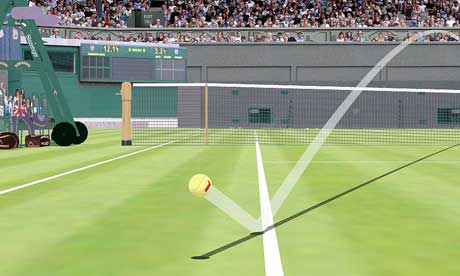 STRATEGIC DECISIONS. As I made clear above, specific skills - shooting a goal, passing to another player, etc. - should not require any thought. But it may well require some thought to decide when to use them - whether to pass or shoot. Or in a sport like tennis, you shouldn't have to think "how do I get the ball to land where I want it to land," but it may be worth thinking "where do I want it to land?" This part definitely varies from sport to sport, and I'm not about to claim that every strategic decision can apply math somehow - most will be very intuitive, based more on experience and a "feel for the game" than an actual mathematical prediction of what an action will result in (for example, I don't think any professional tennis player actually calculates the point on the court at a maximum distance from the opponent in order to aim there; they just know). But whether they keep formulas in their head or not, most good athletes are able to analyze situations and come up with optimal decisions. And this is a mathematical mindset. Math isn't all about knowing formulas - it's about facing a problem, given certain information, and using the information you have to solve the problem. And this is what good athletes do all the time.
The point guard of my high school's basketball team illustrates this point really well. On the one hand, he was just an incredibly technically skilled player - he had put in his hours until basketball came naturally to him. But he also had a sharp eye and a quick mind. First, his sharp eye - he was able to just see things that many people probably wouldn't under the stress of a basketball match (his ability to see more than what most people do also makes this guy an incredibly talented graphic designer, and one of the wittiest people I know). But just because you see all the options doesn't mean you can act on them; this is where his quick mind comes in. He knew the playbook inside and out, and could match any scenario with a play that would fit. In other words, he faced a problem (get the ball into the basket), collected information on the fly (the positions and movements of all other players), and would be able to come up with an optimal solution on the spot. It would be so much fun watching him lead the team, because you'd know you were watching a great mind at work.
Now this point guard wasn't necessarily all that fond of math class, but I would still argue that the type of problem-solving that went through his mind was mathematical. Because the thought process you go through when you see a problem, choose a formula that matches it, and solve the problem using the formula, has very strong connections to the thought process of seeing a problem, choosing a play (like the one on the right) to match the situation, and solve the problem using the play. Plays are essentially formulas in sports - they're a simple set of rules that, given certain conditions, will give you a certain outcome, if you follow the steps correctly. Of course, math is much more than knowing formulas - just like sports is much more than knowing plays. But both math and strategic plays in sports are very much about solving problems, and a mathematical mind knows how to solve problems reeeally well. And how to look for the exceptional cases, the "hidden" options no one else will see or expect; how to carry through any plan consistently; how to settle for nothing less than perfection.
So that's all I have for now. There's probably more to be said... but hopefully my point is clear. Math and sports (like math and anything) are highly interconnected. Definitely not saying that you have to be good at math to be good at sports or appreciate the game; but if you do decide to go after the math, whether you're an athlete, a coach, a manager, or a fan, it unveils a whole new, rich, fascinating layer to the game that could never be truly understood otherwise.
Up next... math and poetry? Maybe some other time.
So that's where you don't use math in a sports match - when performing specific skills upon an instant. These ought to be things you never think about, let alone calculate.
With that said, let's see where math DOES come in.
 |
| "The game is won or lost in the weeks leading up to it." |
Nowhere, I think, is this more evident than in cross country. Maybe I say this just because that's the only high school sport I took part in, so it's the most clear to me there. Maybe I say this just because my coach happened to also work at the school's IT department and so took very well to statistics and times and paces (he even developed an iphone app for keeping score at cross country meets). But whatever the case, math came into our practices and dictated what we did. After every cross country meet, the coach would take our result and calculate a goal time for the next week - our "ice cream time" it was called, because we got a free ice cream bar if we achieved the goal. And his calculation was able to take into account different courses with different difficulties and different lengths and still come up with a reasonable goal to achieve - something that was not out of reach, but still pushed us.
 |
| Coach keeping stats |
Another thing that must be done in the days leading up to a sports match is examining who you'll be up against. Partly this is done by watching them, but it also involves an analysis of their statistics (discussed in part one of this series). In the case of cross country - which runners should I keep on eye on? Whom should I aim to pass, whom should I try to keep up with? Most of these decisions would be based on their time in previous events, and we'd use these statistics to predict their next performance. This of course can come up in other sports too... which players of a team should you keep an eye out for? Which moves or plays do they tend to use the most? Which team member should mark which opponent? And so on. Again, these are decisions often made by the coaches, but the better the players understand the statistics, the better they'll be able to make similar decisions for themselves.
CURRENT STANDINGS. Now we're in the game; the whistle has blown, the gun has fired, the players are in motion. One thing that is crucial to having a good game is understanding where exactly in the game you are at any point in time. Not just how much time is left, but what the current stats are. Which team is up, and (quick mental subtraction) by how many points? How many players have fouls - who on our team should we be cautious around, who on the other team should we encourage to screw up? What needs to be done in order to do as well as possible from this point on?
 |
| Yup, another "me in a sport" picture. Just to make it look more like I know what I'm talking about. :p |
The guy in my high school graduating class who won athlete of the year, star of the cross country team and long distance track team, and also a valuable part of the basketball team, also happened to be incredibly quick at math (well, he was just in general an all-around good student, but it's the math part that's important here). As far back as fourth grade, I remember him doing far better than me at the infamous "mad minutes" we had to complete, and ever since then, any time any of us would start asking "so hang on, what's 857 divided by 13..." he'd be the first to come up with the answer. And he would apply math to sports so smoothly, it made you wonder how people who didn't do so well at math managed to succeed in the sport. He had such an intuitive understanding of the relationship between one's mile-time and final result that, if he were watching a race at the mile point, and he knew the past statistics of each player (which he happened to know unbelievably well), he could probably predict the final times of each to within ten seconds (this one might be an exaggeration... but I wouldn't be surprised, he's amazed us in similar ways before). And he knew his own pace really well, so at every point in the race, he'd be exactly as tired as he predicted he would be.
 |
| Three of the top ten in the league. Not bad. |
So in summary, coming up with a game plan before the game begins is one thing - you have time to think through things, to look at past statistics, to make calm, rational decisions on how to approach the match. But a good athlete is one who can continually update the game plan based on how the game is going - to be able to take stock of where things currently are, and make adjustments as necessary. Throughout any match, you'll be provided with information with how things are playing out - deciding the updated game plan is partly an intuitive "do what feels right" choice, partly a qualitative evaluation of the current situation, but it's also partly mathematical, as you take into account the numbers around you and make some calculations about what this means for how you play throughout the rest of the game.
The point guard of my high school's basketball team illustrates this point really well. On the one hand, he was just an incredibly technically skilled player - he had put in his hours until basketball came naturally to him. But he also had a sharp eye and a quick mind. First, his sharp eye - he was able to just see things that many people probably wouldn't under the stress of a basketball match (his ability to see more than what most people do also makes this guy an incredibly talented graphic designer, and one of the wittiest people I know). But just because you see all the options doesn't mean you can act on them; this is where his quick mind comes in. He knew the playbook inside and out, and could match any scenario with a play that would fit. In other words, he faced a problem (get the ball into the basket), collected information on the fly (the positions and movements of all other players), and would be able to come up with an optimal solution on the spot. It would be so much fun watching him lead the team, because you'd know you were watching a great mind at work.
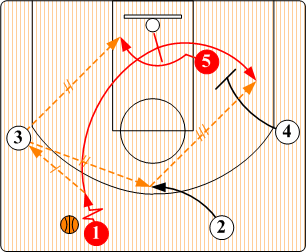 |
| This, believe it or not, is a formula. |
So that's all I have for now. There's probably more to be said... but hopefully my point is clear. Math and sports (like math and anything) are highly interconnected. Definitely not saying that you have to be good at math to be good at sports or appreciate the game; but if you do decide to go after the math, whether you're an athlete, a coach, a manager, or a fan, it unveils a whole new, rich, fascinating layer to the game that could never be truly understood otherwise.
Up next... math and poetry? Maybe some other time.
Monday, April 9, 2012
Math and Sports - Setting up the Game
Last post, I talked about some of the math behind the large-scale problems in sports; the use of statistics and finance, how probability appears in tournament designing, where linear algebra determines rankings, and how several branches of math you may never have heard of before converge in scheduling. And for the most part, I didn't actually present any math at all - I just sort of described the general gist of the way math is used and left it there. This post will be different, hopefully, by actually showing you some of the math involved.
 First off, I'll ask a well-known Microsoft interview question: why are manhole covers round?
If you haven't heard it before, take some time to think of some possible answers. There are a lot of very practical answers, and most come down to some geometric fact about the circle. Something provable about circles before even considering how they work in the physical world. And this idea is one that will come up later in this post - I won't directly refer to this example, but the idea of geometric facts having practical implications is pretty important. BUT for now, back to sports. What math goes into deciding how the game works?
 SPECIFICATIONS. Length and width of the playing area; number of players per team; time limits; points awarded per action; equipment size; there are a lot of very specific rules in every sport determining how the game is to be played. And many of them involve a measurable quantity - length, number, mass, area, time - which can be mathed upon. But chances are that most of these rules developed through trial and error, not through mathematical reasoning - people would try it one way, find it doesn't work so well, and so adjust things to make it work better. So there really isn't a strong connection to mathematics here (at least not one I can easily find). I wouldn't be surprised if some math was used in making the official decisions though - examining the statistics of various athletes playing under various rules, and predicting a set-up that would make the game-play go as well as possible.
Although I definitely could say something about the geometry of a sports court. Lots of rectangles, often circles too. But again, nothing too mathematical behind the sizes of these - can't find any sports court with dimensions following the golden ratio, for example, which seems to pop up in so many other places. Again, sizes seem to be more dependent on what people have found to work.
EQUIPMENT PHYSICS. So sports have all sorts of different equipment. There are balls, shuttles, rackets, sticks, goals, nets, masks, padding, shoes, and more. One basic consideration that has to go into all of these is the material to make the equipment from. To make sure nothing will fall apart in the middle of a game, for one thing. Any protective wear - padding, masks, shoes - should be made of a material that is slightly resilient - able to cushion a blow, but not let it get all the way through, and to distribute the force over a wide area. The goals, nets, etc. have to be able to take a beating without being to dangerous to play around (imagine a volleyball net made of barbed wire... *shudders*). Sticks and rackets should be rigid enough to transfer a powerful blow, but also slightly bouncy so that when the ball/puck/human head hits it, it will reflect most of the kinetic energy back into the ball/puck/human head. Determining the optimal bounciness/hardness of the ball is also important for many of the same reasons. These concerns all fall under materials science, which math is definitely applied in (to calculate resilience, for example - see the graph), but these aren't exactly direct applications of math, so I won't go too much into these (though they still are pretty interesting).
Another consideration is how big or heavy the various equipment should be - most of these (goal size, net height, etc) fall under specifications (above) and were probably developed mostly by trial and error; a few have more physical answers, such as the best length of a hockey stick or tennis racket to apply the most force to whatever you're hitting. Again, math is applied here, but it's more of a physics question (levers, angular momentum, torque) so I'll leave it be for now.
EQUIPMENT SHAPE. Ohhhhh man. Here's where it gets gooood. This particular section, it turns out, was my entire motivation for writing this series on math and sports because it's just so cool.
Many sports use a spherical ball of some sort. And the reason for that should be pretty straightforward, if you've ever tried to played soccer with a football (We'll use the North American definitions of soccer and football here - see the diagram to the left - purely for convenience's sake, to avoid the verbiose and potentially-offensive-to-Canadians "American football"). You know how annoying the behavior of the football is whenever it bounces. The shape of the football is not designed for hitting the ground, it's designed for aerodynamics; any sport which involves a ball that frequently touches the ground - basketball, soccer, tennis, field hockey, and countless others - must have a spherical ball.
Why? Because (using slightly technical jargon - see the figure to the left) a sphere is the only 3d shape such that the tangent plane at any point is perpendicular to the line between the center of the shape and that point. In other words, whenever a sphere hits the ground (or a foot, or a wall), no matter how it lands, its center is directly above the point of contact. And so when a sphere hits the ground and bounces, the normal force from the ground, acting upwards, will just turn the downward motion of the ball into upward (ignoring any effects of friction and spin for now). In other words, it will bounce according to the well-known law of reflection - the angle at which it lands will equal the angle at which it bounces back. And so you can predict its motion. Despite the physical interpretation, this is a purely mathematical fact of spheres - lines from the center to any point are perpendicular to the tangent plane at that point.
This doesn't happen with a football, for example (or a cube, or any non-spherical object), because when a football lands, its center isn't necessarily directly above the point where it hit the ground. Part of the normal force gets put into making the football go back up, but another part goes into spinning the ball (something known as torque). So it won't bounce as high as you'd expect, and it will spin strangely in some unexpected direction. This is the same thing you see happening with dice rolling (which is what makes them so hard to predict), or when you drop your pencil and instead of bouncing back up to you, it ends up in another dimension, never to be seen again. This is why spherical pencils would be awesome.
Similar ideas go into rolling - the sphere is the only shape which doesn't "prefer" any orientation, because it's symmetrical in all directions. Symmetry is the idea that a shape looks the same even when you look at it from a different direction; for example, rotate a square 90 degrees, and it looks exactly like it did before. But no matter how you rotate a sphere, it'll always act the same. Every other shape will have some points where it will rest nicely, but some where it will tip over. And this makes a sphere much nicer to play with (Hockey is a notable exception to the rule that "things which touch the ground must be spherical," because it doesn't go in the air as much, and so bouncing isn't as big of a concern, and because it has no need to roll since it's on ice. But its round shape comes from the same reasoning - it should act the same way no matter which side you hit it from).
So other than sports which employ some strange shape for some strange reason (footballs and badminton shuttles are designed for their aerodynamics, which is itself a fascinating topic but again, more physics, less direct math), the balls used in sports are spheres for a good reason.
But how do you make a sphere? Unfortunately, though spheres are a very natural shape, they're very hard to produce - especially out of materials that are good for sports. Some balls (such as volleyballs) have an inflatable rubber part inside, known as the bladder, which can be pumped up to form a sphere, and some (like baseballs) have a center made of rubber or cork, wrapped up in yarn to form a ball. But a lot of sports want some sort of leather covering for the ball. So when leather comes just in flat strips, how on earth do you make it into a sphere shape to cover the ball? Speaking of earth, this, in fact, is extremely closely related to the problem of drawing maps. The earth is a sphere, so how do you draw flat maps of it?
Both of these questions can be connected with a branch of mathematics known as topology - the study of the basic structure and properties of shapes, not necessarily length or size or angles (which sets it apart from geometry). There's a well-known joke (well, well-known among mathematicians at least) that a topologist can't tell the difference between a donut and a coffee cup, because they both have the distinguishing property that there's a single hole that goes right through them, and that's all topologists notice. One of the central concepts of topology is that of a manifold: any shape that can be made by sewing together pieces that are basically "flat." And by proving things about the little flat pieces, you can then prove things about the entire manifold. So a sphere is a manifold, for example, because you can sew together a bunch of flat things to make something that's essentially spherical. A torus (donut) is also a manifold - as are many other incredibly weird shapes that topologists spend their time studying.
So the fact that the sphere is a manifold is what makes map-making make any sense. You can't really make a sphere flat without destroying it - but you can make flat pieces and describe how they fit together. Which is what maps are - little flat pieces of the sphere. And though they don't actually study topology to do so, this fact, that the sphere is a manifold, is what allows sports equipment manufacturers to make balls. They make flat pieces and stick them together.
 So the question is... what kind of flat pieces do you make, and how do you stick them together to end up with a basically spherical shape? One solution is the tennis ball / baseball method - two strange round pieces that fold over towards each other. Basketballs use eight strips of different types, four of which line up with each other to make a hemisphere. A standard volleyball is made up of eighteen thin strips; three strips are pieced together to make a slightly curved panel, and the six panels are pieced together in the same arrangement as the faces of a cube - so you can identify a top, bottom, front, back, left, and right.
Now the volleyball in particular, of the last couple balls described, is pretty interesting - because it's essentially a cube. Which is strange - cubes have sharp corners, completely unlike spheres. But the idea is that you take a nice shape - like a cube - and just add a few extra curves to it and you get a sphere (to the topologist, who sees a coffee cup and thinks it's a donut, spheres and cubes are identical). In fact, you could do the same thing with all regular polyhedra (listed above; a regular polyhedron is a 3d shape where every edge is the same length, and every face is the same shape). But practically speaking, this wouldn't work too well with, say, a tetrahedron - the corners are a little too sharp, the faces a little too flat. But as you add more faces, you should get closer and closer to a sphere. And presumably, with enough faces, you almost wouldn't even have to worry about making the faces themselves curved (like you do for the volleyball); the sphere shape will just come automatically. Unfortunately, no regular polyhedron has enough faces for that.
The idea behind choosing a regular polyhedron was that every face is the same - which, if you remember, is pretty important to the way a ball works. The more every side looks like every other side, the better. But what if we take one step back from regular polyhedra, and instead look at the shapes you can get if you allow a couple different types of faces? These are known as the Archimedean solids. While the sphere looks the same from any direction whatsoever, and the regular polyhedra look the same no matter what face you look at, Archimedean solids look the same from any vertex (any point where different edges meet) - every vertex is bordered by the same regular shapes. So they're still pretty symmetric. The diagram below shows all Archimedean solids. Look at the picture for a while; can you find one that looks familiar?

Did the truncated icosahedron stand out at all? If so, then that's because that's the shape of the soccer ball! You can make this shape by taking an icosahedron, and chopping a chunk off every vertex (the pentagons are where the vertices of the icosahedron used to be; the hexagons come from the triangle faces that got their corners clipped). So you get a shape with 32 faces, 60 vertices, and all the faces are pretty close to being the same (hexagons and pentagons aren't all that different). This looks like a pretty ideal shape for a ball - just puff it up with a bit of air and it should fill out into a sphere shape rather nicely.
Well aren't we humans so smart for coming up with this shape.
That's right, when you kick around a soccer ball, you're really kicking around a molecular model. Now you'll never be able to play the sport without feeling like a nerd ever again.
Ok, not really, the soccer ball wasn't made in order to model a molecule. But what this DOES show is how interconnected math is. The same mathematical structure - the truncated icosahedron - appears both in molecular physics and in sports. Pretty powerful subject now, isn't it?
There's one other type of ball that has some pretty interesting math behind it - the golf ball. It doesn't face the same "how do you make a sphere out of flat stuff" problem because it's a solid ball of synthetic material. But it does bear one property that makes it stand out - dimples. Amazingly, adding little holes to a golf ball actually makes it fly farther - but again, this is a physical phenomenon which I won't get into here. What I will get into is the geometry of these holes - how do you spread them out? Again, symmetry is of utmost importance - the ball has to look basically the same from any viewing angle, otherwise it will act differently depending on its orientation. The Polora, a golf ball manufactured in the late 1970s, wasn't like this - it had deeper holes along the equator, and shallower holes everywhere else, which caused it to spin differently once in flight - it was banned soon after it was released, and official balls were forced to satisfy certain symmetry requirements.
Oddly enough, however, there is no "standard golf ball;" most golf balls have 250 to 450 holes, with some having over 1000. And yet, manufacturers are forced to obey the symmetry laws if they want their golf balls to be officially allowed. So how do you spread out the holes evenly on the sphere?
It turns out that quite often, you can't spread out the holes evenly. For example, if you try to spread out 5 holes on a sphere, you can never get them truly "evenly" spread out. The best you can do is put two at opposite ends, say the North and South poles, and three along the equator. But then the ones at the poles will be more isolated than the ones on the equator are.
But at least, for five holes, we know the best you can do, even if it's not perfect. It turns out that in general, even the best possible you can do isn't known. Now we haven't described what we mean by "evenly distributed" - and different definitions will actually give different answers. But practically every good definition faces the same problem - we simply don't know the best possible arrangement of holes. We've been able to compute very good arrangements, but have no way of knowing if a better one might exist.
There are a few cases, however, that we understand quite well - and yes, the regular polyhedra are back! If you take a sphere, and imagine drawing a regular polyhedron inside the sphere, so that the vertices all touch the sphere, then these corners would give you points that are perfectly evenly spread out. So that means we can spread out 4 points (using the vertices of a tetrahedron), 6 points (octahedron), 8 points (cube), 12 points (icosahedron), and 20 points (dodecahedron), and under any good definition of "perfectly spread out," these will be so.
So what's to stop us from starting with one of these configurations, and just adding on extra holes inside? I mean, maybe it won't be "the perfect configuration," but it'll still be pretty darn good. And so that's what ends up happening most often - golf ball manufacturers split up their ball into faces based on a regular polyhedron, and just tile the inside of each face with holes. This works for any regular polyhedron except the dodecahedron, because the cube is made of squares and the rest are made of triangles, and squares and triangles tesselate (a bunch of them can be fit together without leaving any gaps). The dodecahedron is made of pentagons, on the other hand, and these don't tesselate, so you can't really divide them up as nicely into similar shapes.
 So here's an example of that getting put into practice. In the diagram to the left, the orange triangle comes from the face of an icosahedron - note how in both cases, they tiled that face with four smaller triangles, and filled in with holes. The left picture shows holes right on the vertices (as I described), while the one on the right doesn't, instead putting three circles in each little triangle. The left pattern requires holes of different sizes; the right pattern leaves some big gaps around some of the vertices; so neither are perfect, but both are acceptable golf ball designs. These designs come from U.S. Patent 4,560,168, which includes several other tiling patterns as well, all based on the faces of the icosahedron.
Phew, I think that's enough geometry for now. Let's not get into the shapes of hockey sticks and of the faces of tennis rackets and the shapes of all those other things out there. (I don't even particularly like geometry as much as some other branches of mathematics). I still have one more subject to discuss: what kinds of mathematics can actually be used by the athletes themselves - how people can use math when they're actually playing.
First off, I'll ask a well-known Microsoft interview question: why are manhole covers round?If you haven't heard it before, take some time to think of some possible answers. There are a lot of very practical answers, and most come down to some geometric fact about the circle. Something provable about circles before even considering how they work in the physical world. And this idea is one that will come up later in this post - I won't directly refer to this example, but the idea of geometric facts having practical implications is pretty important. BUT for now, back to sports. What math goes into deciding how the game works?
SPECIFICATIONS. Length and width of the playing area; number of players per team; time limits; points awarded per action; equipment size; there are a lot of very specific rules in every sport determining how the game is to be played. And many of them involve a measurable quantity - length, number, mass, area, time - which can be mathed upon. But chances are that most of these rules developed through trial and error, not through mathematical reasoning - people would try it one way, find it doesn't work so well, and so adjust things to make it work better. So there really isn't a strong connection to mathematics here (at least not one I can easily find). I wouldn't be surprised if some math was used in making the official decisions though - examining the statistics of various athletes playing under various rules, and predicting a set-up that would make the game-play go as well as possible.Although I definitely could say something about the geometry of a sports court. Lots of rectangles, often circles too. But again, nothing too mathematical behind the sizes of these - can't find any sports court with dimensions following the golden ratio, for example, which seems to pop up in so many other places. Again, sizes seem to be more dependent on what people have found to work.
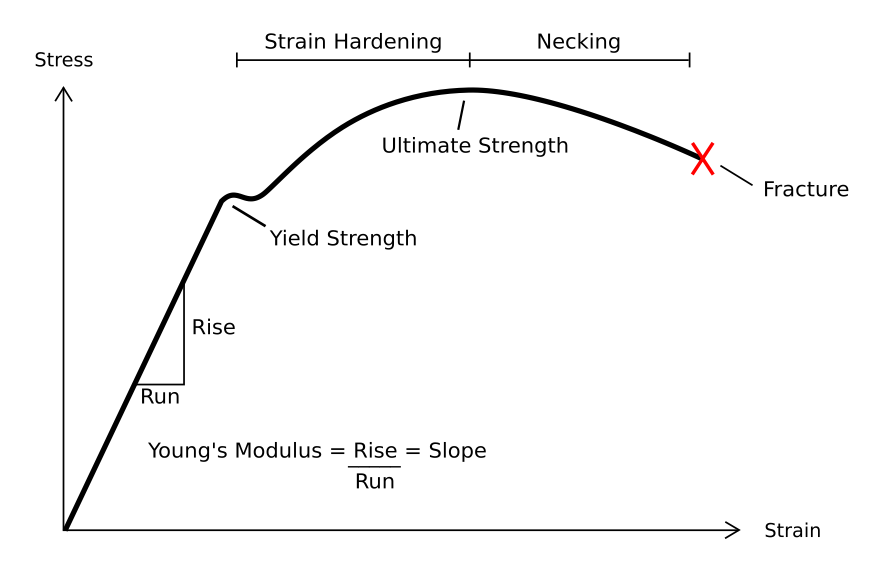 |
| sports equipment has a lot to do with resilience - if you stretch or squeeze something a certain distance (strain), how much force will it push back with (stress) |
Another consideration is how big or heavy the various equipment should be - most of these (goal size, net height, etc) fall under specifications (above) and were probably developed mostly by trial and error; a few have more physical answers, such as the best length of a hockey stick or tennis racket to apply the most force to whatever you're hitting. Again, math is applied here, but it's more of a physics question (levers, angular momentum, torque) so I'll leave it be for now.
EQUIPMENT SHAPE. Ohhhhh man. Here's where it gets gooood. This particular section, it turns out, was my entire motivation for writing this series on math and sports because it's just so cool.
 |
| for the purposes of this blog post: top = football, bottom = soccer ball. |
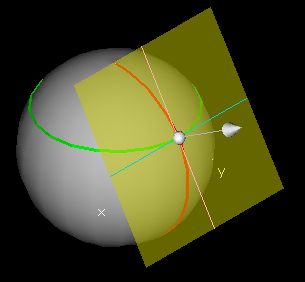 |
| this arrow comes straight from the center of the sphere; so if the yellow plane were the ground, then the center of the sphere would be directly above the point of contact. |
 |
| I know this doesn't look like a football. Just use your imagination. |
Similar ideas go into rolling - the sphere is the only shape which doesn't "prefer" any orientation, because it's symmetrical in all directions. Symmetry is the idea that a shape looks the same even when you look at it from a different direction; for example, rotate a square 90 degrees, and it looks exactly like it did before. But no matter how you rotate a sphere, it'll always act the same. Every other shape will have some points where it will rest nicely, but some where it will tip over. And this makes a sphere much nicer to play with (Hockey is a notable exception to the rule that "things which touch the ground must be spherical," because it doesn't go in the air as much, and so bouncing isn't as big of a concern, and because it has no need to roll since it's on ice. But its round shape comes from the same reasoning - it should act the same way no matter which side you hit it from).
 |
| Football aerodynamics |
But how do you make a sphere? Unfortunately, though spheres are a very natural shape, they're very hard to produce - especially out of materials that are good for sports. Some balls (such as volleyballs) have an inflatable rubber part inside, known as the bladder, which can be pumped up to form a sphere, and some (like baseballs) have a center made of rubber or cork, wrapped up in yarn to form a ball. But a lot of sports want some sort of leather covering for the ball. So when leather comes just in flat strips, how on earth do you make it into a sphere shape to cover the ball? Speaking of earth, this, in fact, is extremely closely related to the problem of drawing maps. The earth is a sphere, so how do you draw flat maps of it?
 |
| Constructing a circle out of flat parts |
 |
| Not all manifolds are as nice as a sphere. (the Calabi Yau manifold) |
 |
| the regular polyhedra (also known as Platonic solids) |
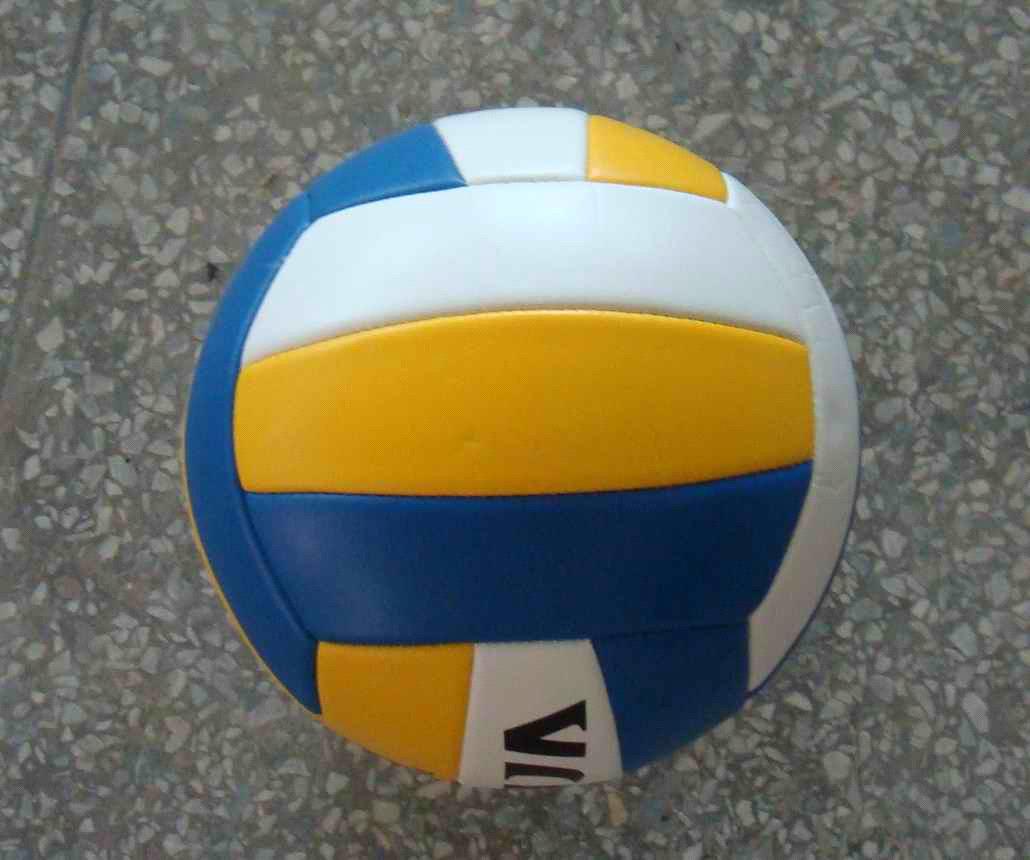 |
| the volleyball: a cube that looks like a sphere. |
The idea behind choosing a regular polyhedron was that every face is the same - which, if you remember, is pretty important to the way a ball works. The more every side looks like every other side, the better. But what if we take one step back from regular polyhedra, and instead look at the shapes you can get if you allow a couple different types of faces? These are known as the Archimedean solids. While the sphere looks the same from any direction whatsoever, and the regular polyhedra look the same no matter what face you look at, Archimedean solids look the same from any vertex (any point where different edges meet) - every vertex is bordered by the same regular shapes. So they're still pretty symmetric. The diagram below shows all Archimedean solids. Look at the picture for a while; can you find one that looks familiar?
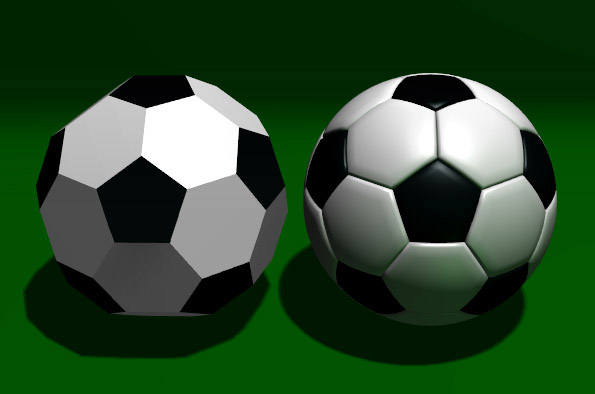 |
| a soccer ball is just an arrogant (i.e. "puffed up") truncated icosahedron. |
Well aren't we humans so smart for coming up with this shape.
That's right, when you kick around a soccer ball, you're really kicking around a molecular model. Now you'll never be able to play the sport without feeling like a nerd ever again.
Ok, not really, the soccer ball wasn't made in order to model a molecule. But what this DOES show is how interconnected math is. The same mathematical structure - the truncated icosahedron - appears both in molecular physics and in sports. Pretty powerful subject now, isn't it?
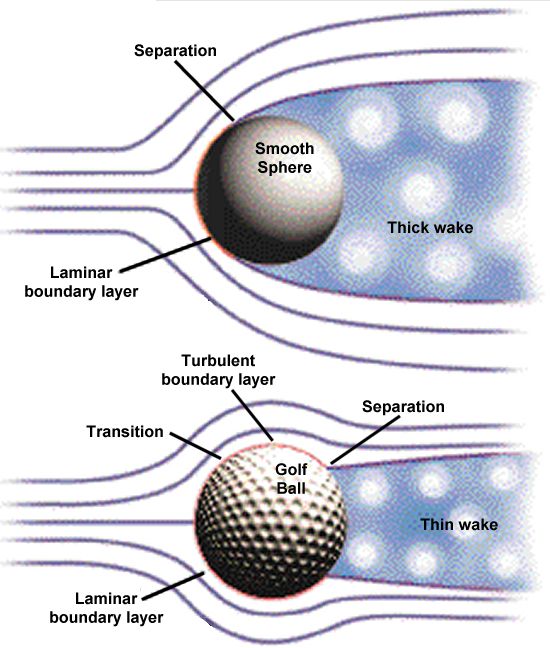 |
| dimples diminish air resistance. |
Oddly enough, however, there is no "standard golf ball;" most golf balls have 250 to 450 holes, with some having over 1000. And yet, manufacturers are forced to obey the symmetry laws if they want their golf balls to be officially allowed. So how do you spread out the holes evenly on the sphere?
It turns out that quite often, you can't spread out the holes evenly. For example, if you try to spread out 5 holes on a sphere, you can never get them truly "evenly" spread out. The best you can do is put two at opposite ends, say the North and South poles, and three along the equator. But then the ones at the poles will be more isolated than the ones on the equator are.
But at least, for five holes, we know the best you can do, even if it's not perfect. It turns out that in general, even the best possible you can do isn't known. Now we haven't described what we mean by "evenly distributed" - and different definitions will actually give different answers. But practically every good definition faces the same problem - we simply don't know the best possible arrangement of holes. We've been able to compute very good arrangements, but have no way of knowing if a better one might exist.
 |
| cube and icosahedron made into spheres. The cube kinda looks like a volleyball. |
 |
| no chance of fitting another pentagon in there. |
So here's an example of that getting put into practice. In the diagram to the left, the orange triangle comes from the face of an icosahedron - note how in both cases, they tiled that face with four smaller triangles, and filled in with holes. The left picture shows holes right on the vertices (as I described), while the one on the right doesn't, instead putting three circles in each little triangle. The left pattern requires holes of different sizes; the right pattern leaves some big gaps around some of the vertices; so neither are perfect, but both are acceptable golf ball designs. These designs come from U.S. Patent 4,560,168, which includes several other tiling patterns as well, all based on the faces of the icosahedron.Phew, I think that's enough geometry for now. Let's not get into the shapes of hockey sticks and of the faces of tennis rackets and the shapes of all those other things out there. (I don't even particularly like geometry as much as some other branches of mathematics). I still have one more subject to discuss: what kinds of mathematics can actually be used by the athletes themselves - how people can use math when they're actually playing.
Math and Sports - big picture
So if you've spent enough time around me (or my online presence), or around just about any math-lover out there, there's one message you've probably come across quite often: math is EVERYWHERE. And we use all sorts of examples to prove it.
STATISTICS. I'm convinced that any extremely devoted fan of a sports team actually has a stronger understanding of statistics than the average person with no interest or a mild interest in sports. The reason? Statistics are EVERYWHERE in sports. Every player has their points/blocks/interceptions per game, their height and weight, their cumulative results over the past however many seasons, their age, their vertical jump, and many more; and teams, likewise, have their wins-losses-ties per season, the last year they made the playoffs, their advantages and disadvantages over other teams in the league... truly mind-blowing amounts of information.
 And yet somehow, devoted fans manage to hear all that information, and not just know it, but interpret it. They can hear a player's batting average and immediately rank them as spectacular, good, average, meh, or awful. They can look at a player's information and deduce how well they would work with the players from this or that team. They can see a team's current standings and predict both an expected outcome, as well as the specific games that would need to be won in order for them to get that goal. Prediction - that's the power of statistics. There would be no point in statistics if it doesn't help you make guesses. A good statistician isn't one who knows a bunch of formulas (though these often do help), but one who can make accurate guesses based on the data given. And so in that sense - many sports fans are statisticians.
We use examples from the natural world - the sizes and angles of plant leaves which grow at certain ratios; the extremely geometrical structure of molecules (and hence crystals, snowflakes, etc.); the cicadas which come out once every 13 or 17 years, because those are prime numbers; I could go on for a looong time.
 |
| A Julia Set. If this isn't art, then what is? |
We use examples from visual art and architecture - the golden ratio which appears everywhere in the Parthenon, the aesthetic attraction of fractals such as the Mandelbrot set, the method for scaling down things which are farther away to give pictures their realism - again, the examples are endless.
We use examples from music - intervals as ratios of frequencies, and "nice" intervals being ratios of small whole numbers; rhythmic subdivision based on powers of 2 and 3 (and very rarely higher numbers); the mind-boggling connections between the 24 common key signatures (12 semitones, major and minor) and the 24 symmetries of a dodecagon (12 rotations, unflipped and flipped) - if you get me started on any of these topics, you better have an escape route planned, because I could literally keep you for hours discussing these.
Lesson learned - nature, art, music, and math are all pretty connected.
 |
| This is NOT what goes on in the mind of your average football player. |
But what about sports? From experience, when most people try to put math and sports together, they come up with something like "oh when you shoot the basketball you calculate the path of the trajectory and the force and angles needed to make it go in lolololol" and... no. Just no. While the physics is accurate, no one actually uses that math during a sports game (I'll address this more in a later post). But there definitely are some strong connections between math and sports, which I hope to illuminate in the next couple posts. I'll be missing a lot, of course - these are just a few connections that came to mind. As the title says, I'm starting with "big picture" stuff - as in, the math that comes before you even look at the sports games themselves. Honestly, these topics are fairly boring compared to what I'm going to write about in later updates, so if you find this hard to read, fear not! My next post has (☞゚ヮ゚)☞ MORE PICTURES ☜(゚ヮ゚☜)
STATISTICS. I'm convinced that any extremely devoted fan of a sports team actually has a stronger understanding of statistics than the average person with no interest or a mild interest in sports. The reason? Statistics are EVERYWHERE in sports. Every player has their points/blocks/interceptions per game, their height and weight, their cumulative results over the past however many seasons, their age, their vertical jump, and many more; and teams, likewise, have their wins-losses-ties per season, the last year they made the playoffs, their advantages and disadvantages over other teams in the league... truly mind-blowing amounts of information.
And yet somehow, devoted fans manage to hear all that information, and not just know it, but interpret it. They can hear a player's batting average and immediately rank them as spectacular, good, average, meh, or awful. They can look at a player's information and deduce how well they would work with the players from this or that team. They can see a team's current standings and predict both an expected outcome, as well as the specific games that would need to be won in order for them to get that goal. Prediction - that's the power of statistics. There would be no point in statistics if it doesn't help you make guesses. A good statistician isn't one who knows a bunch of formulas (though these often do help), but one who can make accurate guesses based on the data given. And so in that sense - many sports fans are statisticians.
And of course, there are the people who make a living calculating and compiling sports statistics, and people who's job it is to analyze the data - and they put far more work into the mathematics than fans do. Statistics is all about collecting information and predicting future information - without it, sports tournaments would be pointless, there would be no craze about wins/losses or team standings, and watching sports games would just be about having a good time. So you have statistics to thank for sports culture as we know it.
RANKING ALGORITHMS. Very connected to the above, but much more awesome. Given a bunch of statistics, how do you actually use the information? How do you choose which players to draft for a team? Which athletes to represent a country in the Olympics? Which horse to bet on? As mentioned above, just knowing a lot of data isn't enough to do statistics - the power of statistics is in its predictions. If a team had to choose between two players to select, and one was better than the other in every way, the choice is obvious - but how do you rank players that have different abilities in different areas? It would be foolish to randomly choose one statistic (say height) and just choose a player based on that. Partly you might have to use intuition - but there are mathematical tools out there that make the decision a whole lot clearer.
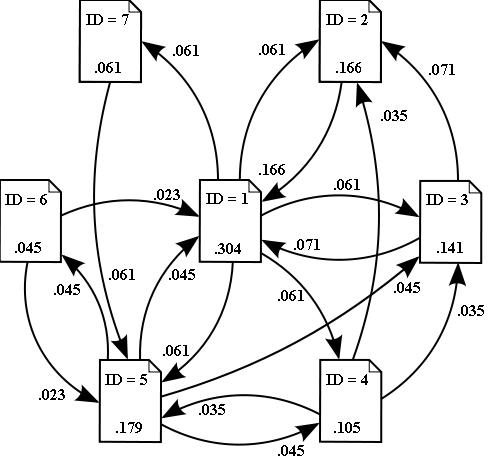 |
| An Internet with seven sites is complicated enough... |
I'm not a statistics person - in general, data is kind of annoying. The real world is so much uglier than the beautiful patterns you can find in math. But possibly the most beautiful use of data I've ever seen came in an intro to linear algebra class, when we were introduced to the basic algorithm Google uses to rank its pages - they take tons and tons of data, and manage to get an incredibly useful fact (the ranking of pages) out of it. The diagram to the right is pretty complicated already - the fact that Google can get meaningful information out of billions of web pages is astonishing, and shows the power of linear algebra. Pleeeease ask if you're curious, it's actually a mind-boggling idea and I'd love to share it, but I won't here right now.
So it turns out that major sports organizations use a similar idea when they rank athletes. They take all the statistics of that player, do some linear algebra to it, and get out a ranking of players. Fascinating.
TOURNAMENT. Which team should play which? How will you determine the winner? Will there be runner-ups? A consolation bracket? Is there enough time for round-robin play? These aren't just arbitrary decisions - a lot of planning has to go into each one. I was on my high school student council for three years... and every single time we hosted a gym night, I would be the one in charge of creating the tournament brackets. It's not as easy as drawing a bracket and randomly picking teams to go in each slot. Granted, I had a few things to worry about that professional leagues didn't - for example, I had a time constraint of a couple hours as opposed to a couple months, so every five minutes counted, and I did my best to make sure that every team would have at least one good game (i.e. don't put a team of freshman girls against a team of senior guys).
 |
| In case you didn't know what a tournament bracket looks like. |
But every tournament has its own host of problems to solve to make sure the tournament works well. Most major league sports have a certain tournament style that they feel solves these problems most effectively. But I can guarantee you that a significant amount of mathematical thinking went into setting that as a standard. Probability is one of the biggest factors here - what are the chances of a team that deserves to win getting eliminated early, or the chances of a comparatively weak team making it really far?
For example, in single-elimination, if the two top teams get put together, then the second-place team might get eliminated at the beginning, which means the resulting rankings don't reflect actual ability. A good tournament is one in which it is very likely that each team will end up about where it's supposed to be. In this sense, the "best" tournament is one where every team plays every other team five or six times (again, probability comes in here - the more games you play against a single team, the more likely the results will average out to reveal the actual comparative ability of the two teams), but this is incredibly inefficient. So you have to find a tournament structure that will be likely to rank teams where they deserve to be ranked, but doing so in as few games as necessary. And being totally fair about it. That's a tough math problem.
SCHEDULING. Related to the above, but even harder. Have you ever thought how difficult it is to take 20 teams, living completely separate from each other, and come up with a schedule that lets every team have the right number of games with every other team, with a good balance of home and away games, all while avoiding conflicts where a team should be in two places at the same time?
 |
| taken from this presentation by Richard Hoshino on travel schedules for Nippon Professional Baseball |
It turns out that this is an INCREDIBLY difficult problem, and many professional mathematicians are working on ways to find efficient solutions. That's right - WE DON'T KNOW how to find the best solution yet. And the study of this problem connects many different branches of mathematics together - graph theory (the study of networks and connections - which team should play which?), dynamical systems (how a certain set-up develops over time), computer science (what should we ask the computer to do if we want it to find a good solution as quickly as possible?), and more. I had the opportunity to talk with a mathematician who was working in this field last year - and he had just made a proposal to Japan's Nippon Professional Baseball League for a way to schedule games that would minimize flight time (meaning less wasted travel time for the players, and less environmental impact). Deep, deep math goes into this.
And this isn't just a problem for national sports leagues - train or airplane schedules, TV programming, business meetings, schools trying to set up a class schedule, or even you trying to find a good day to meet up with a bunch of friends who are busy most of the time - these are very hard problems.
FINANCES. um... duh. Any sports organization has to know how to deal with money, and dealing with money requires math. Amateur sports leagues care about money because they don't have enough to squander it; professional sports leagues care because they want to make as much money as possible. The thing that might not be quite so "duh" about it is how finances interplay with the other math problems a team faces. Because in the end, one of the main things that stops a league from making a "perfectly fair" tournament, and the thing which makes pursuit of an ideal schedule as important as it is, is finances.
These are some of the big factors that come into play on the large scale of sports - tournaments, schedules, rankings, finances, statistics. If you managed to read through all that, good - because it gets more fun from here on. Up next I'll be talking about the rules and equipment of sports games, which, believe it or not, is a lot more fascinating (in my opinion at least. See for yourself).
Subscribe to:
Comments (Atom)