Saturday, December 15, 2012

Thoughts of a TA

For those of you who don't know, I had the opportunity to be a Teacher's Assistant for a first-year college calculus course (MAT135H1, for those of you at UofT) this past semester. It was completely unexpected - on the first day of classes this semester, an upper year math student told me that the department was low on TAs this semester (a lot of the grad students who had signed up to TA had ended up with other commitments) and that if I was interested, I should talk to the professor in charge of assigning TAs to courses. After a ten-minute interview and a few signed papers, I had the job. 

My responsibilities on the job included two tutorial sessions: Each session (about 30 students in each) would begin with a short multiple-choice quiz, after which students were allowed to leave; those who had questions could stay for about forty minutes of answering questions and going over the material they were learning in lectures. Later I would mark the quizzes, submit the scores to the professor, and return them to the students. I also had to spend time in the math aid centre, just being available to answer questions from any student who came in, as well as proctoring the midterm and final exam.


A few things I've learned or noticed over the last semester:

- Great opportunities (like the TA job) will often not come in an expected way, and sometimes there's simply no time to think and make a reasoned decision. While getting practice with split-second decision-making does help, in the end you just have to go with your gut and have faith that everything will work out.

- Two tutorial sessions can be extraordinarily different. For example, about 25 students would show up to each tutorial session for the quiz; from the very first day, straight to the end of the semester, my 4:00 tutorial session would have roughly 10~15 people staying afterwards, but my 5:00 session would have 1~5 (yes, one day there was actually only one person who showed up). There were lots of other differences too - the 4:00 class was slightly more talkative, for example, and the 5:00 class was more likely to ask questions outside of course material.

- Putting names to faces is hard, even when there's extra pressure to do so. The names you remember are the ones that stand out in some way - this person was the first to email me a question, this one got the right solution on a multiple choice quiz but circled the wrong answer, this one would always ask about topics just barely outside course material (epsilon-delta proofs, hyperbolic trigonometry).

- Spending hours at a time in front of a chalkboard really dries out your throat.

- Also regarding chalkboards - when you're right up there, it's soooo hard to actually see anything you've written. It's amazing how easy it is to make a mistake, and then to be completely unaware that anything is wrong. I'm very grateful to the students who point out the mistakes, and I'm making it a habit to regularly stand back from the board to read over what I wrote.

- I've noticed this in the classrooms I've been in as a student, but only this semester did this really hit hard: even when students are ok with speaking up in class to ask questions, there's a powerful stigma against students answering. Any time I posed a question, there would undoubtedly be a ten-second pause before anyone would speak up (more often, actually, no one would answer, and I'd just answer the question myself - even though I know that this isn't a good idea). By the end of the semester, I found myself asking fewer and fewer questions, just going through solutions myself and then asking if any step didn't make sense. I feel bad doing this though, since I have even less knowledge about whether any particular step is causing problems.

It's so tempting to take these silences personally, and interpret them as just a lack of understanding. I would have to force myself to remember my own experiences as a student to remind myself that silence does not necessarily mean complete confusion. As a student, even if I know the answer before the teacher finishes the question, I always wait a long time before answering. I have excuses for this behavior, some good, some not so much - I want other people to have the chance to answer, I don't want to be the one running the class, The teacher might want to spend more time working through this, I don't want to look like a teacher's pet, etc. etc. But recently I've realized that I don't really know why I wait. These are all just, as I said, excuses. Everyone may have different reasons for not answering - maybe they just don't know, maybe they think they know but are afraid of getting it wrong in front of everyone, maybe they want to put up an appearance of not caring - but the fact that this applies to practically everyone seems to imply that there's something deeper and more universal going on - some kind of social stigma against eagerly answering questions.

- Trying to explain something and getting blank stares; then trying to explain another way, and still seeing confusion; then describing an example, and it still not registering; then explaining one last time, and hearing a collective "ohhh" while you're writing something on the chalkboard - it's an indescribably beautiful feeling.

- Proctoring exams: IT'S BORING. Especially three-hour tests. We do have things to do - count heads, go around getting each student to sign an attendance sheet, answer questions when they come up, walk up and down aisles to discourage cheating... but a three-hour exam can get sooo monotonous.

- Proctoring exams: There are really strict standards. For example, after the final exam, the signature sheet had 179 names, but we counted 180 exams - meaning we had to spend half an hour going through every exam and match it with a signature until we found the problem. It's a very good policy (I would hate it if my exam got lost), as are the others, but it's still a lot to remember.

- Proctoring exams: During the test, we're not allowed to answer questions specifically about the test probelms - we can only rsepond if something is illegible, or a test is missing a question, or something else unusual comes up. So I feel like such a jerk when I get a question like "when they say it has a square base, does that mean two sides are equal?" and I have to respond with "I can't answer that, use your best judgment."


Overall it was a fantastic experience, but I realized I have a long way to go in my teaching skills. I'm TAing for another course next semester - this time, oddly enough, it's a calculus class for engineering students (MAT187H1). So any thoughts on what I've written (especially from experienced teachers!) would be much appreciated as I look towards future teaching opportunities.

Tuesday, September 25, 2012

Scariest moment I've had in a while


After an awesome but exhausting weekend (including two nights of travelling where I arrived at my destination after midnight) and one of my crazy over-10-hours-of-classes-and-activities Mondays, I throw myself onto my bed to unwind. I was hoping to just lie down for a couple minutes before getting up and preparing for the next day - setting my alarm, putting stuff in my shoulder bag, taking a shower, etc. I was looking forward to the next day (Tuesday); in addition to a few classes in the morning, I had my FIRST TA SESSIONS at 4:00 and 5:00! Cannot wait. Quite nervous, but looking forward to it too.

So I'm in my bed, hoping to get right out after a couple minutes, but then before long, I'm dreaming. And then I realize I'm awake, and suddenly remember all the things I had been thinking about last night. I check my watch...

It's 5:21. On Tuesday.

I freak out. I had TA sessions at 4 and 5, and I've missed them both! What do I do? Who am I supposed to contact? What do I say? How did I sleep that long? What did my students do for an hour when they expected to be able to come and get their questions answered? Why didn't I set my alarm earlier? Should I still attempt to make the last twenty minutes of my second session? Will this affect my reputation with both the professor and the students for the rest of the semester?

I jump out of bed (Briefly noticing that I have on all the same clothes as I was wearing the day before, and that the sky is quite dark) and rush to the computer, wondering what to do.

But then I notice: it's actually 5:21 AM on Tuesday.

Biggest. Sigh. Of. Relief. Ever.

The pieces begin to fit together as my conscious, reasoning mind starts to wake up - it's completely dark out, but it doesn't get dark until 7 PM here, so it couldn't possibly be 5 PM. My watch didn't show the "PM" light, which is its way of saying "it's AM." I have a natural circadian rhythm that would have woken me up by noon at the latest, no matter how exhausting my weekend has been.

Anyways, at least I still have an exciting day ahead of me... so I'll just post this on the internet (why? I'm actually not sure. My mind is still too sleepy and stress-relieved to want to do any work coming up with good reasons), do a little bit more prep for the day, and then try to get back to sleep. But after that adrenaline rush, I'm not sure I'll be able to get any more sleep in.

In conclusion, those of you who know where I wear my watch must be imagining some hilarious images of me trying to check the time after just waking up.

Thursday, August 9, 2012

What's really wrong with 6÷2(1+2)? (Part (14÷7(5-3)+2)÷3)

If you haven't already, start with Part (14÷7(5-3)+2)÷3, where I introduced the problem. Then, in Part (14÷7(5-3)+2)÷3, I began discussing what's actually going on, and introduced a few other mathematical ideas. Now, in Part (14÷7(5-3)+2)÷3, I will answer the question posed at the end of the last part. When given 12+33+72, which addition do you start with: 12+33, or 33+72?

WHAT?! Addition is associative?!
Well in an incredibly climactic turn of events that none of you were expecting, it turns out that it doesn't matter. When adding three numbers, you can add them in any order you want. But let's take an example which isn't so friendly. Pretend you have a function "avg" that takes the average of two numbers: avg(2, 4) = 3, avg(14, 17) = 15.5, and so on. And just like add(2, 3) can also be written as 2+3, let's say avg(2, 3) can be written as 2#3.

Now what's 1#5#21? Well if you do 1#5 first, you get 3, and 3#21 = 12. But if you do 5#21 first, you get 13, and 1#13 = 7! So you do it in a different order, and you get a completely different answer (note: if you decided to break the "only two at a time" rule and find the average of all three at once, you'd get 9, another completely different answer)

Now, if instead you did it with functions, you couldn't write something unclear like 1#5#21; you have to choose which average is done first. Your options are avg(avg(1, 5), 21), and avg(1, avg(5, 21)). When you write it like this, there's no ambiguity, because it's really clear what has to be done first. And this reflects the actual mathematical ideas, which include knowing which functions depend on the results of other ones. 1#5#21, on the other hand, doesn't. This is what I meant when I said that the mathematical expressions we're used to don't actually reflect the essence of what they try to describe - function notation succeeds in that far better than regular notation does.

Now, it would technically be possible to rewrite all elementary textbooks in function form. But when you realize that something as simple as 2(5+3-4) would then be written as mult(2, sub(add(5, 3), 4)), it begins to get a little hard on the eyes trying to figure out what's inside of what. And so people use expressions like 2(5+3-4), because they're easier. Simply put, these expressions are a shorthand. They're a way of abbreviating mathematical ideas to make them easier to read and write.

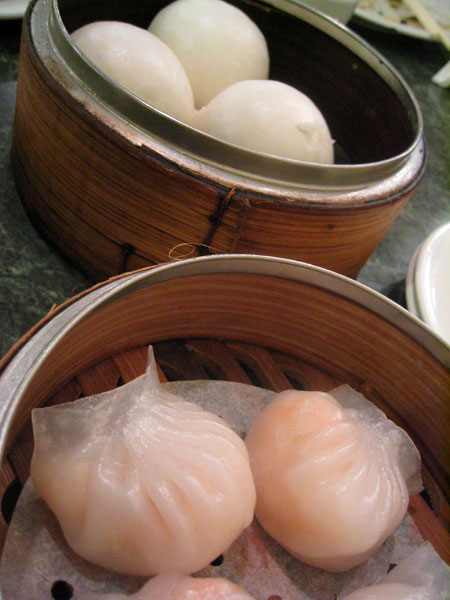
I did a Google Image Search for "AH"
and this was one of the results. I don't
really know why. But mm, dumplings
And whenever you abbreviate something, you lose information. For example, a couple weeks ago I had a Facebook conversation and someone mentioned seeing something on "AH." Unfortunately, I didn't know what that acronym stood for at the time. So I looked the acronym up, and found it could have meant anything from Art History to Adaptive Hypermedia to American Health to Apocalyptic Harbingers to Artificial Horizon to... Later he clarified that he was referring to "Alternate History." But since I didn't know the context, the shortened version was incredibly ambiguous. Making a shorter, easier-to-read version ended up taking away certainty.

And that's exactly what happens with things like 6÷2(1+2). It's a shortened version of the actual mathematical idea behind it, and because of that, it's lost some of its information.

Again, sometimes losing information isn't so bad. Like in the case of 2+5+4. In the end, it doesn't matter which numbers you add first, because you'll get the same answer. But in a case like 2×5+4, how do you know which to do first? Is it add(mult(2, 5), 4) = 14, or mult(2, add(5, 4)) = 18?

Two things were done to try to help the shorthand become slightly more accurate: brackets, and order of operations. Brackets are used to state clearly "everything in here needs to be considered together. You can't do anything to just part of this while leaving the rest behind." Technically, if you had enough brackets, the shorthand could be just as clear as the original function form. For example, add(1, add(add(2, 3), 4))) and (1+((2+3)+4)) mean exactly the same thing, order and all. So people could have just demanded that every operation symbol (+, -, ×, ÷) have its own pair of brackets, and there would be no trouble. But as in the case of (1+((2+3)+4)), this can look almost as messy as the function version, when it doesn't need to be; 1+2+3+4 works just as well, even if it's not clear what to do first, because it doesn't matter what you do first. It's a shorter abbreviation that still works just as well, so why worry about all the extra brackets? But if you drop that requirement, then you need to know what to do when two different operations aren't separated by brackets, when the order does matter - like in 2×5+4.

This is where the order of operations comes from. It's a convention for reading a shorthand notation, so we can all agree that it refers to the same idea. People decided that certain functions were "more important" than others, and gave them different priorities. There are actually some good reasons behind the order*, but it turns out that things would work just as well if the order of operations was completely flipped! You'd just need to learn how to read and write in the new system.

*One example of a good reason is the distributive property, which describes how multiplication and addition relate to each other: a×(b+c) = a×b+a×c. If addition had priority, this would have to be written a×b+c = (a×b)+(a×c) - you'd need an extra pair of brackets.

Excuse me waiter, but I believe
I ordered a sled.
This is what I mean when I say that why it bugs me that people get so uptight about the order of operations. A lot of them seem to think that they're arguing over unchangeable facts. But no, it's way less significant than that. Some people might think that there's a cultural element involved, but that there's a single correct standard accepted today (Even though words can change over time, "I through the ball over their" is just wrong). But no, it's less than that. Some people might think that there are two acceptable versions, but that either one should be seen as, in a way, "as good as possible" ("favourite" is British English, "favorite" is American English - and there's no better way to express the same meaning, so these words are as good as it gets). But I'd still say it's even less than that; I'd say people are arguing over a shorthand notation which doesn't completely describe what's going on. It's like they're arguing over whether "sld" means "sold," "sled," "solid," or "salad." If there's any argument, it's not a problem with English, and it's not a problem with whoever disagrees with your interpretation; it's a problem who came up with the abbreviation. It's up to him to explain why he thought "sld" worked better than writing the whole thing out, or choosing another abbreviation that's more clear.

So what do I say to whoever first wrote 6÷2(1+2)? Explain why you chose that abbreviation. I can understand why you wouldn't write it out fully (as either mult(div(6, 2), add(1, 2)) or div(6, mult(2, add(1, 2)))), but if you're going to use an abbreviation, why didn't you use an abbreviation that causes less argument, like (6÷2)(1+2) or 6÷(2(1+2))? Or better yet, get rid of that division sign altogether and use fraction notation instead - it makes very clear what gets divided by what. You could even use an entirely different system of shorthand, like Polish Notation (where the choices would be × ÷ 6 2 + 1 2 or ÷ 6 × 2 + 1 2) or Reverse Polish Notation (6 2 ÷ 1 2 + × or 6 2 1 2 + × ÷), which in many ways are better than the system we usually use* because no brackets or order of operations are necessary to be perfectly clear about what's going on. So with so many great, unambiguous options, why oh why did you choose 6÷2(1+2)?

*which, in case you're wondering, is called Infix Notation

Of course, the person who came up with that expression probably had a very good reason: to mess with people. And for that, I applaud him, because he has succeeded immensely.

Yes, it is important to come up with a standard convention that we can all agree on, but the reason for this is so that we can spend more time on the math and less time decoding stuff. So when faced with something ambiguous, especially when it doesn't have to be, it's entirely against the point to spend so much time arguing about how to interpret it. Until we see a mathematical expression that is inherently ambiguous - that is, there's no better way to write it - the proper response should be to teach people how to express their mathematical ideas in a non-ambiguous way. Just as how a good English teacher shouldn't be teaching grammar in order to show students how to write really complex, convoluted sentences that are still "correct," but rather teaching students how to write clearly.

Jingle Bells, Batman Spells
In Part (14÷7(5-3)+2)÷3, I asked why so many people who would claim to hate math would get so riled up over a discussion like what the answer to 6÷2(1+2) is. And I guess I answered my own question. The reason they can get so involved in the topic, even though they hate math, is because they're not doing math at all. You want to do math?* Then tell me what you're actually trying to say, and then we can use that to have an epic discussion about commutativity and associativity and inverses and divisibility and factorization and modular arithmetic and all sorts of other cool stuff. But don't expect me to argue about what you're trying to say.

*Most people: PLEASE NO

That about sums it up for now. If you have any additions, questions, things I left out, things you think I got dead-wrong, or correct answers to 6÷2(1+2), please let me know!

Tuesday, August 7, 2012

What's really wrong with 6÷2(1+2)? (Part (14÷7(5-3)+2)÷3)

In Part (14÷7(5-3)+2)÷3 (read it first if you haven't already), I introduced a problem: what does 6÷2(1+2) equal? The post ended with the rather strange, and seemingly exaggerated, assertion that "6÷2(1+2)" is not actually math at all. Here, in part (14÷7(5-3)+2)÷3, the mystery will be resolved!

This word is edible
Now, saying that "6÷2(1+2)" isn't actually math might come as a bit of a shock... until you realize that the word "pizza" isn't (usually) edible. That is, just as "pizza" is used to describe a food, even though the word itself isn't actually a food, "6÷2(1+2)" is just a way of communicating a mathematical idea - the symbols themselves aren't math. What we have here is a written language, a set of symbols that by themselves mean very little, but offer meaning based on how they're arranged, and on what we as a society have decided the arrangements should represent. In both English and this math language, you can make nonsense like "uesohfiwjaoiesjd" and "++4×-÷2=-12÷..×.4++3-", short pieces of information like "butter" or "23", longer expressions like "a stack of pancakes" or "94+2", or sentences that actually make a claim, like "Juice is dry" or "17-4=2." In English, you might have different conventions ("color" or "colour") or ambiguous situations ("I caught a butterfly with a net." "Wow, I've never seen a butterfly carrying a net before!") or statements that sound strange but are actually ok ("The horse raced around the barn fell"), so it's not surprising to see things like that happen in math, right? So is the problem just that we're using a written language, which will never be as precise as we want?

Nope. It is actually possible to produce a written language that's consistent and unambiguous; the problem is deeper than that. Here's the difference between "pizza" and "6÷2(1+2)" (besides the fact that one has tomato sauce, and the other is pizza). The word "pizza," in a sense, completely captures the nature of what it describes. Of course, I can add other description words if I want to narrow down my type of pizza of course, and I could give synonyms or definitions, or translate it into another language, if I wanted to say the same thing without actually using the word "pizza." But in the end, if you want to describe that flattened dough with toppings, you can't really get any closer than "pizza" (or the same word in some other language), because the word "pizza" was defined to mean exactly that. Because of its definition, it manages to communicate the essence of what it tries to describe. But I claim that the mathematical expressions we all know and love don't.

Before I can get to that though, I need to talk about another mathematical idea. Though students often don't learn about this until late middle school or even high school, it's actually a concept far more basic than things like adding and subtracting: the function. Simply put, a function is any rule that gives an output based on an input. So there's

If this picture makes sense to you,
you may skip the next couple paragraphs.
  • a function that takes any number as input, and gives back its triple as output; 
  • a function that takes any person as input, and gives the number of Facebook friends that person has as output; 
  • a function that takes a word as input and gives its definition as output; 
  • a function that takes a colour as input and gives its complementary colour as output; 
  • a function that takes a word or phrase as input and gives the first Google search result of that word or phrase as output... 
as you can see, functions are really basic, really fundamental. Any time you want to connect two pieces of information, you can think of it as a function. The usual way to write down a function is to give its name, then the input in brackets afterwards. So if we call the Facebook friend function "FBfriends," then FBfriends(Jonathan Love) = 1176. If we call the tripling function "f," then f(4) = 12. Functions can also take in more than one piece of information; so for example, you can describe

  • a function that takes two people and gives the number of mutual friends on Facebook;
  • a function that takes two cities and gives the distance between them;
  • a function that takes a person and a year, and gives the amount of time between that year and the year the person was born;
  • a function that takes three mountains and gives the height of the tallest one;
  • a function that takes twenty countries and gives the average population density of all of them...
As an example of one of these, if we call the function that measures distance between cities "Heretothere," then Heretothere(Moscow, New Delhi) = 4,348 km. Another thing you can do with functions is put the result of one function inside another. For example, I could take the distance from Moscow to New Delhi (Heretothere(Moscow, New Delhi) = 4,348 km) and triple it (f(4,348 km) = 13,044 km). This can also be written as  f(Heretothere(Moscow, New Delhi)) = 13,044 km.

It turns out that all the operations you remember from elementary school are actually functions. Given two numbers, you can add them (we'll call this function "add"), subtract them ("sub"), multiply ("mult"), or divide ("div")*. So for example, add(2, 3) = 5, div(24, 3) = 8, sub(19, 2) = 17. And there are others like powers and roots but I won't get into those for now.

*For various reasons, it actually makes more sense a lot of the time to use a different set of functions. Keep the adding and multiplying, but then have two functions that only take one input: an additive inverse function "ainv" and a multiplicative inverse function "minv," so that ainv(x) = -x, and minv(x) = 1/x. But that's not necessary to my point, so I'll stick with what most people are used to for now.

Now, so far, all we have is a different way of writing the same thing: add(2, 3) and 2+3 have the exact same meaning, as do sub(2, 5) and 2-5, or mult(6, 4) and 6×4. And it seems like all I've done is make things longer and more complicated. But let's see what happens if we go a bit further...

Sorry man, can't squeeze in another input.
How would you write 12+33+72 using functions? The natural reaction might be to just write it as add(12, 33, 72). But wait! The function "add" only takes two inputs, you can't just shove another one in there. If that sounds like just a stupid rule, how would you explain sub(10, 4, 3)? What gets subtracted from what? Or even more confusing, What would Heretothere(Moscow, New Delhi, Paris) be? How would you try to explain the "distance between three cities?" There are ways you could make it work - the shortest path connecting all three, or adding up each of the individual distances, for example - but then you're making a new function. The fact is, if you have a function that takes two inputs, it must take two inputs.

If you look again at 12+33+72, there are two + signs, so you're actually adding twice. Add two of the numbers, and then add the result to the third number. But you'll notice that there are two ways to do that - you can add 12 and 33 first to get 45, and add 72 to that, OR add 33 and 72 to get 105, and add 12 to that. Or, writing out the functions, you can have either add(add(12, 33), 72), or add(12, add(33, 72)), but you have to choose one or the other. So which is it? Find the answer in Part (14÷7(5-3)+2)÷3.

What's really wrong with 6÷2(1+2)? (Part (14÷7(5-3)+2)÷3)

So there's this one math question that has been circulating the internet for a looooong time: What is 6÷2(1+2)? This question (as well as related ones, like 48÷2(9+3)) always raises a huge amount of debate, with literally tens of thousands of people giving their idea - often rather heatedly - of what the answer should be: is it 1 or 9?

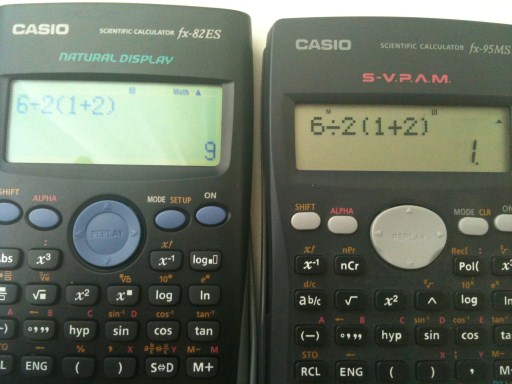
Casio  adamantly claims that the answer is 9.
On the other hand, Casio believes that the answer is 1.
Who do you believe?
The debate ends up revolving around the order of operations - when given a bunch of mathematical operations to do, what is done first? Many schools teach mnemonics like "Please Excuse My Dear Aunt Sally" or "BEDMAS" as a rule to follow: Parentheses (or brackets), Exponents, Multiplication/Division, Addition/Subtraction. Those stages must be done in that order. Why? Oh, it's just the rule, everyone knows that. So let's give it a shot with 6÷2(1+2). Obviously brackets come first, so lets do 1+2 to get 3. Now we're at 6÷2×3 (a number written beside the brackets means you multiply it by whatever's inside). No exponents to worry about, but then we run into problems: what happens in the "Multiplication/Division" stage?

If you use "BEDMAS," "D" comes before "M," so you might think to do division first: 6÷2 is 3, so 6÷2×3 = 3×3 = 9. But if you use "Please Excuse..." (also known as "PEMDAS"), "M" comes before "D." So you should do 2×3 first to get 6, so 6÷2×3 = 6÷6 = 1. But WAIT, multiplication and division actually have the same priority, because one is just the inverse of the other - they're the same kind of operation. So in this case we just go left to right, and the division IS first, and so we get 9. Not so fast. While multiplication and division may have the same priority usually, here we have implied multiplication: the problem isn't 6÷2×(1+2), it's 6÷2(1+2). So the 2, right in front of the brackets, is directly tied to the brackets and must be evaluated first. You're right, it is implied multiplication: but the thing in front of the brackets isn't 2, it's 6÷2. Now hold on a second...
Of course, Calvin was a type (c).

On the one hand, I find it hilarious that people get so riled up about this, since pretty much everyone's view of math is either (a) math is a useless subject they force you to learn in school, (b) math is good because it's applicable to science, technology, finance, business, etc., or (c) math has some intrinsic beauty that's worth studying for the same reason as music or literature (guess which camp I'm in?). But people in (c) should realize that the question is way deeper than just "what rule do you follow," people in (b) should be claiming that the person who wrote the formula should be fired for causing a disruption in the work flow, and people in (a)... why do you care at all?!?

But I also get very scared by the fact that this debate rages on so fiercely. Because in all my scourings of the internet, of the hundreds upon hundreds of comments I have read through, I have seen the "order of operations" invoked in almost all of them... but not once have I seen anyone ask why.

It's true, every now and then I come across a person who doesn't take a side between 1 and 9; they either say that there are multiple rules and different people have been taught differently, or (slightly more to the point) the expression is so sloppy, such bad form, that it's just unanswerable; that it's like asking "How manu apokeis is d Reiwhfds?" and expecting a correct response despite all the spelling errors; and that no one uses a division symbol any more because of issues like this unless they have to, preferring instead fraction notation with one number over top of the other. People like this restore a bit of my hope for humanity's future. And yet, they still shove the main problem under the rug: why is an order of operations even necessary?

click to zoom in
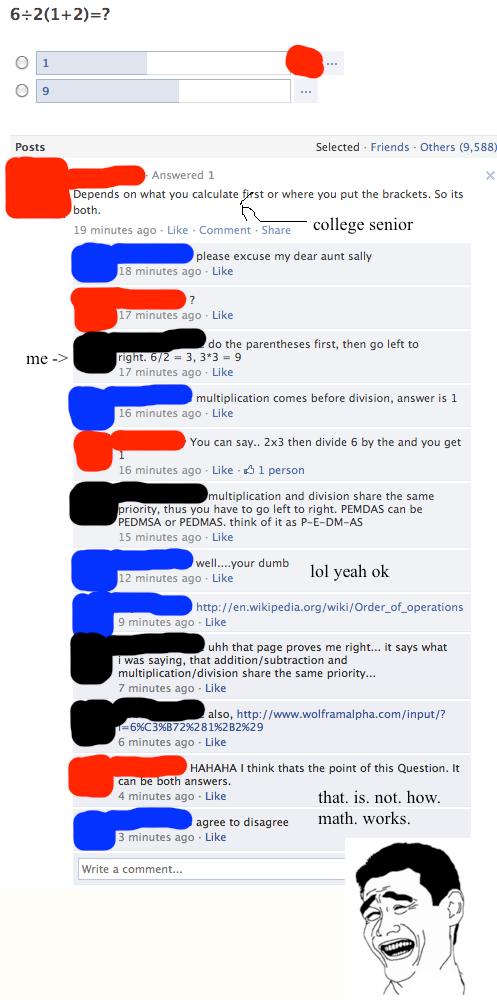
The image to the left in particular is striking. A college senior (who seems to me to be the most intelligent in this conversation) claims that either option is valid. The person labelled "me" in the diagram, however, laughs at this, saying "that. is. not. how. math. works." And here's the thing: he raises a very good point. Math is supposed to be consistent; start at the same place and you should be able to end at the same place. You shouldn't be able to get two different answers depending on how you feel or on your teachers' opinions. So how on earth can we have so many different conventions for the order of operations?

Here's what's going on. "College senior" is correct: there are two answers. "Me" is also correct: math does not work that way. The conclusion? What's really wrong with 6÷2(1+2) is that it's not math.

Want to know what I mean by that? Check out Part (14÷7(5-3)+2)÷3.

Thursday, June 7, 2012

Math and... poetry.

At the end of my treatise on math and sports, I (mostly jokingly) stated "Up next... math and poetry? Maybe some other time." So when a friend of mine posted these two articles and they showed up on my news feed, I felt I just had to share them. Don't think I'll discuss them further though - just read them for yourself and ponder them.

http://poetrywithmathematics.blogspot.ca/2010/04/poetry-and-mathematics-similarities.html

http://mathematicalpoetry.blogspot.ca/2007/02/delineations-between-aesthetics-of-math.html

Saturday, June 2, 2012

A Note from the Past: "Lockdown"


Originally posted as a Facebook note in December 2010, I'm reposting this here because I just had another epic dream. Planning on writing up the new one sometime soon - stay tuned!

Thursday, May 10, 2012

A Note from the Past: Early College?


Recently, two friends of mine from my high school - an underclassman currently in junior year, and a teacher - were apparently having a conversation which led to a note I had written in the past. The underclassman friend asked to see it, and in doing so reminded me that this note actually existed. So I read it again and felt like posting it, adding a few reflections to the end comparing it to where I am now. So without further ado, allow me to introduce you to Jonathan Love, December 2009.

---   ---   ---

Several people have come up to me asking if I was going to go to college a year early; some actually wanting me to consider it, some just joking (I think), and some having heard it from someone else and asking if it was true. It's true that I was seriously considering going to college a year early, but I've decided not to; this note will give an overview of the reasons I was thinking about going, and why I finally decided against it. If you knew I was thinking about it, hopefully this answers your questions, and if you didn't know, well, now you do.

The main reason most people go to college early is because they feel they would get more out of a year of college than another year of high school. And I think it's true that if I went to college instead of completing grade 12, I'd probably learn a lot more and have a lot of opportunities to explore and venture further in knowledge. Going into college earlier would also mean completing college earlier, meaning I could get a good job or do what I wanted to do in life a year earlier than I normally would. As for whether I could, I think I'm able to get into college after my junior year ends; I have the SAT scores and most of the credits needed to get into most colleges. I may be missing a few courses needed to apply to the colleges I'd want to go to, but if I had made the decision to apply a year early to college when I first started thinking about it, I'm sure I would have been able to put in a bit of extra effort to pull together the necessary credits for getting into a college. You don't need a high school diploma to get into college, so graduation requirements wouldn't have been a big issue; I would just need to have the courses the individual college requires, and given my situation (SAT and AP scores, etc.) I probably could have even been exempted from a few of those. I probably could have made it into college, started in fall of 2010, and been fairly successful and enjoy it.

But I didn't.

There are several reasons for that choice. First of all, though I think I would be ready to enter college even now, I still think that I'll be even more prepared given another year of high school. There's still a lot at CAJ (Christian Academy in Japan for those that don't know it) that I haven't learned that will be quite useful to me in college. It's true that I've basically exhausted the math program here, so for that subject I'll have to look elsewhere, but for all the other subjects, there's still more to be learned here. I haven't gotten as much as I possibly could out of high school yet, so another year here won't be a waste of time. By completing another year of high school, I'll be able to enter the college with an extra advantage that I wouldn't have had if I went in a year early, and I might be able to get some better scholarships or get into some higher level schools than if I had gone in with a year less preparation.

Another reason I'm staying behind is because as much as I enjoy a fast-paced life, I don't want to rush it. At this point, it's far too late to start the college application process, but even if I had decided well before that I was going to apply early to college, it would have meant a frantic scramble for college apps, financial aid and scholarships, etc. etc., and I just felt that it wasn't really worth it. In the grand scheme of things, one year doesn't make a huge difference, and especially considering the previous point, that I'd have an extra advantage going into college with grade 12 under my belt, I think my life in the future won't be any worse going into college a year later. I want to enjoy the moment, to be able to live without excessive anxiety, and to just let life happen; I don't want to force my way through life at excessive speeds just to finish it all and not know what it was I even accomplished, or what I'm going to do with it.

That brings me to my next point; I don't really know what I want to do with my future yet. If I had a strong urge to go into medical or law school, for example, getting into college a year early would give me a step towards reaching that goal. But as it is, I have no specific academic goal to work towards, so I figure I'll just let life take me where it will. I'm thinking at this point that for my college career, I'll try and go in a direction that will let me get as much done as possible, but still give me a wide range of opportunities and not narrow me down too much; that way, I'll be able to try a lot of different options, and if I eventually do get a passion for a specific goal, I'll be able to reach it more easily. Whatever the case, entering college a year early won't really help me out here; I'll just let God lead me where he will. If he wants me to know exactly what I will be doing twenty years from now, he'll let me know so I can pursue that goal; until then, I'm quite happy with taking life slow; full, maybe, but not rushed.

Lastly, but by no means leastly, I like CAJ. A lot of people I know just can't stand high school, and I'm sure that if I were one of them, I would do everything within my power to get out of the system as quick as possible. But I feel really blessed that I get to go to CAJ for my schooling. CAJ is by no means perfect; far from it. CAJ leaves a lot to be desired in many ways, and there are other places I've been that have advantages that CAJ lacks. But out of any school I've been to (I've attended 4 schools besides CAJ and visited several others), I don't know of any place I would rather go to school. I could write a 1000+ word rant about this if I really wanted to (and I think I have, actually), but I'll just say that the teachers, the staff, the physical plant, the curriculum, the students, and the community of CAJ have all given me so much, and I want to make the most of the time here I'll get. Not only that, but I want to give back as much as I can as well. That's one reason I try to get involved in so many ways; I just want to do my best at giving back to those who have given me so much already. Missing out on my senior year here is not something I would willingly choose to do.

I'm looking forward to college; it's going to be an exciting next step in the journey. But there's no reason to rush to that next step; running through life only means that you get to the end faster. So to all fellow classmates and underclassmen (and faculty and staff): for better or for worse, I'm here to stay. See you around until June 2011.

---   ---   ---

Back to May 2012 Jonathan. My thoughts now? Well, first of all, I'm really glad I decided to stay. So much happened during my senior year that I really couldn't imagine going without. It shaped me and taught me a lot, clarified my goals and purpose in life, and I was able to give back to the people in my school community in more ways than ever before. A year of many firsts, and of many more lasts; a year I would never wish to have gone without.

Secondly, while I didn't say this quite so bluntly in the actual text, one of my hopes was that by staying through senior year, I'd get that extra boost needed to get into an Ivy League school. And, well... that flopped. haha. But Grade 12 definitely changed my thoughts about college. Before, I didn't know what the plan for my life looked like, so I figured the best way to deal with that would be to get into as prestigious a place as possible so I could have more opportunities to start off with. But by fall of senior year, I still didn't know what the plan for my life looked like, and I still figured I'd try to go in a direction that just gave me a lot of opportunities for directions to follow, but I began to realize that a top-notch school really didn't offer me that much more than a not-quite-so-top-notch school - and when there's a nearly-top-notch school with a tenth of the tuition of the top-notch schools, what's wrong with going with the cheaper option? So I still applied to Harvard, Princeton, UChicago, but I really wasn't too stressed about the applications (maybe that's why I got waitlisted? :\). And when University of Toronto, my "safety" choice, became my only choice, I was totally fine with that. Who knows, maybe I wouldn't have gotten into UofT if I had skipped senior year? Or perhaps, I wouldn't have gotten in with as many scholarships as I did? It doesn't really matter, in the end. I am where I am, and God will take me where I need to go from here.

The interesting thing is that I'm in a similar situation now, with having to decide whether an extra year is worth it. By staying an extra year in high school, I amassed a large quantity of AP credits - I took 11 AP tests, and had I gone to the right school, I could have skipped an entire year of education with those. UofT only accepted 3 of the credits, but I'm still happy with that, because it fulfilled most of my breadth requirements (UofT requires students to take a few courses in a wide variety of subject areas) and set me more than a full semester ahead of the average. I'm currently easily on my way to finish my degree in three and a half years, and with a bit of an extra push, I could be done in three. But after talking with a few upperclassmen in the math department, I've actually been encouraged to stay the extra year. 

Why? Well, if I had a strong passion, a drive to reach a certain point in life by a certain time, or if I had really pressing financial concerns, that would be one thing... but otherwise, staying a full four years is worth the time and money, because it gives me the chance to get to know professors better. And getting to know professors is crucial; not only are they potential recommendation-letter-writers, but they can teach you things one-on-one; they can give you the boost you need to get into a very difficult field of study or research position; they can put in a good word for you when you need it; and of course, they're just awesome people with astonishing amounts of information in their brains that they're just dying to share with others. Why wouldn't you want to spend as much time as you could getting to know them, and letting them get to know you? The higher level courses are the ones where this interaction happens the most - best to take advantage of those upper years, rather than just fly through them. Plus, UofT allows undergrad students to take graduate-level courses if they have the prerequisites, and there are literally thousands of undergrad courses offered as well, so it's not like I'm going to run out of courses to take. Again, I'm in no hurry to get anywhere. Not yet at least. If God wants me to get moving, I'm listening.

Monday, April 23, 2012

The curse of virality - a KONY2012 review

So first there was the video.

Then there was the incredible popularity. The video, a plea for help in an effort to bring justice to Joseph Kony, was watched over 100 million times, produced millions - quite possibly billions - of tweets, got over 3.5 million people to pledge to write to their government about the issue, involved several celebrities and other famous figures, and generated hundreds of Facebook groups around the world devoted to "Cover the Night:" a mission to make Kony famous (or rather, infamous) by putting posters of him up everywhere on April 20th.

At around the same time was the criticism. Some fairly harsh, some merely urging caution, but all pointing out several things wrong with the mission - that the organization behind it wasn't financially trustworthy; that they were supporting a militia as corrupt as the man they were trying to catch; that the video, as well as the entire mission, seemed Eurocentric and paternalistic; that the issue was far more complex than they were making it out to be; and a host of other problems. In particular, many Ugandans responded to the video, and in fact a riot broke out at one rural showing of the video, in anger at its message.

Then there was the breakdown - the narrator of the video, co-founder of Invisible Children, apparently due to the incredible stress of trying to manage a viral sensation, temporarily lost his sanity. And this of course came with many, many reactions.

Then, on April 20th, there was a hush, as the world sat waiting to see just how big Cover the Night would be. Some cities deployed extra police officers, uncertain of what to expect. Practically every major city had a Facebook event page for the night with thousands of people listed as attending.

On Saturday morning, cities around the world woke up to a world of red. Posters lined every building on every street, large banners hung from lamppost to lamppost and off the sides of bridges; roads had been turned into giant canvasses of chalk art displaying Kony's now all-too-familiar face. It was everywhere.

...no, no it wasn't. The world woke up and for the most part didn't have much of a clue that anything was different. Take my experience for example - I was walking all over downtown Toronto over the weekend for various errands and events, a total of nearly 20 km, and in all that time I saw a total of two Stop Kony posters. Two. You'd think that with 6000+ people signed up to attend on Toronto's Cover the Night Facebook event page, the posters would be a bit more visible. Unless they all chose to cover the same secluded alleyways.

So what went wrong? Why would a mission that started off so popular so drastically fizzle out? The viral video was immensely successful, was it not? Perhaps it was the massive wave of criticism that disconcerted people? Perhaps it was seeing the leader of the movement going wild on the street? Perhaps if there had been less criticism, if Jason Russell had just managed to keep his act together, the night would have exploded in colour and posters.

No, the problem was in the presentation. The very thing that allowed the video to rack up so many hits was the same thing that caused it to die - virality.

Invisible Children decided to use a fairly new technique for their mission, one that hasn't been applied all that much in the past - a youtube video, intended to be spread via social networking. And this post, to clarify, is going to focus on this medium; the presentation, not the content. While I do have opinions on whether supporting the cause is good or not, I'm not going to discuss that in depth here - so assume, for now, whether you agree or disagree, that Invisible Children Inc. had the purest of goals and an ethically flawless plan, and that Cover the Night would have, if successful, actually been significantly beneficial to the current political and social climate in central Africa. Keeping this in mind, let's scrutinize the viral video plan.

Likely, they had looked at other viral phenomena (Trololo, Rebecca Black's Friday, and Susan Boyle come to mind as ones the general public is likely to have heard of) and figured that the same networking power that allowed those videos to hit the 8-digit mark would push theirs somewhere as well. And when the views started piling in, they got excited because their message was being spread.

One thing they may not have checked out though... (taken from Google Trends)

Trololo


Rebecca Black

Susan Boyle

The common factor in all these three diagrams is that every viral video spikes, and then after perhaps a week of popularity, there's a sharp decline. Within a month, the popularity of a video is significantly lower than its peak. You can point out a few differences in the above graphs - for example, in the surprising resurgence of Susan Boyle one month later - but these aren't constants. The constant is the spike, short popularity, and quick downfall.

So, then, is this any surprise at all?
Kony


I suppose the spike is much sharper here than the other videos (no "plateau week"), which is definitely a little surprising, and they couldn't have expected. But the lesson from above still holds true here, and is something they should have expected - a viral video will, for the most part, leave the consciousness of the internet within a month after its spike. Again, there are exceptions (nyan cat being one), but it's never wise to depend on exceptions.

So if Invisible Children Inc. wanted Cover the Night to be a success... why didn't they set it for March 20? Or keep it set at April 20, but release the video a month later than they did? They might have chosen a date a month and a half away in order to give people time to prepare - but on the contrary, given too much time to complete a task often makes people less likely to do it (the "there's still time" attitude - the root of procrastination). And besides, people are busy and constantly bombarded with information, there's no way they're going to spend fifty days thinking about a single cause. Give them twenty, and if it's an important enough task, they might decide to keep it in mind the whole time, and carry the excitement through to the end.

Others might argue that no, this social-media-generation is just too passive, nothing would have happened no matter what the timing. That the quote from Hotel Rwanda fits all too well here: "I think if people see this footage, they'll say 'Oh, my God, that's horrible.' And then they'll go on eating their dinners." But I don't completely agree. I've seen legitimate effort go into this movement; if the people who saw the video and were touched by it were told they could do something to help right away, I think many of them would have, especially after seeing how many others were on the same boat. I don't think this would have been a good thing, because it would have been taking advantage of people's emotions to build the movement, but it would have gotten results (perhaps this is exactly the reason they gave it so much time... because they wanted everyone involved to be there because they had made a rational decision to, apart from the emotion of the video?). Yes, for a large number of people, the issue would have been passivity - many people would have gotten excited online, but fail to follow through, regardless of timing. But more generally, I would say the issue is not just plain passivity - it's a short attention span.

To us (meaning practically anyone on the internet enough to read this blog post), a viral video - or practically any shared social media - is a one-time thing. We see it once, or maybe a couple hundred times in a day if it's really funny, and we bring it up in conversations and on our online profiles while it's fresh in our mind, but soon enough there's something else exciting to look at, and we throw it in the giant toy box of all the coolfunnyrandominterestingthoughtprovokingdisgustingaweinspiring things we've ever seen, to be called upon if needed, but not kept on our mental workbench. And if you make a video and hope it goes viral, this is what you must expect.

KONY2012 in Tokyo
And so here we are, on the other side of April 20, with not much different than before. Actually that's not entirely true; there was, in fact, a significant worldwide turnout (some instances are shown on the KONY2012 website). Many people did stay devoted; those who had thought the issues through and decided to stick by the cause (and perhaps those who had bought the action kit when they were still passionate about it and felt it would be a waste not to at least put those few posters up). The students at my old high school (see picture on the left) are a good example of this. Though they were concerned about the financial issues behind Invisible Children Inc., they still wanted to support the cause - so after discussion, prayer, and planning, they decided to make all their own t-shirts, posters, etc. so they didn't have to support the organization financially. And when April 20 rolled around, they were ready. Perhaps not enough students to cover Tokyo, but from a high school of just 200 students, the kind of turnout you see here is remarkable.

So you have the people who thought through the issues and decided to support the cause. And then you have the people who thought through the issues and decided that the plan would do more harm than good. And I have strong respect for both of these groups, for choosing to spend the time to think through the issues just long enough to be able to understand their own position. Unfortunately these seem to be the minority. You can tell by the thousands of "attendees" on hundreds of Facebook groups who never followed through that there are millions of people who, though they may think they care when they first watch the video because of how it tugs at their emotions, are all too ready to move on when it's no longer entertaining. And there are likely just as many people who saw a single critique of the movement and used that as a getaway; an excuse to stop thinking about the issue without a guilty conscience.

Although, who am I to judge that? I definitely put some thought into the issue, reading what I figured was a large variety of viewpoints and primary sources before deciding that supporting the Stop Kony movement wasn't part of my purpose here. But to the people whose lives revolve around issues such as these, I probably seem just as fickle and "I have an excuse to stop thinking now" as everyone else. I am very much a part of the internet generation, susceptible to many of the same failures.

But going back to the people who made the video; they tried something new and innovative, with very little previous experience to go on. They couldn't have known how it would turn out, and while it sparked attention beyond their expectations, it sparked far less action. Because in the end, a lot of people care, but they don't care for long enough. And this is especially true of anything shared worldwide by social media.

Finally, a related page that discusses a lot of the things I was talking about, and from more credible sources. Oh, and apparently there will be a new step of action on November 3; I wonder how many people will show up to that, 8 months after the release of the viral video? But by this time you're probably at the end of your attention span for this topic, so it's about time to move on to something new that the internet has to offer.

Tuesday, April 10, 2012

Math and Sports - in the game

So in my first post in this "Math and Sports" series, we saw how math can be used around sports, but not necessarily in the sports themselves. Next we looked at how math can be used to decide how exactly the sport will work - the rules and the equipment. Finally, we'll dive in one final step - how to use math when you're in the game.

But before I get to that, I need to clarify how math is NOT used in sports.


"oh when you shoot the basketball you calculate the path of the trajectory and the force and angles needed to make it go in lolololol"
 - Jonathan Love


Yeahhhhh... no. Nope. Sports don't work like that. First of all, just because you can calculate the force and angle doesn't mean you have the hand-eye coordination to produce exactly that force and that angle on demand - but more importantly, even if you could, stopping to calculate at a crucial millisecond is a formula for disaster. 

YES, THIS IS ME, NOW STOP AWWW'ING
IT'S GETTING ANNOYING
In my late elementary and early middle school years, I took judo - and one of the main philosophies of judo is never think. It sounds like a very Eastern, zen-like philosophy, and it is, but it actually reflects a very important aspect of sports - skills should never be calculated. Weekly judo practices would include hours upon hours of repetitive drills - for the first month or so, the only thing I practiced was how to fall correctly. Forwards... backwards... sideways... from a standing position... from the knees... when thrown... when tripped... when shoved off balance... hour after hour, week after week. The end result? When I fall, I do it safely, keeping my neck rigid to avoid whiplash or banging it against the ground, spreading my arms out and slamming them against the ground to distribute the load, rolling just enough to avoid a too-sudden change in momentum. Not because I think "oh look I'm falling I need to protect my head, what should my ideal momentum be before coming to a stop..." no, at the speed a judo match moves, having to think that wouldn't give you enough time. It HAS to be a natural reaction, as natural as closing your eyes when a fast-moving object is coming towards your face. Once I was done with falling (which actually never happened - even the masters keep practicing their falls, so they never lose the habit), I moved on to various attacks - but here it was the same. You never have time during a match to think "the opponent is vulnerable here, I should move this way and get them off balance and..." no, you see, and move. It has to be an instinctive response. And until it is, you keep training. And once it finally is a natural reaction... you keep training.

This goes for every sport. Hours of repetitive drills is the only way to learn any skill. Whether it be shooting, serving, spiking, batting, passing, dribbling, screening, volleying, throwing, blocking, sprinting, or catching. You don't learn how to do something by calculating how it should work. Even if you completely understood the physics of a basketball shot, that wouldn't help you get a perfect free throw average. You improve your free throw average by working with the ball until it feels like a part of you - so that getting the ball to land in the net is as easy as getting your hand to land on the doorknob to open the door. And until it is that mind-numbingly simple (which it never will be)... you keep training.

So that's where you don't use math in a sports match - when performing specific skills upon an instant. These ought to be things you never think about, let alone calculate.

With that said, let's see where math DOES come in.

"The game is won or lost in the weeks
leading up to it."
TRAINING. Ok... I guess this isn't actually "in the game," but I'm sure there's some quote somewhere about how "the game is won or lost in the weeks leading up to it" or something like that, so technically this is part of the game. Anyways, an athlete has to know exactly what to do in order to best prepare for an upcoming match. Often the required math is left to a trainer or coach - the athletes trust that the coach will come up with a suitable practice schedule and just listen to what they're told to do. But there is math required, whether it's left to the coach or done on one's own - what you need to in order to be in shape by game day. Exercise routines need to be calibrated; nutrition needs to be moderated; there are a lot of things to keep track of, to calculate what's best for you.

Nowhere, I think, is this more evident than in cross country. Maybe I say this just because that's the only high school sport I took part in, so it's the most clear to me there. Maybe I say this just because my coach happened to also work at the school's IT department and so took very well to statistics and times and paces (he even developed an iphone app for keeping score at cross country meets). But whatever the case, math came into our practices and dictated what we did. After every cross country meet, the coach would take our result and calculate a goal time for the next week - our "ice cream time" it was called, because we got a free ice cream bar if we achieved the goal. And his calculation was able to take into account different courses with different difficulties and different lengths and still come up with a reasonable goal to achieve - something that was not out of reach, but still pushed us.

(photo credit to Bette Vander Haak)
Coach keeping stats
The types of practices we'd have were quite math-driven as well. We would have "jan-ken sprints" (or "rock-paper-scissors sprints") where you'd play rock paper scissors with the coach, and the more times you won in a row, the shorter the distance you'd have to run - and we'd often discuss probability, expectation value, "how far would you run on average" or "worst case" or "best case," and these were taken into account to make sure the practice was a good workout for everyone without killing anyone. We'd do a lot of running for a set time at a set pace (thresholds, my best and worst memory of XC) - the importance being not how far you could get, but whether you could reach the same distance in the same time while always staying below a certain heart rate, even after doing it several times in a row. Great stamina training, and incredibly calculated. The better you were at guessing your pace, and calculating the distance you could run at that pace over a certain period of time, the better runner you could be.

Another thing that must be done in the days leading up to a sports match is examining who you'll be up against. Partly this is done by watching them, but it also involves an analysis of their statistics (discussed in part one of this series). In the case of cross country - which runners should I keep on eye on? Whom should I aim to pass, whom should I try to keep up with? Most of these decisions would be based on their time in previous events, and we'd use these statistics to predict their next performance. This of course can come up in other sports too... which players of a team should you keep an eye out for? Which moves or plays do they tend to use the most? Which team member should mark which opponent? And so on. Again, these are decisions often made by the coaches, but the better the players understand the statistics, the better they'll be able to make similar decisions for themselves.

CURRENT STANDINGS. Now we're in the game; the whistle has blown, the gun has fired, the players are in motion. One thing that is crucial to having a good game is understanding where exactly in the game you are at any point in time. Not just how much time is left, but what the current stats are. Which team is up, and (quick mental subtraction) by how many points? How many players have fouls - who on our team should we be cautious around, who on the other team should we encourage to screw up? What needs to be done in order to do as well as possible from this point on?

(photo credit to Jared Johnson)
Yup, another "me in a sport" picture. Just to make it look
more like I know what I'm talking about. :p
Once again, this is quite clear in cross country. One thing many teams have is a coach standing at the mile mark, yelling out the time as each runner passes. "6:42!" I've been taken it too easy... I'll have to push a bit more for the rest of the course. Or maybe "6:08!" Wow, I've really let my adrenaline run away with me, I'm tiring myself out... all right, where's a good pace that will keep me doing well but not kill me? And then instant calculations must be done to compensate and set a good pace. Knowing at what points in the race to push, and at which to coast, do require some basic math. Note that these aren't "instant skills" (which I claimed should not involve math, or any conscious thought), but rather determined decisions which affect the rest of the match. These kinds of long-term decisions, based on current standings, are decisions which do benefit from a bit of math.

The guy in my high school graduating class who won athlete of the year, star of the cross country team and long distance track team, and also a valuable part of the basketball team, also happened to be incredibly quick at math (well, he was just in general an all-around good student, but it's the math part that's important here). As far back as fourth grade, I remember him doing far better than me at the infamous "mad minutes" we had to complete, and ever since then, any time any of us would start asking "so hang on, what's 857 divided by 13..." he'd be the first to come up with the answer. And he would apply math to sports so smoothly, it made you wonder how people who didn't do so well at math managed to succeed in the sport. He had such an intuitive understanding of the relationship between one's mile-time and final result that, if he were watching a race at the mile point, and he knew the past statistics of each player (which he happened to know unbelievably well), he could probably predict the final times of each to within ten seconds (this one might be an exaggeration... but I wouldn't be surprised, he's amazed us in similar ways before). And he knew his own pace really well, so at every point in the race, he'd be exactly as tired as he predicted he would be.

(photo credit to someone holding Jared Johnson's camera)
Three of the top ten in the league. Not bad.
Relating to the previous section on training, this runner was the one trained the most meticulously, always keeping to what was calculated. He knew statistics of other teams like the back of his hand and was consistently able to make accurate predictions of future match results. This is who I think of when I think of math and sports going together. Such an intuitive understanding of the game statistics, and of pace, distance, and time. But this guy wasn't the only one on the team like that, by no means - several runners on our team were similar in their understanding of the numbers. I think this was one thing that allowed our team to do so well in the league despite being from such a small school. We would be able to beat teams from schools three times our size, because we understood the numbers and acted on them. Oh and also just because we have some awesome runners too. Yeah, if you can't tell, I'm pretty proud of my teamd(*⌒▽⌒*)b
So in summary, coming up with a game plan before the game begins is one thing - you have time to think through things, to look at past statistics, to make calm, rational decisions on how to approach the match. But a good athlete is one who can continually update the game plan based on how the game is going - to be able to take stock of where things currently are, and make adjustments as necessary. Throughout any match, you'll be provided with information with how things are playing out - deciding the updated game plan is partly an intuitive "do what feels right" choice, partly a qualitative evaluation of the current situation, but it's also partly mathematical, as you take into account the numbers around you and make some calculations about what this means for how you play throughout the rest of the game.


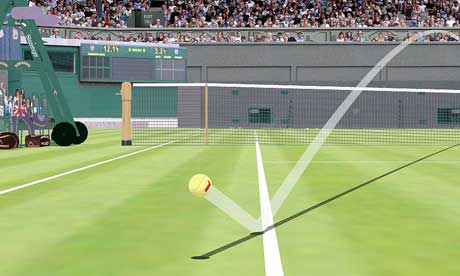
STRATEGIC DECISIONS. As I made clear above, specific skills - shooting a goal, passing to another player, etc. - should not require any thought. But it may well require some thought to decide when to use them - whether to pass or shoot. Or in a sport like tennis, you shouldn't have to think "how do I get the ball to land where I want it to land," but it may be worth thinking "where do I want it to land?" This part definitely varies from sport to sport, and I'm not about to claim that every strategic decision can apply math somehow - most will be very intuitive, based more on experience and a "feel for the game" than an actual mathematical prediction of what an action will result in (for example, I don't think any professional tennis player actually calculates the point on the court at a maximum distance from the opponent in order to aim there; they just know). But whether they keep formulas in their head or not, most good athletes are able to analyze situations and come up with optimal decisions. And this is a mathematical mindset. Math isn't all about knowing formulas - it's about facing a problem, given certain information, and using the information you have to solve the problem. And this is what good athletes do all the time.


The point guard of my high school's basketball team illustrates this point really well. On the one hand, he was just an incredibly technically skilled player - he had put in his hours until basketball came naturally to him. But he also had a sharp eye and a quick mind. First, his sharp eye - he was able to just see things that many people probably wouldn't under the stress of a basketball match (his ability to see more than what most people do also makes this guy an incredibly talented graphic designer, and one of the wittiest people I know). But just because you see all the options doesn't mean you can act on them; this is where his quick mind comes in. He knew the playbook inside and out, and could match any scenario with a play that would fit. In other words, he faced a problem (get the ball into the basket), collected information on the fly (the positions and movements of all other players), and would be able to come up with an optimal solution on the spot. It would be so much fun watching him lead the team, because you'd know you were watching a great mind at work.


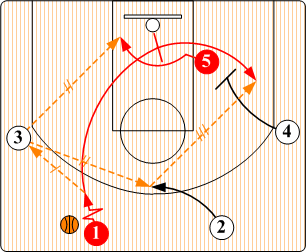
This, believe it or not, is a formula.
Now this point guard wasn't necessarily all that fond of math class, but I would still argue that the type of problem-solving that went through his mind was mathematical. Because the thought process you go through when you see a problem, choose a formula that matches it, and solve the problem using the formula, has very strong connections to the thought process of seeing a problem, choosing a play (like the one on the right) to match the situation, and solve the problem using the play. Plays are essentially formulas in sports - they're a simple set of rules that, given certain conditions, will give you a certain outcome, if you follow the steps correctly. Of course, math is much more than knowing formulas - just like sports is much more than knowing plays. But both math and strategic plays in sports are very much about solving problems, and a mathematical mind knows how to solve problems reeeally well. And how to look for the exceptional cases, the "hidden" options no one else will see or expect; how to carry through any plan consistently; how to settle for nothing less than perfection.


So that's all I have for now. There's probably more to be said... but hopefully my point is clear. Math and sports (like math and anything) are highly interconnected. Definitely not saying that you have to be good at math to be good at sports or appreciate the game; but if you do decide to go after the math, whether you're an athlete, a coach, a manager, or a fan, it unveils a whole new, rich, fascinating layer to the game that could never be truly understood otherwise. 


Up next... math and poetry? Maybe some other time.

Monday, April 9, 2012

Math and Sports - Setting up the Game

Last post, I talked about some of the math behind the large-scale problems in sports; the use of statistics and finance, how probability appears in tournament designing, where linear algebra determines rankings, and how several branches of math you may never have heard of before converge in scheduling. And for the most part, I didn't actually present any math at all - I just sort of described the general gist of the way math is used and left it there. This post will be different, hopefully, by actually showing you some of the math involved.

First off, I'll ask a well-known Microsoft interview question: why are manhole covers round?


If you haven't heard it before, take some time to think of some possible answers. There are a lot of very practical answers, and most come down to some geometric fact about the circle. Something provable about circles before even considering how they work in the physical world. And this idea is one that will come up later in this post - I won't directly refer to this example, but the idea of geometric facts having practical implications is pretty important. BUT for now, back to sports. What math goes into deciding how the game works?

SPECIFICATIONS. Length and width of the playing area; number of players per team; time limits; points awarded per action; equipment size; there are a lot of very specific rules in every sport determining how the game is to be played. And many of them involve a measurable quantity - length, number, mass, area, time - which can be mathed upon. But chances are that most of these rules developed through trial and error, not through mathematical reasoning - people would try it one way, find it doesn't work so well, and so adjust things to make it work better. So there really isn't a strong connection to mathematics here (at least not one I can easily find). I wouldn't be surprised if some math was used in making the official decisions though - examining the statistics of various athletes playing under various rules, and predicting a set-up that would make the game-play go as well as possible.

Although I definitely could say something about the geometry of a sports court. Lots of rectangles, often circles too. But again, nothing too mathematical behind the sizes of these - can't find any sports court with dimensions following the golden ratio, for example, which seems to pop up in so many other places. Again, sizes seem to be more dependent on what people have found to work.
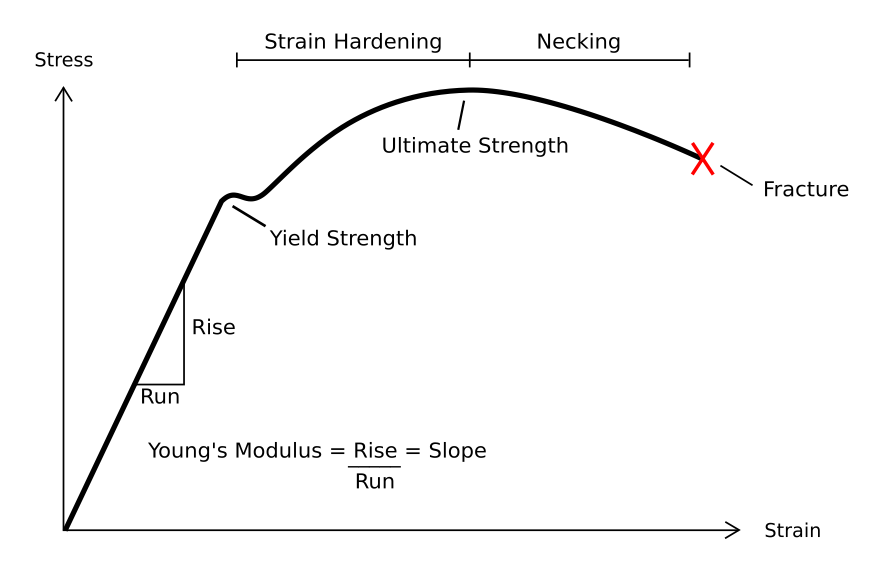
sports equipment has a lot to do with resilience - if you
stretch or squeeze something a certain distance (strain),
how much  force will it push back with (stress)
EQUIPMENT PHYSICS. So sports have all sorts of different equipment. There are balls, shuttles, rackets, sticks, goals, nets, masks, padding, shoes, and more. One basic consideration that has to go into all of these is the material to make the equipment from. To make sure nothing will fall apart in the middle of a game, for one thing. Any protective wear - padding, masks, shoes - should be made of a material that is slightly resilient - able to cushion a blow, but not let it get all the way through, and to distribute the force over a wide area. The goals, nets, etc. have to be able to take a beating without being to dangerous to play around (imagine a volleyball net made of barbed wire... *shudders*). Sticks and rackets should be rigid enough to transfer a powerful blow, but also slightly bouncy so that when the ball/puck/human head hits it, it will reflect most of the kinetic energy back into the ball/puck/human head. Determining the optimal bounciness/hardness of the ball is also important for many of the same reasons. These concerns all fall under materials science, which math is definitely applied in (to calculate resilience, for example - see the graph), but these aren't exactly direct applications of math, so I won't go too much into these (though they still are pretty interesting).

Another consideration is how big or heavy the various equipment should be - most of these (goal size, net height, etc) fall under specifications (above) and were probably developed mostly by trial and error; a few have more physical answers, such as the best length of a hockey stick or tennis racket to apply the most force to whatever you're hitting. Again, math is applied here, but it's more of a physics question (levers, angular momentum, torque) so I'll leave it be for now.

EQUIPMENT SHAPE. Ohhhhh man. Here's where it gets gooood. This particular section, it turns out, was my entire motivation for writing this series on math and sports because it's just so cool.

for the purposes of this blog post: top = football,
bottom = soccer ball.
Many sports use a spherical ball of some sort. And the reason for that should be pretty straightforward, if you've ever tried to played soccer with a football (We'll use the North American definitions of soccer and football here - see the diagram to the left - purely for convenience's sake, to avoid the verbiose and potentially-offensive-to-Canadians "American football"). You know how annoying the behavior of the football is whenever it bounces. The shape of the football is not designed for hitting the ground, it's designed for aerodynamics; any sport which involves a ball that frequently touches the ground - basketball, soccer, tennis, field hockey, and countless others - must have a spherical ball.
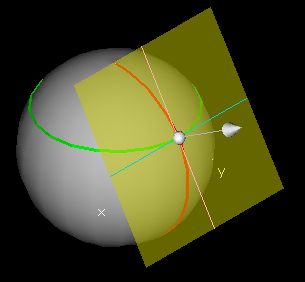
this arrow comes straight from the
center of the sphere; so if the yellow
plane were the ground, then the
center of the sphere would be directly
above the point of contact.
Why? Because (using slightly technical jargon - see the figure to the left) a sphere is the only 3d shape such that the tangent plane at any point is perpendicular to the line between the center of the shape and that point. In other words, whenever a sphere hits the ground (or a foot, or a wall), no matter how it lands, its center is directly above the point of contact. And so when a sphere hits the ground and bounces, the normal force from the ground, acting upwards, will just turn the downward motion of the ball into upward (ignoring any effects of friction and spin for now). In other words, it will bounce according to the well-known law of reflection - the angle at which it lands will equal the angle at which it bounces back. And so you can predict its motion. Despite the physical interpretation, this is a purely mathematical fact of spheres - lines from the center to any point are perpendicular to the tangent plane at that point.

I know this doesn't look like a football.
Just use your imagination.
This doesn't happen with a football, for example (or a cube, or any non-spherical object), because when a football lands, its center isn't necessarily directly above the point where it hit the ground. Part of the normal force gets put into making the football go back up, but another part goes into spinning the ball (something known as torque). So it won't bounce as high as you'd expect, and it will spin strangely in some unexpected direction. This is the same thing you see happening with dice rolling (which is what makes them so hard to predict), or when you drop your pencil and instead of bouncing back up to you, it ends up in another dimension, never to be seen again. This is why spherical pencils would be awesome.

Similar ideas go into rolling - the sphere is the only shape which doesn't "prefer" any orientation, because it's symmetrical in all directions. Symmetry is the idea that a shape looks the same even when you look at it from a different direction; for example, rotate a square 90 degrees, and it looks exactly like it did before. But no matter how you rotate a sphere, it'll always act the same. Every other shape will have some points where it will rest nicely, but some where it will tip over. And this makes a sphere much nicer to play with (Hockey is a notable exception to the rule that "things which touch the ground must be spherical," because it doesn't go in the air as much, and so bouncing isn't as big of a concern, and because it has no need to roll since it's on ice. But its round shape comes from the same reasoning - it should act the same way no matter which side you hit it from).

Football aerodynamics
So other than sports which employ some strange shape for some strange reason (footballs and badminton shuttles are designed for their aerodynamics, which is itself a fascinating topic but again, more physics, less direct math), the balls used in sports are spheres for a good reason.

But how do you make a sphere? Unfortunately, though spheres are a very natural shape, they're very hard to produce - especially out of materials that are good for sports. Some balls (such as volleyballs) have an inflatable rubber part inside, known as the bladder, which can be pumped up to form a sphere, and some (like baseballs) have a center made of rubber or cork, wrapped up in yarn to form a ball. But a lot of sports want some sort of leather covering for the ball. So when leather comes just in flat strips, how on earth do you make it into a sphere shape to cover the ball? Speaking of earth, this, in fact, is extremely closely related to the problem of drawing maps. The earth is a sphere, so how do you draw flat maps of it?

Constructing a circle out of flat parts
Both of these questions can be connected with a branch of mathematics known as topology - the study of the basic structure and properties of shapes, not necessarily length or size or angles (which sets it apart from geometry). There's a well-known joke (well, well-known among mathematicians at least) that a topologist can't tell the difference between a donut and a coffee cup, because they both have the distinguishing property that there's a single hole that goes right through them, and that's all topologists notice. One of the central concepts of topology is that of a manifold: any shape that can be made by sewing together pieces that are basically "flat." And by proving things about the little flat pieces, you can then prove things about the entire manifold. So a sphere is a manifold, for example, because you can sew together a bunch of flat things to make something that's essentially spherical. A torus (donut) is also a manifold - as are many other incredibly weird shapes that topologists spend their time studying.

Not all manifolds are as nice as a sphere.
 (the Calabi Yau manifold)
So the fact that the sphere is a manifold is what makes map-making make any sense. You can't really make a sphere flat without destroying it - but you can make flat pieces and describe how they fit together. Which is what maps are - little flat pieces of the sphere. And though they don't actually study topology to do so, this fact, that the sphere is a manifold, is what allows sports equipment manufacturers to make balls. They make flat pieces and stick them together.

So the question is... what kind of flat pieces do you make, and how do you stick them together to end up with a basically spherical shape? One solution is the tennis ball / baseball method - two strange round pieces that fold over towards each other. Basketballs use eight strips of different types, four of which line up with each other to make a hemisphere. A standard volleyball is made up of eighteen thin strips; three strips are pieced together to make a slightly curved panel, and the six panels are pieced together in the same arrangement as the faces of a cube - so you can identify a top, bottom, front, back, left, and right.

the regular polyhedra (also known as Platonic solids)

the volleyball: a cube
that looks like a sphere.
Now the volleyball in particular, of the last couple balls described, is pretty interesting - because it's essentially a cube. Which is strange - cubes have sharp corners, completely unlike spheres. But the idea is that you take a nice shape - like a cube - and just add a few extra curves to it and you get a sphere (to the topologist, who sees a coffee cup and thinks it's a donut, spheres and cubes are identical). In fact, you could do the same thing with all regular polyhedra (listed above; a regular polyhedron is a 3d shape where every edge is the same length, and every face is the same shape). But practically speaking, this wouldn't work too well with, say, a tetrahedron - the corners are a little too sharp, the faces a little too flat. But as you add more faces, you should get closer and closer to a sphere. And presumably, with enough faces, you almost wouldn't even have to worry about making the faces themselves curved (like you do for the volleyball); the sphere shape will just come automatically. Unfortunately, no regular polyhedron has enough faces for that.

The idea behind choosing a regular polyhedron was that every face is the same - which, if you remember, is pretty important to the way a ball works. The more every side looks like every other side, the better. But what if we take one step back from regular polyhedra, and instead look at the shapes you can get if you allow a couple different types of faces? These are known as the Archimedean solids. While the sphere looks the same from any direction whatsoever, and the regular polyhedra look the same no matter what face you look at, Archimedean solids look the same from any vertex (any point where different edges meet) - every vertex is bordered by the same regular shapes. So they're still pretty symmetric. The diagram below shows all Archimedean solids. Look at the picture for a while; can you find one that looks familiar?

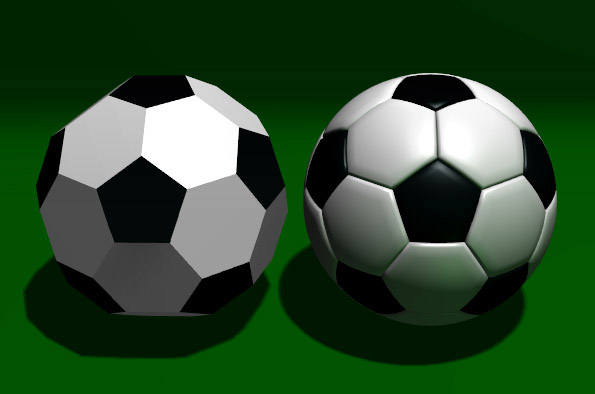
a soccer ball is just an arrogant (i.e.
"puffed up") truncated icosahedron.
Did the truncated icosahedron stand out at all? If so, then that's because that's the shape of the soccer ball! You can make this shape by taking an icosahedron, and chopping a chunk off every vertex (the pentagons are where the vertices of the icosahedron used to be; the hexagons come from the triangle faces that got their corners clipped). So you get a shape with 32 faces, 60 vertices, and all the faces are pretty close to being the same (hexagons and pentagons aren't all that different). This looks like a pretty ideal shape for a ball - just puff it up with a bit of air and it should fill out into a sphere shape rather nicely.

Well aren't we humans so smart for coming up with this shape.

That's right, when you kick around a soccer ball, you're really kicking around a molecular model. Now you'll never be able to play the sport without feeling like a nerd ever again.

Ok, not really, the soccer ball wasn't made in order to model a molecule. But what this DOES show is how interconnected math is. The same mathematical structure - the truncated icosahedron - appears both in molecular physics and in sports. Pretty powerful subject now, isn't it?
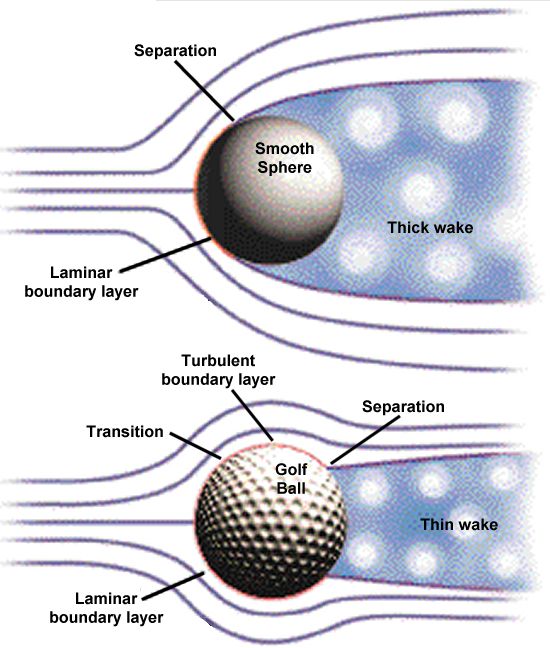
dimples diminish air resistance.
There's one other type of ball that has some pretty interesting math behind it - the golf ball. It doesn't face the same "how do you make a sphere out of flat stuff" problem because it's a solid ball of synthetic material. But it does bear one property that makes it stand out - dimples. Amazingly, adding little holes to a golf ball actually makes it fly farther - but again, this is a physical phenomenon which I won't get into here. What I will get into is the geometry of these holes - how do you spread them out? Again, symmetry is of utmost importance - the ball has to look basically the same from any viewing angle, otherwise it will act differently depending on its orientation. The Polora, a golf ball manufactured in the late 1970s, wasn't like this - it had deeper holes along the equator, and shallower holes everywhere else, which caused it to spin differently once in flight - it was banned soon after it was released, and official balls were forced to satisfy certain symmetry requirements.

Oddly enough, however, there is no "standard golf ball;" most golf balls have 250 to 450 holes, with some having over 1000. And yet, manufacturers are forced to obey the symmetry laws if they want their golf balls to be officially allowed. So how do you spread out the holes evenly on the sphere?

It turns out that quite often, you can't spread out the holes evenly. For example, if you try to spread out 5 holes on a sphere, you can never get them truly "evenly" spread out. The best you can do is put two at opposite ends, say the North and South poles, and three along the equator. But then the ones at the poles will be more isolated than the ones on the equator are.

But at least, for five holes, we know the best you can do, even if it's not perfect. It turns out that in general, even the best possible you can do isn't known. Now we haven't described what we mean by "evenly distributed" - and different definitions will actually give different answers. But practically every good definition faces the same problem - we simply don't know the best possible arrangement of holes. We've been able to compute very good arrangements, but have no way of knowing if a better one might exist.

cube and icosahedron made into spheres. The cube kinda
looks like a volleyball.
There are a few cases, however, that we understand quite well - and yes, the regular polyhedra are back! If you take a sphere, and imagine drawing a regular polyhedron inside the sphere, so that the vertices all touch the sphere, then these corners would give you points that are perfectly evenly spread out. So that means we can spread out 4 points (using the vertices of a tetrahedron), 6 points (octahedron), 8 points (cube), 12 points (icosahedron), and 20 points (dodecahedron), and under any good definition of "perfectly spread out," these will be so.

no chance of fitting another
pentagon in there.
So what's to stop us from starting with one of these configurations, and just adding on extra holes inside? I mean, maybe it won't be "the perfect configuration," but it'll still be pretty darn good. And so that's what ends up happening most often - golf ball manufacturers split up their ball into faces based on a regular polyhedron, and just tile the inside of each face with holes. This works for any regular polyhedron except the dodecahedron, because the cube is made of squares and the rest are made of triangles, and squares and triangles tesselate (a bunch of them can be fit together without leaving any gaps). The dodecahedron is made of pentagons, on the other hand, and these don't tesselate, so you can't really divide them up as nicely into similar shapes.

So here's an example of that getting put into practice. In the diagram to the left, the orange triangle comes from the face of an icosahedron - note how in both cases, they tiled that face with four smaller triangles, and filled in with holes. The left picture shows holes right on the vertices (as I described), while the one on the right doesn't, instead putting three circles in each little triangle. The left pattern requires holes of different sizes; the right pattern leaves some big gaps around some of the vertices; so neither are perfect, but both are acceptable golf ball designs. These designs come from U.S. Patent 4,560,168, which includes several other tiling patterns as well, all based on the faces of the icosahedron.


Phew, I think that's enough geometry for now. Let's not get into the shapes of hockey sticks and of the faces of tennis rackets and the shapes of all those other things out there. (I don't even particularly like geometry as much as some other branches of mathematics). I still have one more subject to discuss: what kinds of mathematics can actually be used by the athletes themselves - how people can use math when they're actually playing.