 |
| Casio
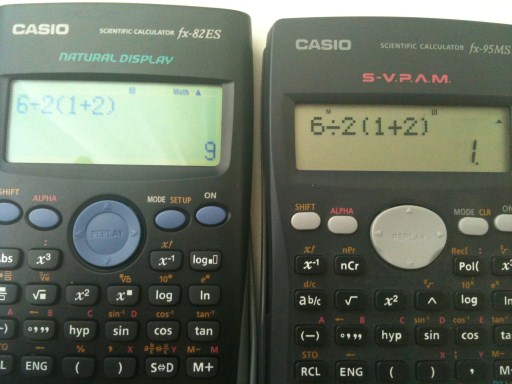
adamantly claims that the answer is 9. On the other hand, Casio believes that the answer is 1. Who do you believe? |
If you use "BEDMAS," "D" comes before "M," so you might think to do division first: 6÷2 is 3, so 6÷2×3 = 3×3 = 9. But if you use "Please Excuse..." (also known as "PEMDAS"), "M" comes before "D." So you should do 2×3 first to get 6, so 6÷2×3 = 6÷6 = 1. But WAIT, multiplication and division actually have the same priority, because one is just the inverse of the other - they're the same kind of operation. So in this case we just go left to right, and the division IS first, and so we get 9. Not so fast. While multiplication and division may have the same priority usually, here we have implied multiplication: the problem isn't 6÷2×(1+2), it's 6÷2(1+2). So the 2, right in front of the brackets, is directly tied to the brackets and must be evaluated first. You're right, it is implied multiplication: but the thing in front of the brackets isn't 2, it's 6÷2. Now hold on a second...
 |
| Of course, Calvin was a type (c). |
On the one hand, I find it hilarious that people get so riled up about this, since pretty much everyone's view of math is either (a) math is a useless subject they force you to learn in school, (b) math is good because it's applicable to science, technology, finance, business, etc., or (c) math has some intrinsic beauty that's worth studying for the same reason as music or literature (guess which camp I'm in?). But people in (c) should realize that the question is way deeper than just "what rule do you follow," people in (b) should be claiming that the person who wrote the formula should be fired for causing a disruption in the work flow, and people in (a)... why do you care at all?!?
But I also get very scared by the fact that this debate rages on so fiercely. Because in all my scourings of the internet, of the hundreds upon hundreds of comments I have read through, I have seen the "order of operations" invoked in almost all of them... but not once have I seen anyone ask why.
It's true, every now and then I come across a person who doesn't take a side between 1 and 9; they either say that there are multiple rules and different people have been taught differently, or (slightly more to the point) the expression is so sloppy, such bad form, that it's just unanswerable; that it's like asking "How manu apokeis is d Reiwhfds?" and expecting a correct response despite all the spelling errors; and that no one uses a division symbol any more because of issues like this unless they have to, preferring instead fraction notation with one number over top of the other. People like this restore a bit of my hope for humanity's future. And yet, they still shove the main problem under the rug: why is an order of operations even necessary?
 |
| click to zoom in |
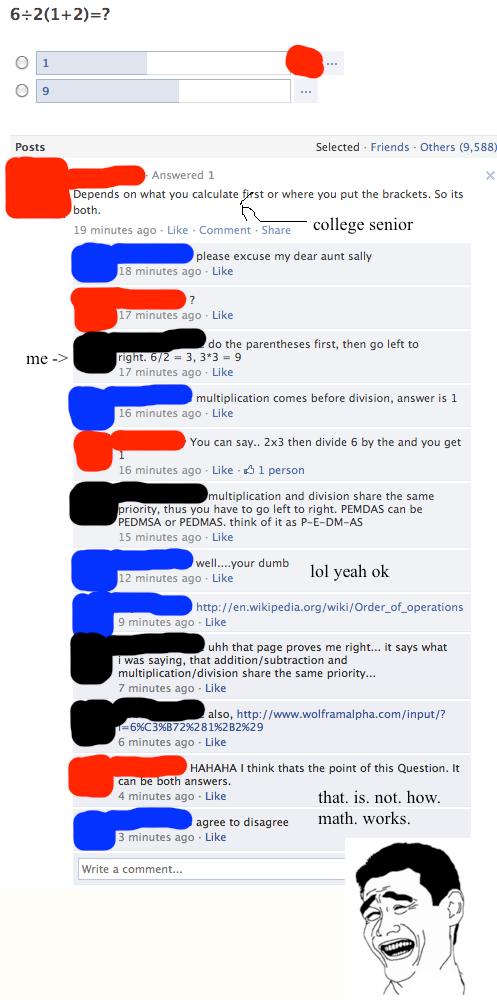
Here's what's going on. "College senior" is correct: there are two answers. "Me" is also correct: math does not work that way. The conclusion? What's really wrong with 6÷2(1+2) is that it's not math.
Want to know what I mean by that? Check out Part (14÷7(5-3)+2)÷3.

No comments:
Post a Comment