|
| WHAT?! Addition is associative?! |
Now what's 1#5#21? Well if you do 1#5 first, you get 3, and 3#21 = 12. But if you do 5#21 first, you get 13, and 1#13 = 7! So you do it in a different order, and you get a completely different answer (note: if you decided to break the "only two at a time" rule and find the average of all three at once, you'd get 9, another completely different answer)
Now, if instead you did it with functions, you couldn't write something unclear like 1#5#21; you have to choose which average is done first. Your options are avg(avg(1, 5), 21), and avg(1, avg(5, 21)). When you write it like this, there's no ambiguity, because it's really clear what has to be done first. And this reflects the actual mathematical ideas, which include knowing which functions depend on the results of other ones. 1#5#21, on the other hand, doesn't. This is what I meant when I said that the mathematical expressions we're used to don't actually reflect the essence of what they try to describe - function notation succeeds in that far better than regular notation does.
Now, it would technically be possible to rewrite all elementary textbooks in function form. But when you realize that something as simple as 2(5+3-4) would then be written as mult(2, sub(add(5, 3), 4)), it begins to get a little hard on the eyes trying to figure out what's inside of what. And so people use expressions like 2(5+3-4), because they're easier. Simply put, these expressions are a shorthand. They're a way of abbreviating mathematical ideas to make them easier to read and write.
 |
| I did a Google Image Search for "AH" and this was one of the results. I don't really know why. But mm, dumplings |
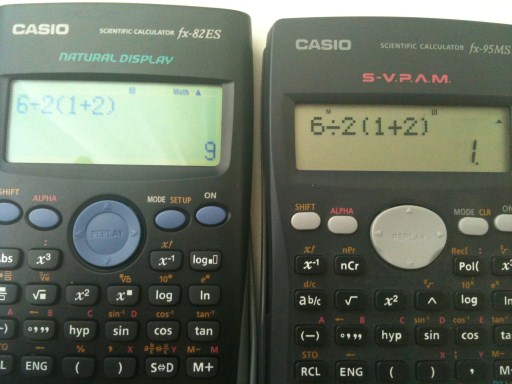
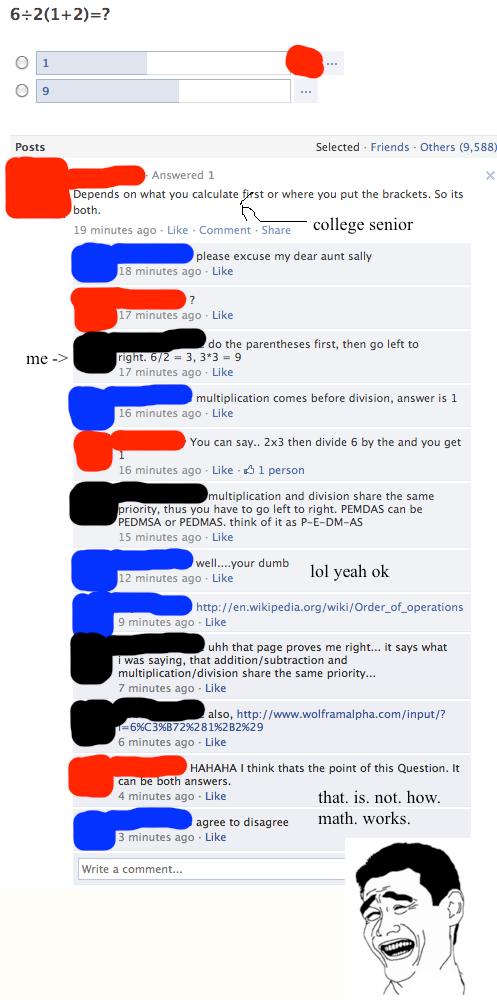
And that's exactly what happens with things like 6÷2(1+2). It's a shortened version of the actual mathematical idea behind it, and because of that, it's lost some of its information.
Again, sometimes losing information isn't so bad. Like in the case of 2+5+4. In the end, it doesn't matter which numbers you add first, because you'll get the same answer. But in a case like 2×5+4, how do you know which to do first? Is it add(mult(2, 5), 4) = 14, or mult(2, add(5, 4)) = 18?
Two things were done to try to help the shorthand become slightly more accurate: brackets, and order of operations. Brackets are used to state clearly "everything in here needs to be considered together. You can't do anything to just part of this while leaving the rest behind." Technically, if you had enough brackets, the shorthand could be just as clear as the original function form. For example, add(1, add(add(2, 3), 4))) and (1+((2+3)+4)) mean exactly the same thing, order and all. So people could have just demanded that every operation symbol (+, -, ×, ÷) have its own pair of brackets, and there would be no trouble. But as in the case of (1+((2+3)+4)), this can look almost as messy as the function version, when it doesn't need to be; 1+2+3+4 works just as well, even if it's not clear what to do first, because it doesn't matter what you do first. It's a shorter abbreviation that still works just as well, so why worry about all the extra brackets? But if you drop that requirement, then you need to know what to do when two different operations aren't separated by brackets, when the order does matter - like in 2×5+4.
This is where the order of operations comes from. It's a convention for reading a shorthand notation, so we can all agree that it refers to the same idea. People decided that certain functions were "more important" than others, and gave them different priorities. There are actually some good reasons behind the order*, but it turns out that things would work just as well if the order of operations was completely flipped! You'd just need to learn how to read and write in the new system.
*One example of a good reason is the distributive property, which describes how multiplication and addition relate to each other: a×(b+c) = a×b+a×c. If addition had priority, this would have to be written a×b+c = (a×b)+(a×c) - you'd need an extra pair of brackets.
 |
| Excuse me waiter, but I believe I ordered a sled. |
So what do I say to whoever first wrote 6÷2(1+2)? Explain why you chose that abbreviation. I can understand why you wouldn't write it out fully (as either mult(div(6, 2), add(1, 2)) or div(6, mult(2, add(1, 2)))), but if you're going to use an abbreviation, why didn't you use an abbreviation that causes less argument, like (6÷2)(1+2) or 6÷(2(1+2))? Or better yet, get rid of that division sign altogether and use fraction notation instead - it makes very clear what gets divided by what. You could even use an entirely different system of shorthand, like Polish Notation (where the choices would be × ÷ 6 2 + 1 2 or ÷ 6 × 2 + 1 2) or Reverse Polish Notation (6 2 ÷ 1 2 + × or 6 2 1 2 + × ÷), which in many ways are better than the system we usually use* because no brackets or order of operations are necessary to be perfectly clear about what's going on. So with so many great, unambiguous options, why oh why did you choose 6÷2(1+2)?
*which, in case you're wondering, is called Infix Notation
Of course, the person who came up with that expression probably had a very good reason: to mess with people. And for that, I applaud him, because he has succeeded immensely.
Yes, it is important to come up with a standard convention that we can all agree on, but the reason for this is so that we can spend more time on the math and less time decoding stuff. So when faced with something ambiguous, especially when it doesn't have to be, it's entirely against the point to spend so much time arguing about how to interpret it. Until we see a mathematical expression that is inherently ambiguous - that is, there's no better way to write it - the proper response should be to teach people how to express their mathematical ideas in a non-ambiguous way. Just as how a good English teacher shouldn't be teaching grammar in order to show students how to write really complex, convoluted sentences that are still "correct," but rather teaching students how to write clearly.
 |
| Jingle Bells, Batman Spells |
*Most people: PLEASE NO
That about sums it up for now. If you have any additions, questions, things I left out, things you think I got dead-wrong, or correct answers to 6÷2(1+2), please let me know!